

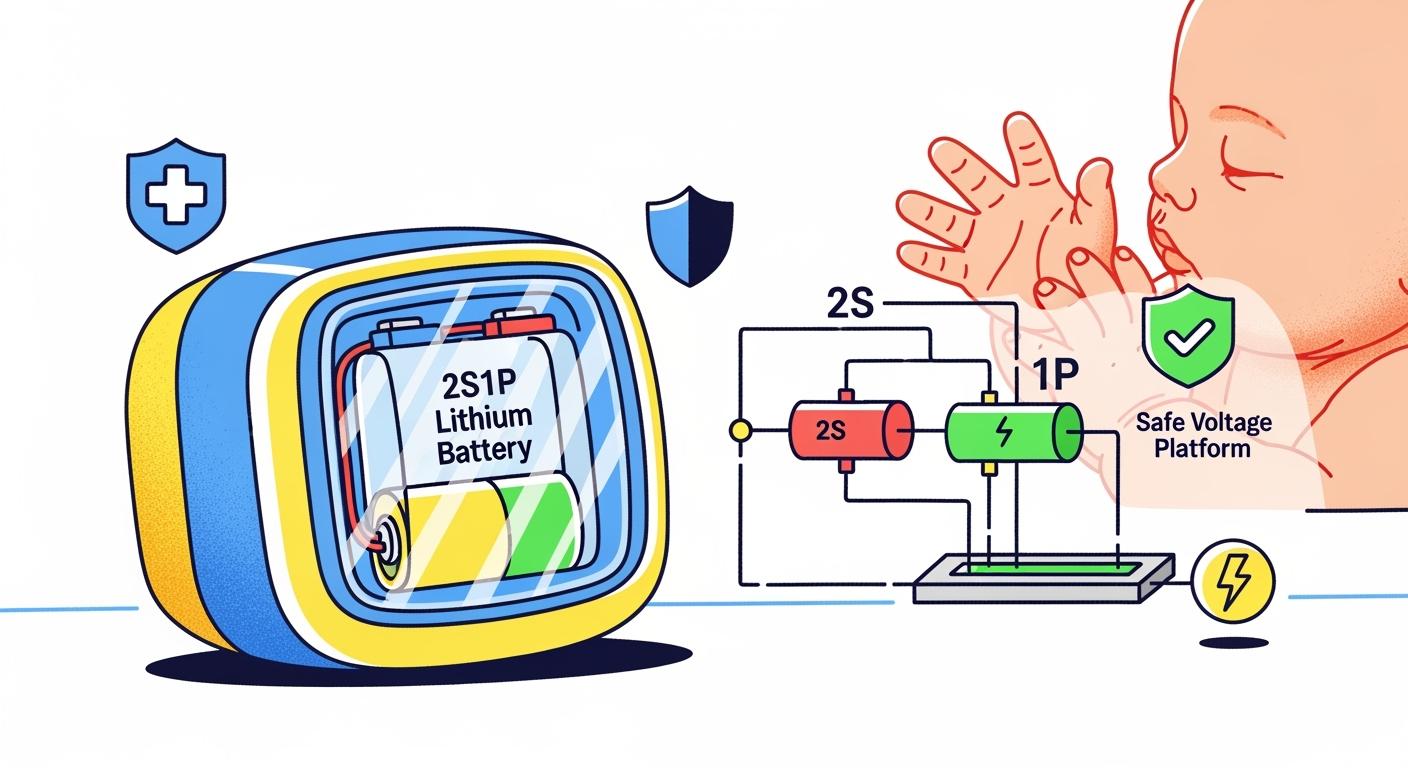
Quick Answer: A 2S1P lithium battery pack connects two cells in series to provide a nominal voltage of approximately 7.2–7.4V while retaining the capacity of a single cell. For neonatal monitoring devices, the configuration can provide a compact power platform when combined with matched cells, a properly designed protection circuit, thermal monitoring, and medical-grade quality controls. Final voltage, capacity, enclosure, and charging parameters must be matched to the monitor’s actual load profile and backup-runtime requirements.
Neonatal monitoring devices require stable, continuous power to support real-time measurements, wireless communication, alarms, and data transmission in neonatal intensive care units. Any unexpected shutdown, voltage fluctuation, or thermal event can interrupt monitoring and increase clinical risk.
A carefully engineered 2S1P lithium battery pack can balance voltage, size, weight, and runtime for compact neonatal monitors. However, selecting the configuration alone is not enough. Engineers must also evaluate cell chemistry, peak current, charging voltage, operating temperature, enclosure constraints, and communication requirements.
A dedicated Battery Management System or protection circuit should provide overcharge, over-discharge, overcurrent, short-circuit, and temperature protection. Cell consistency, traceability, connector reliability, and compliance testing are equally important when developing batteries for medical devices.
Key Takeaways
Use a 2S1P battery configuration when the device requires a compact 7.2–7.4V nominal power platform.
Match battery capacity to the monitor’s continuous load, wireless transmission peaks, alarm events, and required backup runtime.
Integrate voltage, current, short-circuit, and temperature protection through a properly designed BMS or PCM.
Verify cell consistency, pack traceability, charger compatibility, and enclosure performance before integration.
Validate the finished battery pack against applicable medical-device, transport, and battery safety requirements.
Part 1: Lithium Battery Selection for Neonatal Monitoring
1.1 2S1P Configuration Overview
You select the 2S1P configuration for neonatal monitoring devices to achieve a balance between voltage and capacity. This configuration connects two cells in series and one in parallel, providing a stable voltage platform for continuous monitoring in the NICU. The 2S1P setup supports real-time data transmission and wireless communication in wearable systems. You ensure that the voltage remains consistent, which is critical for neonatal health monitoring and clinical accuracy. The 2S1P configuration also allows you to optimize battery chemistries for energy density and cycle life.
1.2 Key Selection Criteria for Neonatal Devices
You evaluate several criteria when choosing batteries for neonatal monitoring. These include energy requirements, voltage compatibility, size, weight, cycle life, safety features, and water resistance. Neonatal devices typically consume 5 mW when active and 2 mW when idle. You use a rechargeable 70 mAh lithium-polymer battery to provide up to 14 hours of continuous monitoring. Safety mechanisms prevent overcharging and overheating, reducing risks for infants. Short circuit and overcurrent protection ensure the battery stops functioning during malfunctions. You select batteries with water resistance to protect against fluid exposure in neonatal care environments.
Tip: Always check battery specifications for compatibility with real-time data needs and wireless transmission in clinical settings.
Parameter | Value |
|---|---|
Power Consumption | 5 mW (active), 2 mW (idle) |
Battery Type | 70 mAh lithium-polymer |
Usage Duration | 14 hours |
1.3 Battery Performance and Safety for Infants
You prefer lithium batteries for neonatal monitoring because they offer high energy density, stable voltage platforms, and long cycle life. Lithium battery chemistries support continuous data collection and real-time monitoring in wearable systems. You prioritize safety features to prevent overheating, swelling, or leakage, which are common causes of battery-related recalls in neonatal health monitoring. You monitor battery performance to ensure reliable operation in NICU environments and reduce neonatal mortality risks. Lithium batteries enable wireless, clinical-grade monitoring for preterm infants and support continuous health data transmission.
Source | Evidence |
|---|---|
Baby Monitors, Dehumidifiers Recalled Over Burn Risks from Overheating Batteries | Lithium-ion batteries can overheat, causing burns and property damage. |
Philips Avent recalled nearly 13,000 baby monitors due to overheating issues with rechargeable lithium-ion batteries. | |
A Comprehensive Analysis of Class I Medical Device Recalls | Risks include battery swelling, leakage, or severe overheating. |
Part 2: Safe Voltage Platform Design in Neonatal Health Monitoring
2.1 Voltage Range and Platform Selection
You must establish a safe voltage platform for neonatal monitoring devices to ensure reliable operation and protect infants in the NICU. The 2S1P configuration delivers a nominal voltage of 7.4V, which matches the requirements for most wearable neonatal health monitoring systems. You should select a voltage range that supports continuous monitoring and real-time data transmission without risking over-discharge or overcharge. For lithium battery chemistries, you typically operate between 6.0V (cut-off) and 8.4V (fully charged) to maximize cycle life and maintain stable performance.
You need to consider the energy density and cycle life of each lithium battery chemistry. Lithium-ion batteries offer high energy density and long cycle life, making them suitable for continuous neonatal monitoring. Lithium-polymer batteries provide flexibility in form factor, which is essential for wearable systems.
Note: Always match the voltage platform to the device’s power management requirements to avoid voltage drops that could interrupt real-time data collection.
You must also account for the unique needs of preterm infants. Devices should maintain stable voltage during wireless data transmission and continuous monitoring in the NICU. This approach reduces the risk of device failure and supports clinical-grade health data accuracy.
2.2 Protection Circuits and Battery Management
You must integrate advanced protection circuits and battery management systems (BMS) to safeguard neonatal monitoring devices. Protection circuits address common failure modes in lithium battery packs, including:
Thermal risks from rapid battery discharge and excessive power dissipation. Electronic sensors and closed-loop circuits halt operation when overheating occurs.
A thermally activated bladder structure creates a barrier and detaches the device upon overheating, protecting infants’ skin from thermal injury.
Overcharge, over-discharge, and short-circuit protection to prevent battery swelling, leakage, or fire.
You should implement a BMS that monitors voltage, current, and temperature in real time. This system ensures continuous monitoring and immediate response to abnormal conditions. For more on BMS integration, see our Battery Management System guide.
Tip: Use redundant safety features in wearable systems to minimize neonatal mortality risks and ensure clinical reliability.
You must also follow recommended maintenance protocols for lithium batteries in neonatal health monitoring devices:
Catalog all equipment with lithium batteries in a centralized database for proactive maintenance.
Charge devices in designated areas with proper ventilation, away from patients and oxygen-rich environments.
Store batteries in temperature-controlled environments and remove damaged or expired batteries immediately.
Train staff to recognize battery failure signs and emergency procedures.
Conduct routine inspections for battery performance and safety.
Document and investigate any incidents involving lithium batteries to improve future responses.
2.3 Compliance and Operational Best Practices
You must comply with international safety standards for lithium battery packs in neonatal health monitoring. The following table summarizes key compliance standards:
Compliance Standard | Description |
|---|---|
CSA C22.2 No. 62133-2:20 | A standard for lithium-ion batteries ensuring safety in health-related devices. |
UL 1642 | A standard that addresses safety requirements for lithium batteries to prevent hazards. |
UL 2054 | A standard that outlines safety and performance requirements for battery systems in devices. |
You should also adopt operational best practices to maximize battery lifespan and safety. The 80/20 and 40-80 charging rules are effective strategies for lithium battery maintenance in neonatal monitoring:
Charging Rule | Pros | Cons |
|---|---|---|
80-20 Rule | Extends cycle life, reduces stress on electrodes | Sacrifices full capacity |
40-80 Rule | Maximizes longevity, less stress on electrodes | Reduces usable capacity further |
You should charge batteries between 40% and 80% or 20% and 80% of their capacity. This approach reduces electrode stress, extends cycle life, and supports continuous monitoring in the NICU. Although these rules reduce usable capacity, they provide greater reliability for real-time data collection and wireless transmission.
Note: Operational best practices and compliance with medical standards are essential for reducing neonatal mortality and ensuring safe, continuous monitoring.
Practical Example: Battery Selection and Integration
Consider a wearable neonatal monitor designed for continuous, real-time data collection in the NICU. You select a 2S1P lithium-polymer battery pack with a nominal voltage of 7.4V and a capacity of 70 mAh. You integrate a BMS with overcharge, over-discharge, and thermal protection. You follow the 40-80 charging rule to maximize battery lifespan. You ensure compliance with UL 1642 and CSA C22.2 No. 62133-2:20. You train staff on safe charging and maintenance protocols. This approach supports reliable, wireless monitoring for preterm infants and reduces neonatal mortality risks.
For more information on medical applications, visit our Medical Battery Solutions page.
You ensure neonatal monitoring devices deliver continuous data with reliable battery packs. Key steps include selecting the right battery size, maintaining compliance, and prioritizing safety.
Choose batteries with sufficient capacity for continuous neonatal monitoring.
Integrate backup systems for uninterrupted data.
Consult experts for customized neonatal battery solutions here.
FAQ
What makes a 2S1P lithium battery pack ideal for neonatal monitoring devices?
You gain stable voltage and reliable energy delivery for neonatal monitoring. This battery configuration supports continuous data collection and ensures safety in neonatal care environments.
How do you ensure battery safety and compliance in neonatal monitoring applications?
You implement advanced protection circuits and battery management systems. These features prevent overcharge, over-discharge, and overheating, ensuring neonatal safety and uninterrupted data monitoring.
Where can you get customized lithium battery solutions for neonatal monitoring?
You can consult with Large Power for tailored battery packs. Visit Large Power Customized Consultation to discuss neonatal monitoring data requirements and battery integration.


