

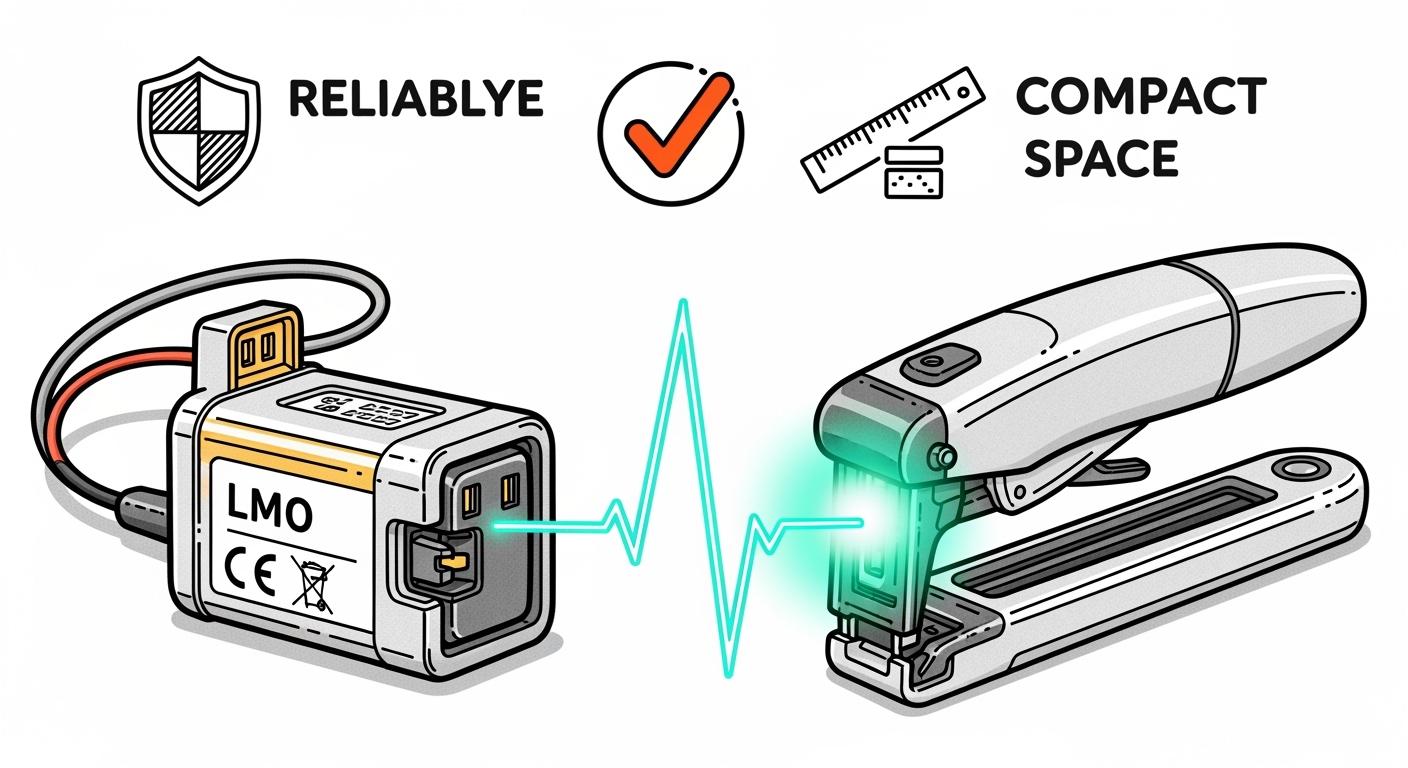
Quick Answer: Powered surgical staplers require compact battery systems capable of delivering short, high-current pulses without excessive voltage drop or temperature rise. Battery selection must distinguish rechargeable LMO lithium-ion cells from primary lithium manganese dioxide (Li-MnO₂) cells. The appropriate solution depends on whether the stapler is disposable or reusable, its firing profile, sterilization method and regulatory pathway.
Powered surgical staplers use electric motors to control tissue compression, cutting and staple formation. Each firing cycle can create a short-duration peak load, making pulse-current capability, voltage stability and internal resistance more important than nominal capacity alone.
A properly engineered custom lithium battery pack should address:
Peak current, pulse duration and voltage recovery
Temperature rise during repeated firing cycles
Remaining-energy estimation and end-of-life indication
Protection against short circuits and abnormal loads
Compact mechanical integration and secure connectors
Compatibility with the validated sterilization process
Cell and pack traceability under the medical-device quality system
Design Area | Engineering Requirement |
|---|---|
Pulse performance | Maintain sufficient voltage during motor startup and firing |
Mechanical integration | Fit the handle without affecting balance or ergonomics |
Thermal control | Limit cell and connection-point temperature rise |
Reliability | Deliver the required number of firing cycles with design margin |
Sterilization compatibility | Validate the battery, packaging and device using the selected process |
Quality management | Maintain component traceability and controlled production records |
Key Takeaways
Do not treat rechargeable LMO and primary Li-MnO₂ as interchangeable battery technologies.
Validate pulse voltage, current, temperature rise and recovery under the stapler’s actual firing profile.
Do not claim autoclave resistance unless the complete battery assembly has been designed and validated for steam sterilization.
A Battery Management System may be appropriate for rechargeable packs, while primary packs require protection designed for their chemistry and intended use.
IEC 60601-1 addresses basic safety and essential performance at the medical-equipment level; ISO 13485 concerns the manufacturer’s quality-management system rather than battery certification.
Part1: Demands of Surgical Staplers
1.1 High Pulse Discharge Needs
You require surgical staplers that deliver precise and immediate action. These devices must cut and staple tissue quickly, often in a single motion. High pulse discharge from the battery pack ensures the stapler can perform these demanding tasks without delay. If the battery cannot provide enough power in a short burst, the stapler may fail during a procedure. Custom LMO Battery Packs offer the high current output needed for rapid tool activation. This feature supports consistent performance, even when the device faces repeated use in a busy surgical environment.
1.2 Compact Size for Integration
Space inside a surgical stapler is limited. You need battery packs that fit into small, lightweight housings without sacrificing power. A compact battery design allows you to add more features to your device, such as advanced sensors or wireless communication. Custom LMO Battery Packs use efficient cell layouts and advanced engineering to maximize energy in a small footprint. This approach helps you create ergonomic tools that are easy for medical staff to handle and maneuver.
1.3 Reliability in Medical Use
Reliability is essential in any medical device. You cannot risk battery failure during surgery. Custom LMO Battery Packs are engineered for stable performance and long service life. They must also withstand harsh sterilization processes, such as autoclaving. During autoclave sterilization, battery packs face high heat, steam, and pressure. Manufacturers develop new materials and technologies to make batteries resistant to these conditions. These advancements help you design surgical staplers that remain safe and functional after repeated sterilization cycles.
Battery packs must endure high heat, steam, and pressure during autoclave sterilization.
Technologies and materials are being developed to create autoclave-resistant battery systems.
These advancements help surgical tool manufacturers design batteries that can withstand repeated autoclave exposure.
Custom LMO Battery Packs balance high pulse discharge, compact size, and reliability. This balance supports the strict demands of surgical staplers in clinical settings.
Part2: Custom LMO Battery Packs: Chemistry & Engineering
2.1 LMO Chemistry Advantages
You need battery chemistry that delivers both safety and performance in medical environments. LMO (Lithium Manganese Oxide) stands out because it supports high pulse discharge and maintains stability under stress. This chemistry gives you several important benefits:
High thermal stability lets the battery operate safely at elevated temperatures.
Low internal resistance allows for quick charging and high current delivery.
The ability to deliver high current outputs makes LMO ideal for rapid energy delivery.
You can see how these features make LMO a strong choice for surgical staplers and other medical devices that demand instant, reliable power. When you compare LMO to other lithium battery chemistries, you notice clear differences in performance, safety, and application suitability.
Chemistry | Energy Density (Wh/kg) | Cycle Life (cycles) | Max Pulse Discharge | Thermal Stability | Typical Applications |
|---|---|---|---|---|---|
LMO | 100–120 | 500–1,000 | High | High | Medical, power tools, robotics |
NMC | 150–220 | 1,000–2,000 | Moderate | Moderate | EVs, industrial, energy storage |
LCO | 150–200 | 500–1,000 | Low | Low | Consumer electronics |
LiFePO4 | 90–120 | 2,000–4,000 | Moderate | Very High | Medical, solar, backup power |
Solid-State | 250–400 | 2,000+ | Moderate | Very High | Next-gen medical, aerospace |
Lithium Metal | 350–500 | 500–1,000 | High | Moderate | Research, specialty medical |
Tip: LMO batteries offer a balance of safety and high pulse output, making them a preferred option for medical tools that require both reliability and rapid response.
2.2 Engineering for High Pulse Output
You want your surgical stapler to respond instantly every time. Custom LMO Battery Packs use advanced engineering to achieve this. Engineers design the cell layout to minimize resistance and maximize current flow. They select materials that handle high current without overheating. You benefit from a battery pack that delivers strong, consistent pulses, even after many uses.
Engineers also focus on compactness. They use modular designs and efficient cell arrangements to fit more power into a smaller space. This approach lets you add more features to your device without increasing its size. You can rely on these packs for high performance in other sectors as well, such as robotics, security systems, and industrial automation.
If your application requires advanced monitoring or protection, you can integrate a Battery Management System (BMS). A BMS helps you track battery health, prevent overcharging, and extend service life.
2.3 Advanced Packaging Solutions
You need battery packs that survive harsh medical environments. Custom LMO Battery Packs use innovative packaging to protect against heat, moisture, and pressure. Proprietary designs shield the battery from intense heat and high-pressure steam during autoclave sterilization. This protection extends battery life and ensures reliable operation after repeated sterilization cycles.
Manufacturers test these packs rigorously to meet safety standards. You can trust that each pack complies with industry regulations and delivers consistent performance. Advanced packaging not only improves safety but also boosts the longevity of your medical devices.
Note: Reliable packaging solutions are essential for medical, industrial, and infrastructure applications where safety and durability matter most.
Part3: Reliability, Safety & Compliance
3.1 Quality Control Measures
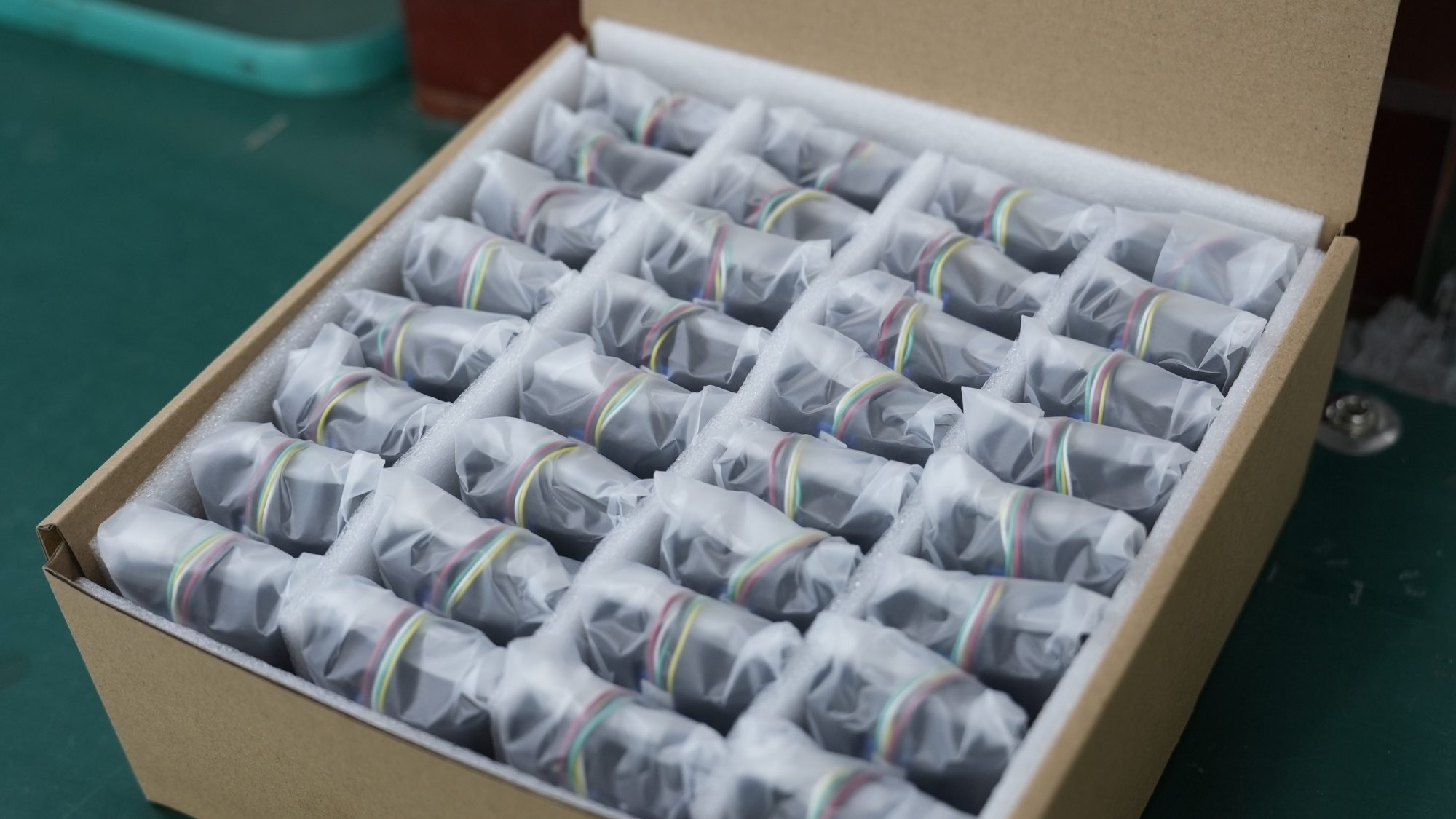
You need to trust that every battery pack meets strict quality standards. Manufacturers use advanced inspection systems and automated testing to catch defects early. Each Custom LMO Battery Pack goes through multiple checks, including:
Visual inspections for physical damage or assembly errors
Electrical tests to confirm voltage, capacity, and pulse discharge performance
Environmental stress tests to simulate real-world use
You benefit from these steps because they reduce the risk of failure in critical applications. In medical, robotics, and security systems, even a small defect can cause major problems. Quality control also includes traceability, so you can track each pack from production to delivery.
3.2 Regulatory Standards & Testing
You must comply with international regulations to bring your medical devices to market. Standards like IEC 62133 and ISO 13485 shape how you design, test, and document your battery packs. These rules help you ensure safety and performance for every device.
IEC 62133 and ISO 13485 set safety and performance standards for medical battery packs.
Compliance ensures safe and reliable operation, which is critical for patient safety.
These regulations guide you in documenting, validating, and testing your products, making regulatory approval and market access easier.
ISO 13485 provides guidelines for designing medical devices by risk class.
Meeting IEC 62133 and UN38.3 requirements speeds up approval and market entry.
Standard | Focus Area | Benefit for You |
|---|---|---|
IEC 62133 | Battery safety | Reduces risk of malfunction |
ISO 13485 | Medical device quality | Ensures consistent product performance |
UN38.3 | Transport safety | Enables global shipping |
3.3 Smart Battery Features
You gain extra safety and reliability from smart battery technology. Many Custom LMO Battery Packs include built-in monitoring systems. These features help you:
Track battery health and charge status in real time
Detect overheating, overcurrent, or short circuits
Enable redundancy, so your device keeps working even if one cell fails
Smart features support compliance and make maintenance easier. You can use these packs in medical, industrial, and infrastructure applications where uptime and safety matter most.
Tip: Smart battery packs can alert you to problems before they affect device performance, helping you avoid costly downtime.
Part4: Customization & Collaboration
4.1 Tailoring Packs to Device Needs
You face unique challenges when designing surgical staplers. Each model requires a specific battery pack shape, capacity, and discharge profile. Custom LMO Battery Packs allow you to match these requirements precisely. You can select cell configurations that fit tight spaces and deliver the right amount of power for rapid stapling. You may need batteries that withstand frequent sterilization or integrate with advanced sensors. Engineers work with you to optimize the pack for your device, ensuring compatibility and performance.
Note: Customization extends beyond medical devices. You can tailor battery packs for robotics, security systems, and industrial tools, meeting the demands of each sector.
4.2 Manufacturer Collaboration
You achieve the best results when you collaborate closely with battery manufacturers. You share your device specifications, operating environment, and regulatory needs. Manufacturers respond by proposing solutions that address your requirements. You participate in prototype testing and validation, ensuring the battery pack meets your standards. This partnership streamlines development and reduces time to market.
You gain access to technical expertise and testing facilities.
You receive support for regulatory documentation and compliance.
You benefit from ongoing feedback and improvements.
Collaboration helps you create reliable products that perform well in clinical and industrial settings.
4.3 Case Example: Balanced Performance
You can see the value of customization in a real-world scenario. A surgical stapler manufacturer needed a battery pack that fit a compact handle, delivered high pulse discharge, and survived repeated autoclave cycles. Engineers designed a Custom LMO Battery Pack with a modular cell layout and reinforced packaging. The pack passed rigorous electrical and environmental tests. The manufacturer integrated the battery into the stapler, achieving reliable performance and compliance with IEC 62133 and ISO 13485.
Requirement | Solution Provided | Outcome |
|---|---|---|
Compact size | Modular cell arrangement | Easy integration |
High pulse discharge | LMO chemistry, low resistance | Instant tool activation |
Sterilization | Reinforced packaging | Survived autoclave cycles |
Regulatory compliance | Documentation and testing | Passed IEC/ISO standards |
Tip: You can explore sustainable battery customization options for your devices.
You see how Custom LMO Battery Packs help you meet the strict demands of surgical staplers. These packs balance high pulse discharge, compact size, and reliability for safe and efficient medical tools. You benefit from strong engineering, advanced chemistry, and strict compliance. Ongoing collaboration with battery suppliers supports your innovation through:
Building trust for smooth production
Good communication to avoid issues
Industry knowledge for new solutions
You can expect future battery designs to focus on smarter features and even greater safety across medical, robotics, and industrial sectors.
FAQ
What makes lithium batteries suitable for powered surgical staplers?
Lithium batteries can provide high pulse power in a compact and lightweight format. Low internal resistance and controlled voltage drop help the motor complete tissue compression, cutting and staple formation reliably. The specific chemistry must be selected according to the device architecture and firing requirements.
Are LMO and Li-MnO₂ batteries the same?
No. LMO usually refers to rechargeable lithium manganese oxide lithium-ion chemistry. Li-MnO₂ generally refers to a primary, non-rechargeable lithium manganese dioxide system. They have different voltage characteristics, charging requirements, safety controls and application profiles.
Can a surgical-stapler battery withstand autoclave sterilization?
Not automatically. Conventional lithium batteries should not be exposed to autoclave temperatures and steam unless the complete assembly has been specifically designed and validated for that process. Some disposable devices use separately sterilized primary battery packs, while reusable systems may keep the rechargeable battery outside the sterilized disposable component.
How should pulse-discharge performance be validated?
Engineers should test peak current, pulse duration, minimum loaded voltage, recovery time, connection resistance and temperature rise. Testing should include repeated firing sequences, low state of charge, aging and the specified operating-temperature range.
Which standards apply to the battery system?
Applicable requirements depend on the battery chemistry, device design and target market. IEC 60601-1 applies to the basic safety and essential performance of medical electrical equipment. Battery standards, transportation testing such as UN 38.3, risk management and sterilization validation must be assigned separately rather than presented as one general certification.


