

Apple’s September 9 event is only days away, and one of the more interesting iPhone 18 Pro Max rumors has little to do with cameras or AI features. It is the battery.
Regulatory filings believed to correspond to the new Pro Max point to a substantially larger cell than the one used in the iPhone 17 Pro Max. If those filings prove accurate, the increase will be meaningful by recent iPhone standards.
But a larger battery does not automatically translate into a proportional increase in runtime. Capacity is only one part of the system. Processor efficiency, display power consumption, modem behavior, thermal management, and the charging curve all determine what users eventually experience.
More importantly, a larger battery changes the other side of the equation too: how quickly that energy can be put back into the phone.
The Battery Increase Is Bigger Than It First Appears
Apple officially lists the eSIM-only iPhone 17 Pro Max at 5,088 mAh, while versions with a physical SIM tray use a smaller 4,823 mAh battery.
Regulatory filings reported ahead of the iPhone 18 launch point to approximately 5,567 mAh for the U.S. iPhone 18 Pro Max and 5,391 mAh for versions designed around a physical SIM tray. The filings do not name the phone directly, so those figures should still be treated as pre-release information, but they would represent an increase of roughly 9% to 12% over the equivalent iPhone 17 Pro Max configurations.
For a phone that has already moved beyond the 5,000 mAh mark, that is not a trivial change.
Capacity, however, should not be considered in isolation.
The iPhone 18 Pro models are also expected to use Apple’s A20 Pro processor manufactured on TSMC’s 2nm process. Reports have suggested significant efficiency gains over the A19 generation, although claims of “30% better efficiency” should not be interpreted as 30% longer phone battery life. Process-node efficiency figures and complete-device power consumption are not the same measurement.
The display may contribute as well. The Pro models are reportedly moving to LTPO+ technology, which could give the panel finer control over power use under different operating conditions.
If all three changes arrive together—more stored energy, a more efficient processor, and a more efficient display—the battery-capacity increase becomes more useful than the mAh figure alone suggests.
A Bigger Battery Also Has to Be Recharged
There is a simple trade-off that often disappears from discussions about larger smartphone batteries: more stored energy generally takes more time to replace if charging power remains unchanged.
That does not mean a 5,500 mAh battery can be compared with a 5,000 mAh battery by simply dividing capacity by charger wattage. Smartphone charging does not work at a fixed power level from empty to full. Current changes with state of charge, temperature, battery voltage, and the limits imposed by the phone’s charging controller.
The practical point is simpler. If you keep using the same low-output adapter while battery capacity increases, short charging sessions restore a smaller percentage of the total battery.
This makes charger matching more important, particularly for users who depend on 15- or 20-minute top-ups rather than charging overnight.
Apple has not yet published the official maximum wired charging rate for the iPhone 18 Pro Max, so there is no basis for claiming that the phone will continuously accept 40W, 45W, or any other specific figure. A higher-rated USB-C adapter merely provides available headroom; the phone still negotiates and draws only the power it supports.
For users replacing an older low-wattage adapter, a 45W GaN iPhone charger such as ESR’s Xtend 45W is one practical option. It supports PD 3.2 AVS and PPS and combines the charger with a built-in 3.1-foot retractable USB-C cable and foldable plug.
The retractable cable matters more than it may sound. It removes a separate cable from a travel or work bag while keeping enough power available for phones, tablets, and other compatible USB-C devices.
GaN also makes compact high-output charger designs easier to build, but it should not be treated as shorthand for “no heat.” Thermal performance still depends on the charger’s complete electrical and mechanical design.
A More Expensive Phone Raises the Cost of Leaving It Unprotected
Battery capacity is not the only number expected to increase this year.
Macworld has reported analyst estimates suggesting the iPhone 18 Pro line could become $200 to $300 more expensive than the equivalent iPhone 17 Pro models, largely because of higher component costs. Apple has not confirmed those prices, so the final numbers may differ.
Even without the increase, the current iPhone 17 Pro Max starts at $1,199 in the U.S. At that price level, protecting the device is less about keeping it cosmetically perfect and more about reducing the chance that one impact turns into an expensive repair.
Pre-launch case compatibility deserves particular caution this year.
Reports have not been completely consistent about the final iPhone 18 Pro Max thickness. Some indicate a thicker and heavier chassis to accommodate the larger battery, while other reports have suggested dimensions closer to the current model. Rumored camera changes, including a variable-aperture system on the Pro Max, could also alter the area around the camera plateau.
That means buyers should not assume an existing case will provide correct button, camera, and edge alignment simply because the overall design looks familiar.
The same principle applies across the Pro line. A model-specific iPhone 18 Pro case avoids relying on approximate fit, while a screen protector for iPhone 18 Pro Max should be checked against the exact model rather than purchased purely on nominal display size.
This is especially relevant for accessories ordered before launch. Compatibility claims, cutout dimensions, and the retailer’s return policy are worth checking once Apple publishes the final hardware specifications.
Car Charging Becomes More Useful for Short Top-Ups
A larger battery does not mean every user needs a faster charger in every location. If a phone spends seven hours on a bedside charger, maximum charging power is rarely the limiting factor.
The situation is different in a car.
A 30- or 45-minute commute creates a fixed charging window, so available power and cable convenience have more practical value. This is also where a charger with substantially more capacity than the phone itself requires can make sense.
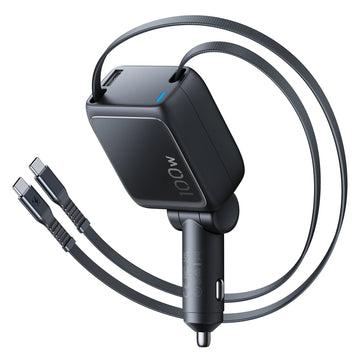
ESR’s 100W dual USB-C car charger, for example, uses two built-in 3.1-foot retractable USB-C cables and an additional USB-A port. Total output can reach 100W, while a single USB-C cable can deliver up to 67W.
An iPhone will not draw 100W simply because the charger can provide it. The advantage of that extra capacity is simultaneous charging: a phone can negotiate the power it needs while the same adapter supplies a USB-C laptop or another device.
For commuters and business travelers, that is more useful than treating the 100W figure as an iPhone charging specification.
What to Check Before Ordering
The most useful information will arrive on September 9, when Apple can replace battery and charging rumors with actual specifications.
Until then, three things are worth checking before buying accessories.
First, look at the chargers you already use. A low-power adapter is not automatically obsolete, especially for overnight charging, but users who rely on short daytime top-ups may benefit from a newer USB-C charger with more available headroom.
Second, do not assume an older case or screen protector will transfer to the new phone. Wait for final dimensions or choose accessories explicitly listed for the exact model.
Finally, treat the expected September 12 pre-order date and September 18 release date as likely rather than confirmed until Apple announces its sales schedule.
If the regulatory filings are accurate, Apple is giving the iPhone 18 Pro Max a substantially larger energy reserve. The next question is whether the charging hardware and accessories around the phone are ready to make practical use of it.


