

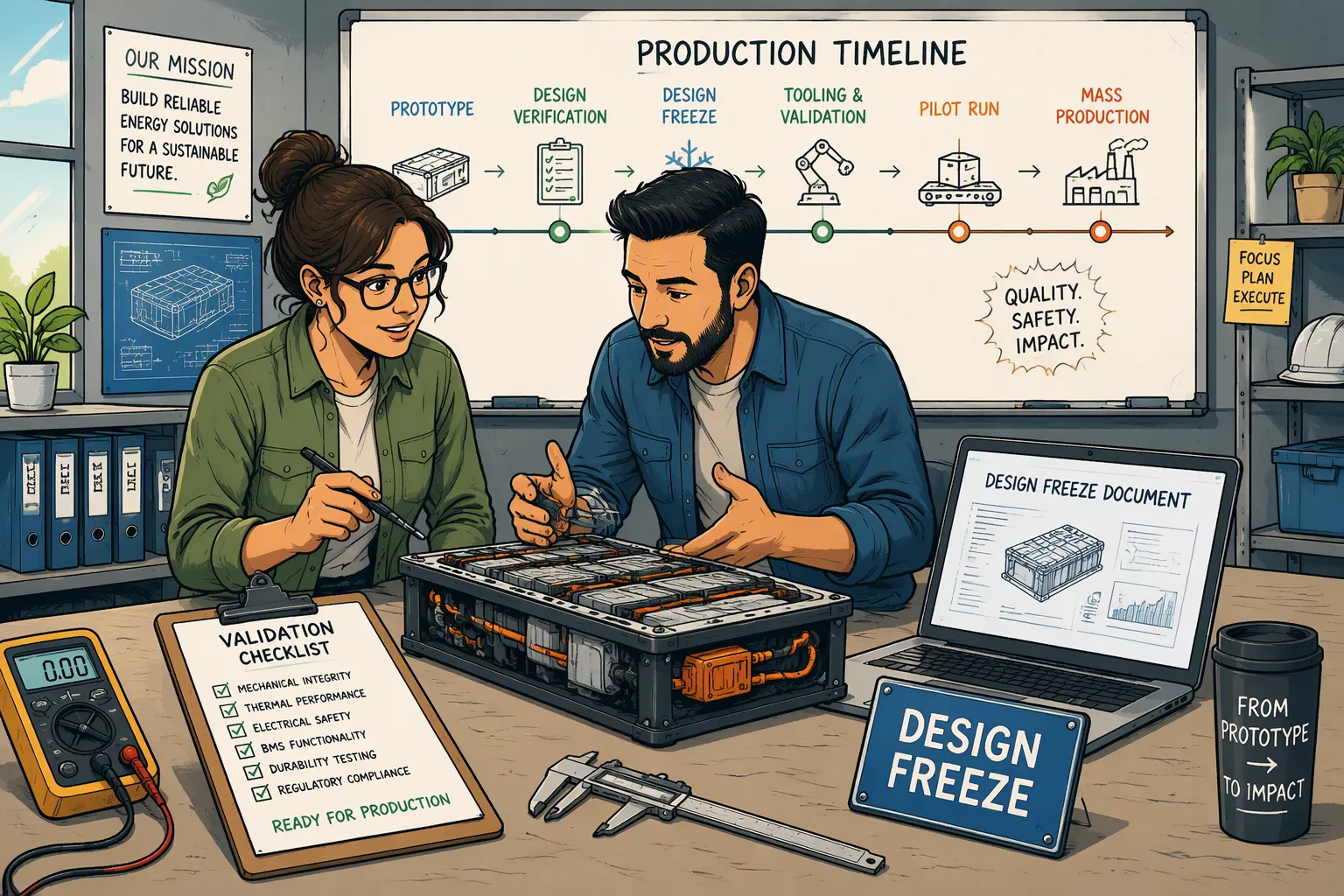
A working battery prototype demonstrates feasibility, not readiness for repeatable production. Before an OEM releases a custom lithium battery pack, the team must connect requirements, test evidence, an approved design configuration and a capable manufacturing process. A sample that powers the device on a bench may still leave unanswered questions about runtime, charger compatibility, assembly variation and fault response.
Quick Answer: Treat design freeze as a controlled baseline, not a claim that development can never change. Define the evidence required for each gate, freeze the approved BOM, drawings and relevant firmware together, then use production-intent builds to verify manufacturing readiness. Release mass production only after the required design, process, compliance and supply-chain evidence has been reviewed. Manage remaining changes and deviations through an authorized process.
Key Takeaways
Separate engineering feasibility, design verification, intended-use validation and production readiness.
Define freeze criteria for the specific project; there is no universal rule that all testing starts or ends at design freeze.
Control cell models, mechanical details, protection settings and software as a linked configuration.
Select test conditions by application and applicable standards, not by a laboratory’s maximum equipment ratings.
Use pilot results, traceable records and approved release criteria to decide whether the process is ready to scale.
Part 1: Define the Development Gates Before Building Samples
1.1 Separate Design Freeze from Production Release
Programs may use terms such as EVT, DVT and PVT, or their own stage names. The important point is to define what each gate permits. An early architecture baseline may support tooling decisions while detailed verification continues. A later production baseline should identify the configuration approved for manufacturing. Neither milestone automatically means that customer shipment is authorized.
Gate | Main decision | Typical evidence |
|---|---|---|
Feasibility review | Can the proposed architecture meet the application? | Requirements, preliminary risk review and engineering sample results |
Design baseline or freeze | Is the defined configuration mature enough for the next stage? | Controlled design package, completed gate-required tests and an approved plan for remaining work |
Pilot readiness | Can the intended process build production-intent units? | Materials, tooling, instructions, test equipment and trained personnel |
Mass-production release | Are the design and manufacturing process ready for the authorized release scope? | Required qualification, pilot results, compliance evidence and accountable approvals |
Verification checks outputs against defined requirements. Validation addresses intended use and user needs. Process validation addresses whether a process can consistently achieve its specified results where required. These activities may overlap and iterate; they should not be described as beginning only after freeze or always being fully complete before the first pilot run.
1.2 Make Requirements Testable
Capture operating and charging voltage, continuous and pulse current, pulse duration, runtime, temperature, storage, mechanical envelope and expected service conditions. Define the actual host charger, load profile, connector and communication interface. Identify who owns battery-level and device-level validation.
Specify acceptance criteria and sample rationale before testing. Link each requirement to a method, responsible owner, configuration and result. Where long-duration testing continues beyond an intermediate gate, document its status and the decisions it limits. Do not use conditional approval to bypass an unresolved safety requirement or mandatory release evidence.
Part 2: Freeze a Complete Battery Pack Configuration
2.1 Control the BOM, Drawings and Software Together
The controlled package should identify the exact cell manufacturer and model, approved alternatives, series/parallel arrangement, interconnects, protection electronics, insulation, enclosure and connector. Include relevant firmware, configuration parameters and programming instructions. Not every pack has software, contactors or active cooling; document the components actually used.
Electrical: schematics, ratings, fuse selection, wiring, pinout and protection limits with tolerances.
Mechanical: finished dimensions, tolerance stack, mounting, cable exit, bend limits, insulation and required expansion allowance.
Software and communication: released version, parameter set, data definitions, startup behavior and fault response.
Manufacturing: assembly drawings, work instructions, joining parameters and inspection methods.
Acceptance: incoming, in-process and final-test limits, labeling and packaging requirements.
A cell change may affect several documents, but it does not automatically invalidate every drawing or report. Perform an impact assessment and update affected records. Treat the baseline as a traceable set of approved revisions rather than relying on a single undated “golden sample.”
2.2 Distinguish Cell Procurement from Cell Manufacturing
A pack assembler normally qualifies purchased cells and controls their identity, condition and use in the assembly. Electrode coating, electrolyte filling and separator manufacture belong to cell production, unless the supplier actually performs those operations. Do not present cell-factory material controls as routine pack assembly steps.
Agree incoming checks and cell-selection criteria appropriate to the design, including voltage, resistance or capacity sampling where justified. Specify measurement conditions and approved limits. Do not invent a universal matching tolerance or promise that imbalance will appear after a fixed number of cycles. Review cell availability, change notification and approved substitution procedures with procurement.
Part 3: Build an Application-Specific Validation Matrix

3.1 Select Tests by Function, Risk and Market
Test conditions must come from the approved requirements and applicable test methods. A chamber capable of extreme temperatures or an abuse rig rated for thousands of volts does not define the conditions for a small medical or industrial pack.
Area | Questions to resolve | Evidence |
|---|---|---|
Electrical performance | Does the pack support the intended load and charging system? | Usable energy, runtime, pulse voltage drop, charger compatibility and standby behavior |
Mechanical integration | Does the finished assembly fit and survive intended handling? | Dimensions, mounting, connector retention, cable routing and relevant mechanical tests |
Thermal and environmental | Are temperatures and environmental exposure controlled? | Temperature mapping, sensor coverage and applicable humidity, vibration or ingress tests |
Protection | Do faults produce the specified safe response? | Threshold, delay, tolerance, recovery and protective-device coordination |
Host integration | Does the complete device respond correctly? | Communication, alarms, low-battery reserve, startup and power-transition results |
For portable lithium systems, assess the applicability of IEC 62133-2. For industrial lithium applications, review IEC 62619. These have different scopes; automotive and stationary-system requirements should not be imposed on every instrument battery without justification. Confirm the required edition and scheme with the responsible compliance team.
Transport evidence is separate from intended-use qualification. PHMSA’s lithium-battery guidance provides an official starting point for U.S. transport requirements and test-summary information. A UN 38.3 test summary does not certify host-device safety, and packaging and shipment obligations remain separate.
3.2 Define Safe Methods and Traceable Results
Do not require nail penetration, crush, fire exposure or thermal propagation testing for every pack simply because these tests exist. Determine applicability and sample conditioning from the relevant method. Destructive qualification tests belong in a controlled facility using designated samples, not on every saleable battery.
For functional protection checks, define the simulated condition, measured threshold, tolerance, response time and recovery. A small pack may interrupt current through MOSFETs, while another architecture uses contactors or a fuse. Avoid generic acceptance statements such as “interrupt within milliseconds” without the approved design limit and test conditions.
Record sample identifiers, cell lots, assembly revision, firmware or parameters, equipment, calibration status, operator and date. Retain measurements, deviations and failure investigations, not only a pass mark. Compare pilot samples with the qualified configuration; document any differences and their assessment. Cell evidence alone does not establish the performance of the completed pack or host.
Part 4: Validate Manufacturing Readiness Through Pilot Builds
4.1 Link Process Risks to Practical Controls
Build pilot units using the intended materials, equipment and work methods to the extent defined by the pilot plan. Record prototype fixtures or manual steps that differ from the intended line. A hand-built engineering sample can reveal design problems, but cannot by itself demonstrate full-rate manufacturing capability.
Review process risks such as reversed cells, damaged insulation, poor joints, incorrect sensor placement, wrong parameter programming and connector miswiring. Link each significant risk to prevention, detection and a defined response. A process FMEA supports this work, but its scoring method should follow the adopted framework; ranking only by a multiplied RPN can overlook high-severity hazards.
The control plan should name the characteristic, test method, frequency, limit, record and reaction plan. Validate joining and other processes as appropriate, especially when final inspection cannot fully verify the result. Establish fixture maintenance and calibration, operator training and controls for rework.
4.2 Evaluate Yield, Measurement Capability and Rate
Use first-article checks to confirm the initial assembly against released drawings and BOM. Track first-pass yield, rework, scrap and recurring defects. Where production-rate performance matters, assess throughput, staffing, equipment capacity and test-cycle time under representative conditions.
Process capability indices require suitable data and assumptions. NIST’s capability guidance relates capability to process variability and specification limits. Do not declare a process ready from a small, unstable pilot sample or treat Cpk 1.33 as a universal regulatory threshold. Agree the statistical approach, measurement-system suitability and acceptance target for the characteristics concerned.
Define end-of-line testing for the actual design. Checks may include identity, polarity, voltage, communication and selected protective functions. Capacity sampling and long-term qualification serve different purposes. Neither “100% tested” nor a brief functional check proves every lifetime or safety requirement.
Part 5: Control Changes During Ramp-Up
5.1 Assess Changes Before Implementation
After a baseline is approved, route changes through an authorized request and impact review. Assess performance, safety, compliance, tooling, supply, inventory and schedule. Specify affected part numbers, software revisions, validation tasks and the point at which production changes over.
A firmware update does not automatically invalidate the mechanical design or every certificate. A replacement cell is not automatically acceptable because its nominal voltage and capacity match. Review the particular change and existing evidence, and obtain a determination from the responsible laboratory or certification body where needed.
For transport, assess whether a change creates a new battery type requiring further testing under applicable provisions. For other approvals, follow the relevant scheme’s change rules. Define how old and new configurations will be separated, identified and supported in the field.
5.2 Handle Deviations Without Losing Configuration Control
Document nonconforming material, quarantine affected units and authorize disposition. If a temporary deviation is permitted, define quantity or time limits, affected serial numbers, rationale, required approvals and expiry. It must not bypass safety or legal obligations.
Investigate pilot failures rather than adjusting limits simply to obtain a pass. A thermal issue may involve layout, load, cell behavior or process variation. A communication defect may involve the host, harness or BMS configuration. Verify the correction and apply risk-based regression testing before releasing the affected configuration.
Part 6: Use a Consolidated Production Release Checklist
6.1 Review Evidence and Assign Approval Owners
Release item | Evidence to review | Decision |
|---|---|---|
Requirements and design | Approved specifications, BOM, drawings and relevant software baseline | Confirm released configuration and approved variants |
Qualification | Required verification, intended-use validation and risk-control evidence | Close mandatory gaps before the applicable release |
Compliance | Applicable reports, certificates, scope and transport documentation | Match evidence to model, configuration and intended market |
Production process | Pilot results, instructions, tooling, training and control plan | Confirm readiness for the authorized production scope |
Inspection and traceability | Release limits, test records, lot or serial mapping and rework controls | Confirm reproducible acceptance and failure containment |
Supply and logistics | Approved suppliers, change notifications, labeling and packaging | Confirm material availability and shipment readiness |
Use pass, fail, blocked or not-applicable outcomes with reasons. Assign approval authority under the project’s quality system; the number and names of departments are not universal. Outstanding mandatory safety or compliance evidence must not be hidden inside a generic “conditional pass.”
6.2 Release a Defined Scope and Monitor Early Production
The release record should specify the product revision, manufacturing site or line where relevant, authorized volume or scope, effective date and accountable approvers. Keep supporting records linked so that a field issue can be traced to the applicable design and build history.
Monitor early production for defects, rework trends, supplier changes and customer feedback. Define escalation and containment triggers. Production readiness is maintained through control of the process and configuration, not established forever by one successful pilot batch.
When planning a custom battery project with Large Power, agree the intended use, interfaces, validation responsibilities and release documents early. Review BMS and PCM requirements alongside mechanical integration, and match testing and certification capabilities to the particular evidence needed. A disciplined transfer makes the approved design reproducible without promising that one checklist replaces qualification.
FAQ
When should an OEM freeze the battery design?
At the project-defined gate where the configuration and required evidence are mature enough for the next stage. Design freeze and mass-production approval are different decisions. Define remaining work and the decisions it limits.
Must every test finish before a pilot build?
No universal sequence applies. Pilot builds can support verification and process development. The plan must identify prerequisites, control risks and prevent shipment before the required release evidence is complete.
Does every pack need nail penetration or automotive abuse testing?
No. Select tests from the application, applicable standards and risk assessment. Laboratory equipment ratings and automotive examples do not establish requirements for every portable pack.
Does a firmware change require complete requalification?
Not automatically. Assess affected functions, risk controls and approval scope, then document the necessary regression testing, validation or scheme review.
Is Cpk 1.33 enough to approve mass production?
Not by itself. Capability needs suitable measurements, sufficient representative data and a stable process. The agreed target is only one part of production readiness.
Can cell test reports replace pack validation?
No. Cell reports support component qualification within their scope. The assembled battery and intended host introduce additional electrical, mechanical, thermal and control requirements.


