

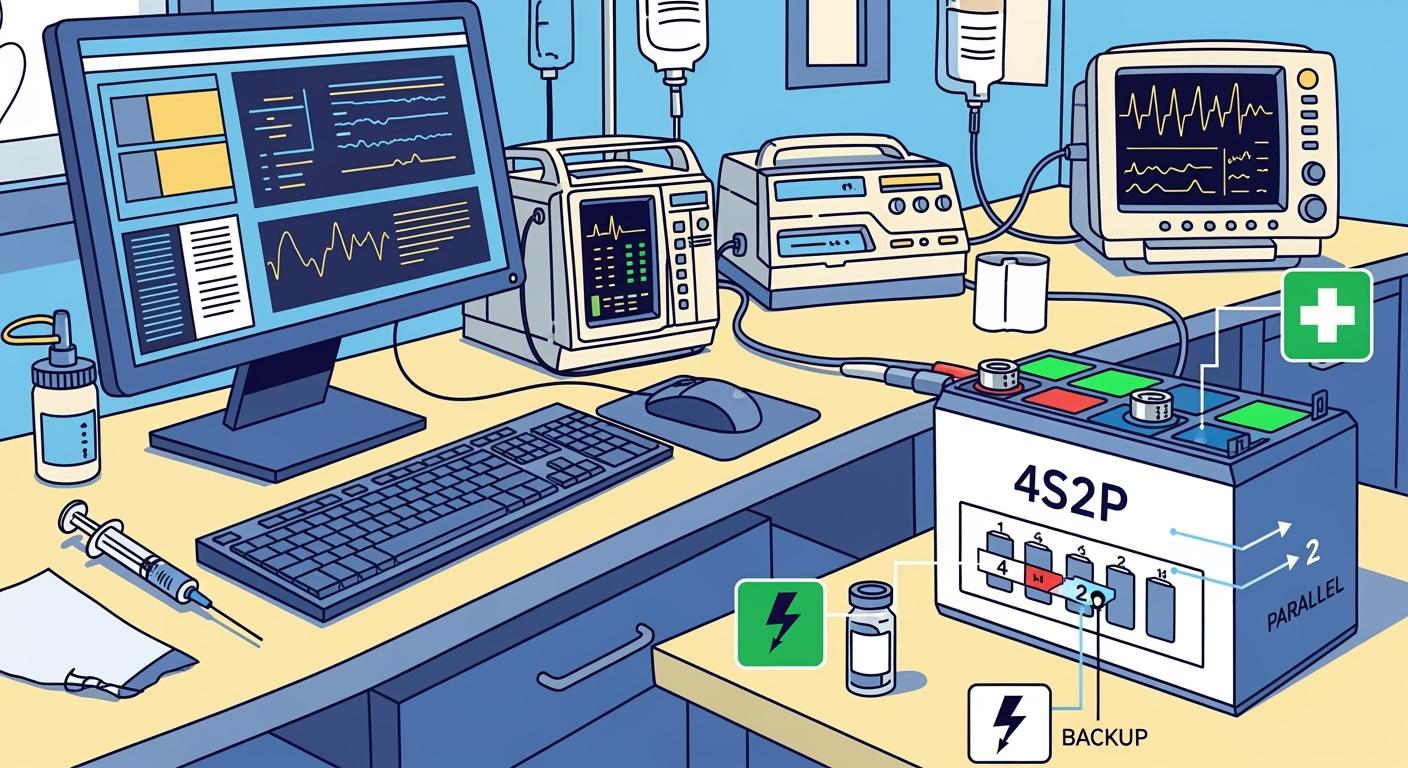
A 4S2P lithium battery backup system uses four cells in series and two in parallel. You gain a reliable 12V power source with up to 12 Ah capacity, ideal for medical injection workstations. Strict standards like UN 38.3 and UL 60601 ensure safety and compliance in critical hospital environments.
Key Takeaways
A 4S2P lithium battery backup system provides a reliable 12V power source, ensuring uninterrupted operation for clinical injection workstations during power outages.
Safety is crucial in medical environments. Adhere to strict standards like ANSI/AAMI ES 60601-1 to ensure compliance and protect both patients and devices.
Regular maintenance, including annual checks and temperature monitoring, extends the life of your battery backup system and ensures consistent performance.
Part 1: Requirements & 4S2P Configuration

1.1 Power Needs of Clinical Workstations
You must ensure that your clinical injection workstation operates without interruption, even during power outages. These workstations often run critical diagnostic and injection equipment that require a stable power supply. Typical backup duration ranges from 30 minutes to several hours, depending on the load profile. A Lithium Battery Backup system provides the reliability and runtime you need for continuous operation. You can match the battery pack’s output to the device’s power draw, ensuring seamless transitions during outages.
1.2 4S2P Structure and Voltage
The 4S2P configuration connects four lithium-ion cells in series and two in parallel. This design delivers a nominal voltage of 14.8V, which you calculate by multiplying the single cell voltage (3.7V) by four. This voltage level matches the requirements of most medical devices, providing consistent and reliable energy. You can learn more about lithium-ion technology and its advantages for medical applications here. The 4S2P structure also allows you to scale capacity while maintaining the necessary voltage for your Lithium Battery Backup.
1.3 Capacity and Energy Density
Selecting the right capacity ensures your Lithium Battery Backup meets both runtime and energy density needs. Review the following table for typical values:
Battery Type | Rated Capacity | Rated Voltage |
|---|---|---|
Li-ion | 10Ah | 14.8V |
High energy density means you can fit more power into a compact space, which is essential for integration in clinical environments. Custom battery solutions offer several advantages:
They ensure reliability and safety, which are critical in clinical settings.
You can tailor features to meet the operational needs of your devices.
Advanced protection circuits prevent malfunctions and support continuous operation.
Customization allows adjustments in size, voltage, and capacity for seamless integration.
Real-time battery status communication supports predictive maintenance and device readiness.
A well-designed Lithium Battery Backup system supports your clinical workstation’s performance and compliance.
Part 2: Lithium Battery Backup Design & Integration

2.1 Safety and BMS Features
You must prioritize safety when designing a Lithium Battery Backup for clinical injection workstations. Medical environments demand strict adherence to standards such as ANSI/AAMI ES 60601-1 and IEC 62133. These standards ensure that your system meets the highest safety and performance requirements. The following table outlines essential safety features you should implement:
Safety Feature | Description |
|---|---|
Adherence to ANSI/AAMI ES 60601-1 | General requirements for safety and performance of medical battery systems. |
Compliance with IEC standards | Includes IEC 62133, IEC 60086 Part 4, and UL 1642 for lithium batteries. |
Design for approved battery use | Use only approved batteries and chargers to minimize risks. |
Instructions for Use (IFU) | Provide clear guidelines for storage, charging, and maintenance. |
Safe storage practices | Minimize thermal events during storage and transportation. |
Thermal management plays a critical role in preventing thermal runaway. You should incorporate thermal barriers and passive cooling systems to minimize heat buildup. Pressure relief vents allow gases to escape during abnormal events, reducing the risk of explosive ruptures. These features, combined with a robust Battery Management System (BMS), protect both the device and the patient.
2.2 Component Selection
Selecting the right components ensures reliability and compliance for your Lithium Battery Backup. You should evaluate lithium cell chemistries based on safety, energy density, and cycle life. The table below compares common lithium battery chemistries used in medical devices:
Chemistry Type | Platform Voltage | Energy Density (Wh/kg) | Cycle Life (cycles) | Advantages | Limitations |
|---|---|---|---|---|---|
LiFePO4 (LFP) | 3.2V | 90–120 | 3000–6000 | Excellent safety, long cycle life | Lower energy density |
LiMn2O4 (LMO) | 3.7V | 100–150 | 1000–2000 | High safety, moderate energy | Moderate lifespan |
LiNiMnCoO2 (NMC) | 3.7V | 150–220 | 1000–2000 | High energy, high power | Moderate lifespan |
LiCoO2 (LCO) | 3.7V | 150–200 | 500–1000 | High energy, long runtimes | Moderate power, life |
LiNiCoAlO2 (NCA) | 3.6V | 200–260 | 1000–2000 | Highest energy, high power | Similar to NMC |
You can learn more about lithium-ion battery packs and their integration in medical devices.
When choosing lithium cells, consider the following:
Cycle life: Select cells with high cycle life to reduce replacement frequency.
Shelf life: Choose cells with long shelf life for backup systems stored before use.
Device compatibility: Match the cell form factor to your workstation’s requirements.
Safety features: Use cells with built-in protection against overcharging and overheating.
Battery type: Decide between primary and secondary cells based on your application.
For connectors and enclosures, select medical-grade materials that resist corrosion and meet regulatory standards. Use connectors with secure locking mechanisms to prevent accidental disconnection. Choose enclosures with flame-retardant properties and adequate ingress protection.
2.3 Integration Steps
You must follow a systematic approach when integrating a Lithium Battery Backup into your clinical workstation:
Wiring: Use high-quality, appropriately rated wires for series and parallel connections. Ensure all connections are secure and insulated to prevent short circuits.
Mounting: Install the battery pack in a dedicated compartment with proper ventilation. Secure the pack to prevent movement during operation or transport.
System Testing: Perform initial electrical tests to verify voltage, current, and communication with the workstation. Test the BMS for accurate cell balancing, overcurrent protection, and temperature monitoring.
Compliance Verification: Confirm that the integrated system meets all relevant medical device standards and passes safety inspections.
Tip: Always document each integration step. This practice supports troubleshooting and regulatory audits.
2.4 Maintenance Best Practices
Routine maintenance extends the life and reliability of your Lithium Battery Backup. You should:
Schedule annual service checks to ensure smooth operation and minimize unexpected failures.
Measure ambient and battery temperatures, float voltage, charge current, and open circuit voltage.
Inspect battery terminals for discoloration, corrosion, or buildup. Clean terminals with a soft, dry cloth and apply a spray-on protectant to reduce corrosion.
Store batteries at approximately 50% state of charge in a cool, dry environment to prevent permanent capacity loss and increase shelf life.
Minimize maintenance charging if there are no parasitic loads.
Conduct environmental inspections to remove any hazards that could interfere with battery operation.
Replace batteries when capacity drops below 80% of the rated value. Schedule preventive replacements before reaching critical thresholds.
Note: Regularly test the backup system under realistic load conditions to verify runtime and performance.
By following these best practices, you ensure that your Lithium Battery Backup system remains reliable, safe, and compliant throughout its service life.
You achieve reliable, safe, and compliant backup power for clinical injection workstations by following a structured 4S2P lithium battery pack design. The table below highlights key features:
Feature | Description |
|---|---|
Voltage | 12.8V |
Capacity | 12000mAh |
Configuration | 4S2P |
Safety Mechanisms | Overcharge, over-discharge, thermal stability, short-circuit protection |
Application | Life-supporting equipment, real-time communication systems |
Ongoing maintenance ensures consistent power, longer lifespan, and reduced replacement frequency, which enhances operational efficiency and lowers total cost of ownership.
FAQ
What advantages does a 4S2P lithium battery pack offer for medical workstations?
You gain stable voltage, scalable capacity, and enhanced safety. Large Power provides custom solutions for medical devices.
How do LiFePO4, NMC, and LCO chemistries compare for backup systems?
Chemistry | Platform Voltage | Energy Density (Wh/kg) | Cycle Life (cycles) |
|---|---|---|---|
LiFePO4 | 3.2V | 90–120 | 3000–6000 |
NMC | 3.6-3.7V | 150–220 | 800-1000 |
LCO | 3.7V | 150–200 | 500–1000 |
What maintenance steps ensure reliable lithium battery backup performance?
You should inspect terminals, monitor temperature, and test runtime. Replace batteries when capacity drops below 80%. Schedule preventive checks for optimal system reliability.


