

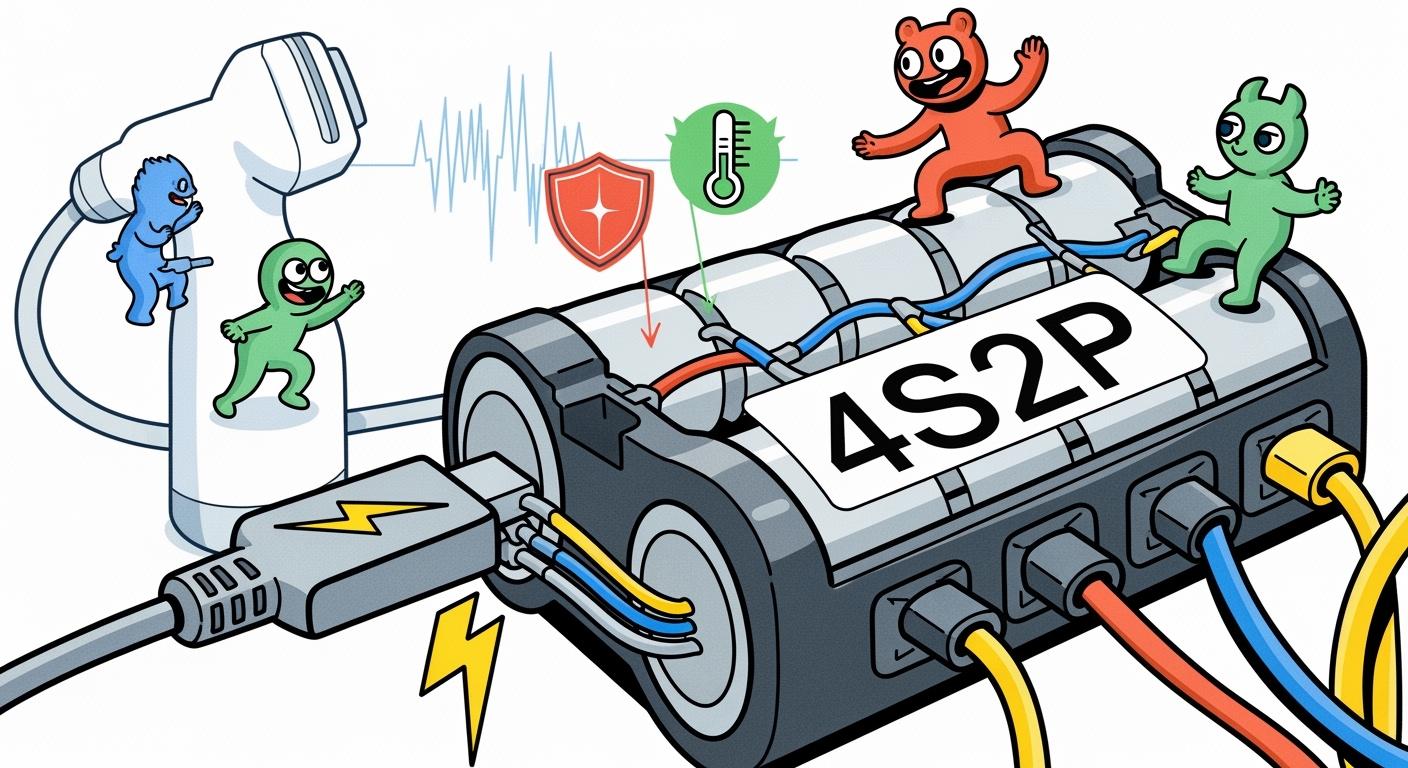
You need a fast-charging design that keeps your 4S2P lithium battery packs in ultrasound systems safe, efficient, and reliable. Charging speed directly affects battery health and longevity. Fast charging can accelerate cell aging, so advanced management becomes essential. By focusing on thoughtful design, you reduce risks during practical implementation.
Key Takeaways
Prioritize safety by using a reliable Battery Management System (BMS) and additional protection mechanisms to prevent overcharging and overheating.
Balance charging speed with battery health by monitoring temperatures and adjusting charging rates to extend battery life.
Implement strict monitoring and maintenance practices to ensure the ongoing safety and performance of your custom battery pack.
Part1: Fast-Charging Design Priorities
1.1 Safety and Efficiency in Battery Packs
When you design a fast-charging system for a 4S2P lithium battery pack in a medical device, safety must always come first. You need to address several critical factors to ensure both safety and efficiency during charging.
Battery Management System (BMS): This system protects your pack from overcharging, deep discharge, overcurrent, and short circuits. A reliable BMS is essential for any custom battery pack.
Secondary Protection Mechanisms: Devices like PTC resettable fuses, current interrupt devices (CID), and thermal cutoff switches add extra layers of safety. These components help prevent dangerous failures during fast-charging.
Structural Integrity: The enclosure of your pack shields the cells from mechanical shocks and environmental hazards. This protection is especially important in demanding medical environments.
Tip: Always select a manufacturer with a proven track record in safety-focused battery production. Quality assurance in manufacturing directly impacts the reliability of your custom battery pack.
You must also consider the matching ratio of cells in your pack. Using well-matched cells improves operational efficiency and safety. Grade A cells deliver consistent performance and reduce the risk of thermal runaway, especially under fast-charging conditions. If you use Grade B cells, you need to manage them carefully to avoid swelling and capacity imbalances. This attention to detail ensures your pack meets the high standards required in medical and industrial applications.
Temperature control is another key aspect of fast-charging design. Effective strategies include both passive and active cooling. Passive cooling uses natural air circulation and thermal barriers to limit heat buildup. In high-power applications, active cooling systems like liquid convection loops maintain stable temperatures and prevent thermal runaway. The table below compares common cooling strategies:
Cooling Strategy | Temperature Rise (°C) | Effectiveness |
|---|---|---|
Liquid Convection | < 3.2 | Superior thermal control |
Natural Convection | 30.7 | Inadequate cooling |
Moderate-Conductivity TIM | Reduced by 34% | Enhanced heat dissipation |
1.2 Balancing Charging Speed and Battery Health
You need to balance charging speed with long-term battery health. Fast-charging design often uses the Constant Current Constant Voltage (CCCV) method. This approach delivers a steady current until the battery reaches a set voltage, then switches to a constant voltage phase. This method helps protect the battery from overcharging and extends its cycle life.
However, rapid charging increases internal heat and accelerates cell aging. You must monitor temperature closely and adjust charging rates to prevent damage. Advanced BMS solutions can track cell temperatures and adjust charging parameters in real time. This proactive management reduces the risk of thermal events and preserves battery performance.
When you work with custom battery pack manufacturers, insist on thorough testing and quality control. Testing ensures that each pack meets strict safety and performance standards. High-quality production processes and careful cell selection lead to reliable, long-lasting packs.
Note: Always verify that your charger matches the specifications of your custom battery pack. Using an incompatible charger can cause safety issues and reduce battery life.
Part2: 4S2P Custom Battery Pack Configuration

2.1 Structure and Voltage Output
A 4S2P lithium battery pack combines four cells in series and two in parallel. This structure increases both voltage and capacity, making it suitable for demanding medical and industrial applications. When you use a LiFePO4 chemistry, you benefit from a stable voltage output, which is essential for sensitive equipment. The configuration supports high discharge rates, allowing quick power delivery during critical operations. You also gain a long cycle life, which means your battery can handle frequent use without significant degradation.
Configuration | Voltage Output (V) | Capacity (Ah) | Cycle Life (cycles) | Application Example |
|---|---|---|---|---|
4S1P | 12.8 | 3.2 | 2000+ | Portable ultrasound |
4S2P | 12.8 | 6.4 | 2000+ | Medical imaging device |
Note: Always confirm the platform voltage and cycle life with your manufacturer to ensure compatibility with your device.
2.2 Series-Parallel Impact on Fast-Charging Design
The 4S2P arrangement introduces unique challenges for fast-charging design. You must ensure that your battery management system (BMS) can balance both charging and discharging across all cells. High current charging can exceed the BMS’s capabilities, especially if you use a single BMS for multiple packs. Overcharging weaker cells becomes a risk, which can compromise safety and performance.
Each pack in a 4S2P configuration may require its own BMS, increasing design complexity.
Discrepancies in cell capacity can lead to overcharging risks when using a single charger.
The combined C rating can push excessive current through lower capacity packs, making fast-charging more challenging.
Fast charging also amplifies cell-to-cell variations and interconnect resistances. If you do not manage these factors, you risk accelerated aging and safety issues. In series configurations, all batteries must handle the same current, so balanced charging is essential. Parallel connections help distribute charging current more evenly, reducing the risk of overcharging individual units.
Tip: Work closely with your manufacturer to implement robust testing and quality control during production. This ensures your lithium battery pack meets strict safety and performance standards.
Part3: Safety Mechanisms in Fast-Charging Design
3.1 Overcharge and Overcurrent Protection
You must prioritize overcharge and overcurrent protection in every fast-charging design for a custom battery pack. In medical and industrial applications, these features prevent dangerous failures and ensure reliable operation. The table below outlines essential protection functions and their roles in lithium battery packs:
Function | Description |
|---|---|
Over-charge protection | Protects cells from exceeding 4.25V |
Over-discharge protection | Prevents cells from dropping below 2.5–3.0V |
Cell balancing | Ensures all cells are at similar charge levels |
Overcurrent & short-circuit protection | Safeguards against excessive current flow |
Temperature sensing & thermal cutoff | Monitors temperature to prevent overheating |
Communication options | Supports SMBus, CAN, UART, Bluetooth |
Industry standards require strict limits on voltage and current. Overcharge can push voltage above 4.2V, causing electrolyte breakdown and thermal runaway. Overcurrent leads to rapid heating and internal damage. Both risks can result in swelling, leakage, or even fire.
3.2 Temperature Monitoring and Thermal Management
Temperature monitoring is critical in fast-charging lithium battery packs. The Battery Management System (BMS) tracks each cell’s temperature. If the system detects abnormal heat, it can stop charging or disconnect faulty cells. This action prevents thermal runaway and protects your custom battery pack from catastrophic failure. You should always verify that your charger and pack include robust thermal management features.
3.3 Cell Balancing and BMS Features
Advanced BMS features are essential for maintaining safety and performance in custom battery packs. Key functions include:
Thermal management to keep the battery within safe temperature limits.
Capacity management to optimize charging speed and efficiency.
Communication enhancements for real-time data sharing and alerts.
A well-designed BMS regulates performance and enhances safety, especially during fast-charging. You should work with custom battery pack manufacturers who prioritize quality, thorough testing, and reliable production. This approach ensures your lithium battery pack meets the highest standards for safety and longevity.
Part4: Optimizing Charging for Custom Battery Packs
4.1 Current Limits and Voltage Thresholds
You need to set precise current limits and voltage thresholds when designing fast-charging protocols for your custom battery pack. These parameters protect your lithium battery packs from overcharging and extend their operational life. Consider the following recommended values:
Charging Voltage: 16.8V (±0.3%)
Minimum Voltage: 10.6V (±0.3%)
Discharging Limit: Avoid discharging below 3.0V per cell
Proper voltage levels help you avoid overcharging, which can cause lithium plating and thermal runaway. The charge current directly impacts internal heating, which is critical for safety. Charging within +10°C to +45°C ensures optimal performance and reduces risk. Exceeding maximum voltage may lead to instability, venting, or even fire.
4.2 Managing Heat and Cycle Life
You must manage heat generation to maintain the cycle life of your battery. Fast-charging increases internal temperatures, which can accelerate aging. The table below shows how heat generation changes as your pack ages:
Cycle Count | Heat Generation (W/m³) | Reversible Heat (%) | Irreversible Heat (%) |
|---|---|---|---|
New Battery | 41,275.9 | 29.2 | 70.8 |
After 400 Cycles | 81,996.2 | 50.18 | 49.82 |
Effective cooling methods include synthetic ester-based forced flow immersion, phase-change materials (PCM), and liquid cooling systems. PCM systems offer efficiency with fewer components, while liquid cooling provides superior thermal performance. These solutions help you maintain safe temperature differences between cells and enhance battery quality.
4.3 Monitoring and Maintenance Practices
You should implement strict monitoring and maintenance practices to ensure ongoing safety and performance of your custom battery pack. Follow these best practices:
Handle batteries carefully to prevent physical damage.
Store packs in a cool, dry place to avoid thermal stress and corrosion.
Use non-conductive containers for organization and short-circuit prevention.
Ensure proper ventilation to dissipate heat.
Regular testing and collaboration with custom battery pack manufacturers improve reliability and production quality. Always verify that your charger matches your battery specifications for safe and efficient charging.
You can implement fast-charging design for your 4S2P lithium battery packs by following these steps:
Use a charger matched to your battery chemistry and pack.
Monitor battery health with advanced BMS and regular testing.
Prioritize safety mechanisms and quality production.
Monitoring Technique | Description |
|---|---|
BMS | Tracks battery state and charging safety. |
Deep Learning Models | Predict battery health under fast-charging. |
FAQ
What is the recommended fast-charging current for a 4S2P LiFePO4 battery pack?
You should set the charging current at 0.5C to 1C. This range balances charging speed and battery health for medical and industrial applications.
How does Large Power ensure safety in custom lithium battery packs?
Large Power integrates advanced BMS, cell balancing, and temperature monitoring. You can request a customized battery consultation for tailored safety solutions.
Can you compare LiFePO4 and NMC chemistries for fast-charging in ultrasound devices?
Chemistry | Platform Voltage (V) | Energy Density (Wh/kg) | Cycle Life (cycles) |
|---|---|---|---|
LiFePO4 | 3.2 | 100–180 | 2000+ |
NMC | 3.7 | 160–270 | 1000–2000 |
LiFePO4 offers longer cycle life and stable voltage. NMC provides higher energy density.


