

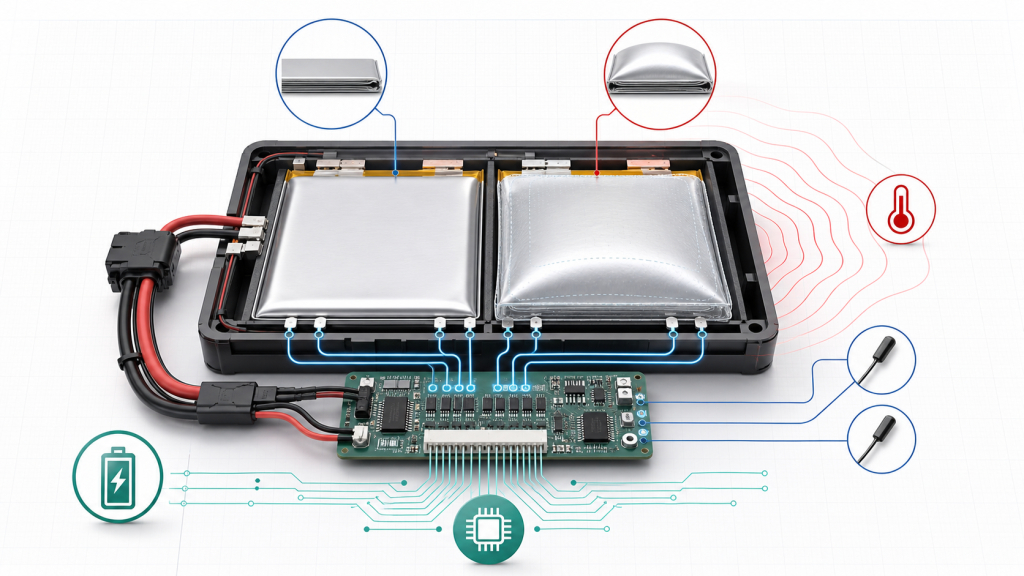
Quick Answer: Li-Po battery swelling is usually caused by gas generation inside the pouch cell due to high temperature, overcharging, prolonged high state of charge, cell aging, internal defects, or unsuitable mechanical constraints. Manufacturers can reduce the risk by selecting qualified cells, controlling charging voltage and temperature, designing an effective Battery Management System (BMS), allowing controlled expansion space, and validating the complete battery pack under realistic operating conditions.
Lithium polymer batteries provide high energy density, flexible dimensions, and a lightweight pouch structure. These advantages make them suitable for portable medical equipment, handheld instruments, consumer electronics, and other space-constrained devices. However, pouch cells can visibly swell when internal gas accumulates. Swelling is not merely a cosmetic issue. It can deform an enclosure, stress connectors, reduce electrical reliability, and indicate degradation inside the cell.
Preventing Li-Po battery swelling therefore requires more than adding a protection circuit. The cell, charger, BMS, thermal path, enclosure, and operating profile must be designed as one system.
Part 1: Why Li-Po Batteries Swell
1.1 Gas Generation Inside Pouch Cells
A Li-Po pouch cell contains active materials, electrolyte, separator layers, and a laminated aluminum-plastic enclosure. During normal operation, electrochemical reactions should remain controlled. When the cell experiences excessive voltage, high temperature, contamination, aging, or internal damage, side reactions may decompose the electrolyte and generate gas.
Because a pouch cell does not have a rigid metal can, the accumulated gas causes the package to expand. This makes swelling easier to observe than in cylindrical cells, but the underlying electrochemical degradation can occur in any lithium-ion format.
1.2 Common Causes of Li-Po Battery Swelling
| Cause | How It Accelerates Swelling | Design Response |
|---|---|---|
| Overcharge | High cell voltage accelerates electrolyte oxidation and gas generation. | Accurate charger termination, BMS overvoltage protection, and cell-voltage monitoring. |
| High temperature | Heat accelerates parasitic chemical reactions and cell aging. | Thermal sensors, lower charging current at elevated temperature, and improved heat dissipation. |
| Long storage at full charge | High state of charge increases chemical stress during storage. | Use a storage SOC appropriate to the cell supplier’s guidance. |
| Cell imbalance | One cell may reach its voltage limit before the rest of a series pack. | Cell-level monitoring and balancing through the BMS. |
| Excessive charge or discharge current | Higher internal heating and polarization accelerate degradation. | Match current limits to cell specifications and the real load profile. |
| Mechanical damage | Compression, bending, puncture, or assembly stress can damage internal layers. | Controlled mounting, edge protection, and adequate expansion allowance. |
| Poor cell quality or contamination | Manufacturing defects may create abnormal internal reactions. | Supplier qualification, incoming inspection, traceability, and batch validation. |
Part 2: Charging Strategies That Reduce Swelling Risk
2.1 Control the Maximum Charging Voltage
Charging voltage has a direct impact on Li-Po cell stress. A charger must use the voltage limit specified for the selected cell chemistry and model. Even a small, repeated overvoltage condition can accelerate electrolyte decomposition and capacity loss.
The design team should evaluate the complete voltage-control chain, including charger accuracy, BMS measurement tolerance, voltage drop across wiring, calibration drift, and component tolerances. Protection thresholds must not be treated as the normal charging target. The charger should terminate safely below the BMS emergency cutoff.
2.2 Adjust Charging Current by Temperature
Charging at low or high temperatures can damage lithium-ion cells. A single fixed charging current is rarely appropriate across the entire operating range. A safer strategy uses temperature-dependent charging limits:
- Block charging outside the cell’s approved temperature range.
- Reduce charging current near the upper and lower temperature boundaries.
- Place temperature sensors where they represent actual cell temperature.
- Consider heat generated by the device while the battery is charging.
- Validate charging in the final enclosure, not only on an open test bench.
For equipment that operates in difficult environments, a low-temperature battery solution may be required instead of relying only on software limits.
2.3 Avoid Unnecessary Time at 100% State of Charge
Some devices remain connected to external power for long periods. If the battery is continuously held at maximum voltage, calendar aging and swelling risk can increase. Depending on runtime requirements, manufacturers can consider charge-hold strategies, adaptive charging, or a lower normal charge ceiling.
These decisions involve a trade-off between maximum runtime and service life. They should be based on the real duty cycle rather than a generic consumer-electronics charging profile.
Part 3: BMS Design for Swelling Prevention
3.1 Cell-Level Voltage Monitoring
In multi-cell packs, monitoring only total pack voltage can hide imbalance. One cell may exceed its safe charging voltage while the overall pack still appears normal. A properly designed BMS and PCM measures each series group and responds before an individual cell enters an abusive condition.
Voltage thresholds should account for sensing accuracy, resistor tolerance, analog front-end error, temperature drift, and the delay between detection and current interruption.
3.2 Cell Balancing
Cell imbalance grows over time because cells do not age identically. Balancing helps prevent one cell from becoming the limiting cell during charging or discharge. Passive balancing is common in compact packs, while more advanced systems may use active balancing when capacity, efficiency, or operating time justifies the added complexity.
Balancing cannot repair a damaged or mismatched cell. Good cell matching, consistent production lots, and end-of-line verification remain essential.
3.3 Temperature Monitoring and Fault Response
A thermistor should be positioned to detect the hottest relevant cell area under charging and peak load. Larger packs or uneven thermal environments may require multiple sensors. The BMS can then reduce current, stop charging, disconnect the load, or report a fault through SMBus, CAN, UART, or another device interface.
Temperature protection should be coordinated with the host device. A battery that silently disconnects may create a different system-level risk in medical devices or critical industrial equipment. Designers should define warning states, fallback behavior, and service instructions.
3.4 State-of-Health and Swelling-Related Diagnostics
A BMS cannot directly measure gas generation unless the pack includes a pressure or displacement sensor. However, it can identify warning trends such as rising internal resistance, abnormal temperature rise, reduced usable capacity, increasing cell imbalance, or unusual charging time.
Logging these parameters supports preventive maintenance and helps engineers distinguish normal aging from an emerging fault.
Part 4: Mechanical Design Strategies
4.1 Allow Controlled Expansion Space
Pouch cells change thickness slightly during normal cycling. The enclosure must accommodate the cell supplier’s specified dimensional tolerance and expected expansion over life. A design that clamps the cell too tightly may apply damaging pressure, while an enclosure with no restraint may allow movement, abrasion, or connector fatigue.
The goal is controlled support: keep the cell secure while providing a defined direction and allowance for expansion.
4.2 Avoid Sharp Edges and Uneven Pressure
Battery trays, brackets, screws, PCB corners, and cable routing can create localized pressure points. Engineers should use smooth contact surfaces, suitable cushioning materials, edge protection, and controlled assembly torque. Adhesives should be compatible with the pouch film and operating temperature.
4.3 Protect the Cell Without Trapping Heat
Foam and insulation can protect a pouch cell from vibration, but excessive insulation may retain heat. Mechanical protection and thermal management must be developed together. Heat from the battery, charger, processor, display, motor, or other internal components should be mapped during worst-case operation.
For rugged industrial battery systems, the pack may also require vibration resistance, ingress protection, reinforced connectors, and strain relief without creating excessive mechanical constraint.
Part 5: Cell Selection and Manufacturing Controls

5.1 Select Cells for the Actual Application
Cell selection should consider more than nominal capacity. Engineers should evaluate maximum continuous current, pulse current, charging rate, operating temperature, storage temperature, cycle-life target, thickness tolerance, swelling specification, and traceability.
A high-capacity cell operated near its thermal or current limit may perform worse than a slightly lower-capacity cell with more design margin.
5.2 Maintain Cell Matching and Traceability
Cells used in one pack should be matched according to voltage, capacity, internal resistance, production lot, and aging condition. Mixing cells with significantly different characteristics increases imbalance and thermal variation.
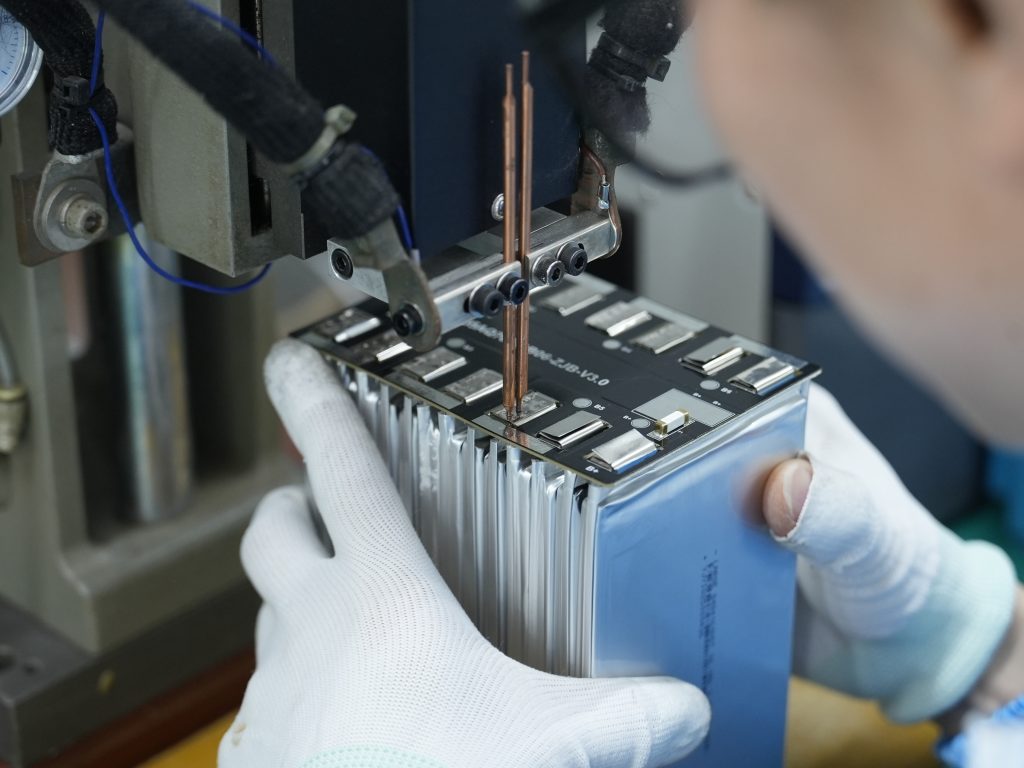
Production controls should include incoming inspection, cell OCV measurement, internal-resistance screening, welding validation, insulation inspection, BMS programming, functional testing, and final pack traceability.
5.3 Validate the Complete Battery Pack
Cell certificates alone do not prove that the finished battery pack is suitable for the device. Validation should cover the pack, charger, enclosure, wiring, firmware, and host equipment under realistic conditions.
- Charge and discharge cycling at relevant temperatures
- High-temperature storage at defined states of charge
- Cell imbalance and protection-threshold testing
- Abnormal charger and single-fault testing
- Vibration, shock, drop, and compression evaluation
- Thermal mapping inside the final device enclosure
- Transport testing such as UN 38.3 where applicable
- Application-specific safety and regulatory testing
Part 6: What to Do When a Li-Po Battery Is Swollen
A swollen battery should not be charged, punctured, compressed, or returned to normal service. Stop using the device, isolate it according to the manufacturer’s safety procedure, and arrange evaluation or disposal through a qualified service provider. Do not attempt to flatten the pouch cell or release the gas.
For manufacturers, a swelling report should trigger a structured investigation. Review the battery history, charger behavior, temperature logs, cell voltages, storage conditions, mechanical marks, production lot, and returned-sample condition. The purpose is to identify whether the event relates to cell quality, system design, assembly, use conditions, or aging.
Part 7: Engineering Checklist for New Li-Po Battery Projects
| Design Area | Questions to Confirm |
|---|---|
| Cell | Is the cell qualified for the required current, temperature, lifetime, and thickness tolerance? |
| Charging | Are voltage accuracy, current limits, recharge behavior, and temperature derating validated? |
| BMS | Does it monitor every series group and provide suitable balancing, protection, and diagnostics? |
| Mechanical | Is the pouch protected from sharp edges and uneven pressure while retaining expansion space? |
| Thermal | Has the hottest operating and charging condition been tested in the final enclosure? |
| Manufacturing | Are cells matched, processes controlled, and pack-level records traceable? |
| Compliance | Are the applicable transport, product-safety, and industry standards included in the validation plan? |
FAQ
What is the main cause of Li-Po battery swelling?
Li-Po battery swelling occurs when unwanted chemical reactions generate gas inside the pouch cell. Common triggers include overcharging, high temperature, prolonged storage at full charge, cell aging, internal defects, and mechanical damage.
Can a BMS completely prevent a Li-Po battery from swelling?
A BMS significantly reduces risk by monitoring voltage, current, temperature, and cell balance, but it cannot eliminate every cause. Cell quality, charger accuracy, thermal design, mechanical support, manufacturing controls, and operating conditions are also important.
How much expansion space should a pouch cell have?
There is no universal allowance. Designers should use the cell manufacturer’s dimensional tolerance and swelling guidance, then verify the complete enclosure through cycle-life, temperature, and mechanical testing.
Is a swollen Li-Po battery safe to use?
No. Stop charging and using a visibly swollen battery. Do not puncture, squeeze, or attempt to flatten it. Follow the device manufacturer’s isolation, service, transport, and disposal instructions.
Can Large Power develop a swelling-resistant custom Li-Po battery pack?
Large Power can tailor cell selection, charging parameters, BMS protection, thermal sensing, enclosure design, and validation to the requirements of your device. Request a custom battery consultation to review voltage, capacity, operating temperature, lifetime, dimensions, and compliance requirements.


