

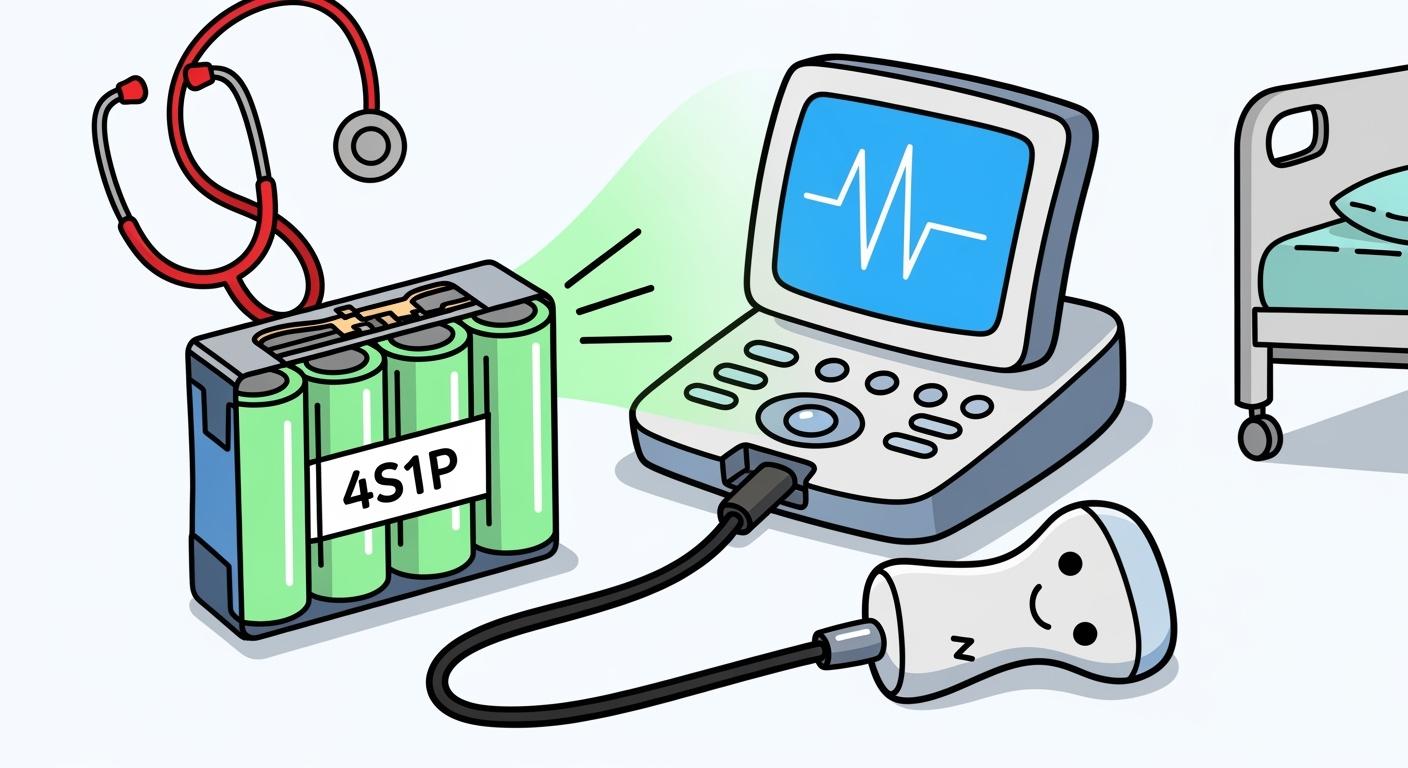
You need a reliable Lithium Battery Configuration for portable ultrasound systems. The 4S1P setup uses four cells in series, delivering stable voltage and high capacity, as shown below:
Configuration | Voltage | Capacity | Application |
|---|---|---|---|
4S1P | 12V | 30Ah, 40Ah, 50Ah | Medical, Solar Street Light |
High energy density keeps your equipment compact and operational for longer hours.
Key Takeaways
The 4S1P lithium battery configuration provides stable voltage and high energy density, making it ideal for portable ultrasound systems.
Using this configuration ensures extended runtime and compact design, which are crucial for medical devices.
Prioritize safety by implementing Battery Management Systems and adhering to certifications like UN 38.3 and IEC 62133.
Part1: Lithium Battery Configuration Basics

1.1 4S1P Meaning and Structure
You encounter the 4S1P Lithium Battery Configuration often in portable medical devices. This setup uses four cells connected in series and one in parallel.
A series connection involves connecting the positive terminal of one battery to the negative terminal of another battery, creating a chain of batteries.
4 cells are connected in series.
This series connection increases the voltage.
The capacity of the battery is equivalent to that of one cell.
In a 4S1P Lithium Battery Configuration, you gain higher voltage without increasing the overall capacity. This structure supports stable power delivery, which is essential for portable ultrasound systems.
1.2 Voltage and Capacity Overview
You need consistent voltage and capacity for reliable imaging. The typical 4S1P Lithium Battery Configuration delivers:
Voltage | Capacity |
|---|---|
14.4V | 3350-3500mAh |
This voltage matches the requirements of most portable ultrasound devices. You can expect a capacity around 48Wh, which ensures extended runtime and fewer interruptions during medical procedures.
1.3 Energy Density and Reliability
Lithium batteries offer superior energy density compared to other chemistries.
Lithium batteries have a significantly higher energy density compared to other battery chemistries.
This high energy density makes lithium batteries particularly suitable for portable medical devices.
You benefit from lightweight battery packs that last longer and maintain performance. Reliability metrics, such as State of Health (SOH) and Time of Flight (TOF), show strong correlations with battery aging and performance.
Study | Key Metrics | Findings |
|---|---|---|
Williams et al. (2025) | SOH, TOF | Strong correlation between SOH reduction and TOF shifts due to loss of lithium inventory. |
Sun et al. (2023) | SS-value | Proposed a new metric for energy dissipation, highlighting nonlinear aging characteristics. |
Xie et al. (2022) | Lithium plating | Identified lithium plating as a primary mechanism for accelerated degradation. |
Montoya-Bedoya et al. (2021) | SOC, SOH, TOF | Observed trends between ultrasound wave properties and battery state, emphasizing the need for further research. |
Fordham et al. (2023) | TOF, SA | Showed that cell orientation affects degradation metrics, with rotated cells exhibiting higher degradation. |
You ensure optimal performance and reliability in portable ultrasound systems by choosing the right Lithium Battery Configuration.
Part2: Advantages and Considerations for Ultrasound Systems
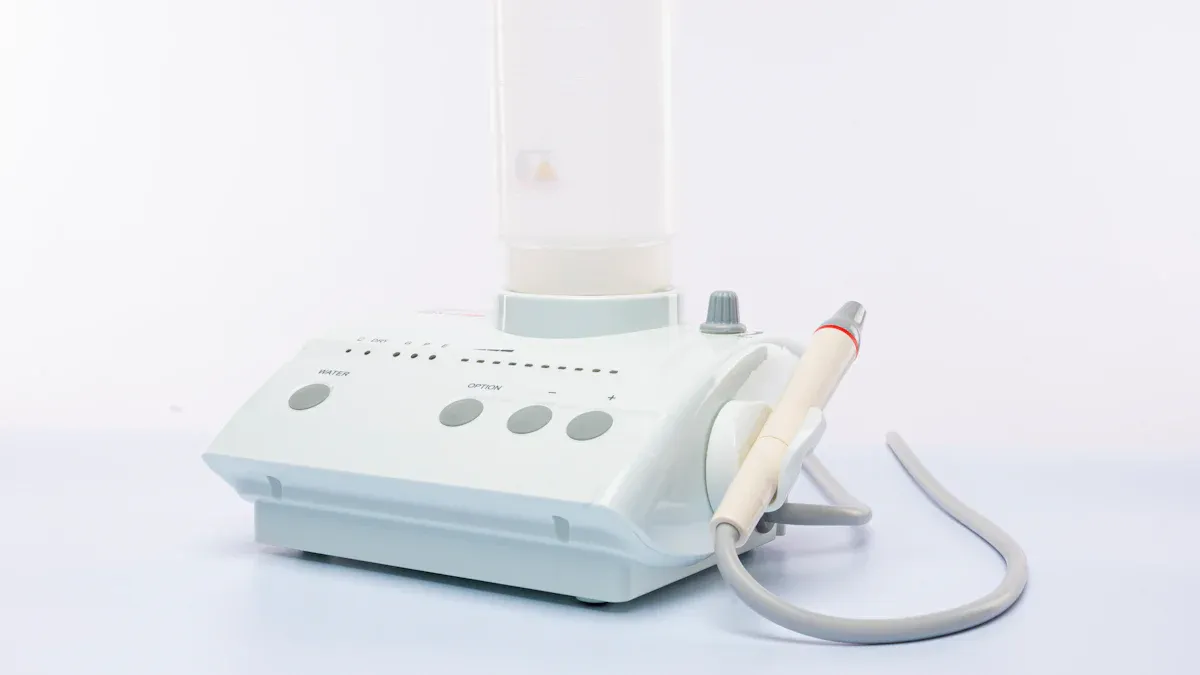
2.1 Power Needs of Portable Ultrasound
You must meet demanding power requirements when designing portable ultrasound systems. These devices need consistent voltage and high efficiency to deliver accurate imaging in clinical settings. Most portable units operate with a rechargeable battery and require a power supply between 600 and 1,000 W. Basic models use approximately 200 W, while advanced systems can exceed 1 kW. Weight and dimensions remain critical, as you want equipment that is easy to transport and handle.
Feature | Specification |
|---|---|
Output Impedance | Less than 0.3 Ω |
Acoustic Power Output | Greater than 50 W |
Weight | Under 6 lb |
Dimensions | 2×6×4 in.³ |
Power Source | Rechargeable battery |
Efficiency | More than 95% voltage transfer |
Power requirements vary based on application.
Basic units: approximately 200 W.
High-end units: over 1 kW.
You must also consider battery performance, image quality, and device portability. The Lithium Battery Configuration you select directly impacts runtime and reliability.
2.2 Benefits of 4S1P Configuration
You gain several advantages by using the 4S1P Lithium Battery Configuration in portable ultrasound systems. This setup delivers a nominal voltage of 14.4V, which matches the operational needs of most medical imaging equipment. You benefit from a compact battery pack that maintains high energy density and supports extended runtime.
Feature | Description |
|---|---|
Configuration | 4-series, 1-parallel (4S1P) |
Nominal Voltage | 14.4V |
Application | Ideal for devices requiring higher operational voltage while maintaining compactness |
Optimal voltage ensures stable imaging performance.
Lightweight design improves portability for clinical staff.
High energy density supports longer operation between charges.
Safety features protect against overcharge and thermal events.
You can deploy portable ultrasound systems in medical, robotics, security, infrastructure, consumer electronics, and industrial sectors. For custom battery solutions, contact Large Power for professional consultation.
2.3 Safety and Charging Protocols
You must prioritize safety when integrating Lithium Battery Configuration into medical devices. Early warning signs, such as rapid loss of runtime or charging inconsistencies, indicate potential battery issues. Abnormal battery behavior should prompt immediate inspection to prevent serious incidents.
Consistent maintenance, including proper charging practices and routine inspections, reduces risk.
Battery Management Systems (BMS) protect cells from overcharge and over-discharge.
Insulated terminals and proper spacing prevent short circuits.
Temperature monitoring with thermal cutoffs or sensor ports helps avoid overheating.
Ventilation holes or heat sinks improve heat dissipation.
Flame-retardant plastics or metal enclosures add safety.
Compliance with standards such as UN 38.3, IEC 62133, and RoHS ensures legal and safe operation.
You must use a CC-CV lithium charger with an output of 14.4V – 14.6V for optimal charging. The standard charge cut-off voltage for 4S1P lithium batteries is 14.6±0.1V. Using an incorrect charger can lead to incomplete charging and reduced runtime.
Consideration | Description |
|---|---|
Safety Features | Critical mechanisms to ensure safe operation of lithium batteries. |
Overcharge/Over-Discharge Protection | Prevents voltage extremes with a Battery Management System (BMS). |
Short Circuit Prevention | Insulated terminals and proper spacing to avoid short circuits. |
Temperature Monitoring | Use of thermal cutoffs or sensor ports to monitor battery temperature. |
Ventilation & Heat Dissipation | Incorporation of ventilation holes or heat sinks to prevent thermal runaway. |
Fire-Resistant Materials | Use of flame-retardant plastics or metal enclosures for added safety. |
Compliance with Standards | Ensures adherence to safety and legal requirements. |
UN 38.3 Certification | Required for air transport of lithium batteries. |
IEC 62133 | International standard for safety in portable sealed batteries. |
RoHS Compliance | Ensures components are free from hazardous substances. |
Local Regulations | Compliance with regional laws for commercial use and shipping. |
You must also comply with regulatory requirements for lithium battery use in portable medical devices. Certifications such as UN38.3, CE, IEC/EN60601-1, and national standards like UL, PSE, KC, RCM, EAC/Gost, and BIS are mandatory for commercial deployment.
2.4 Comparison with Other Configurations
You must evaluate different Lithium Battery Configuration options to select the best fit for your application. The 4S1P setup offers a balance of voltage, capacity, and portability. Other configurations, such as 3S1P and 4S2P, provide alternative solutions.
Configuration | Voltage | Capacity | Application Scenario |
|---|---|---|---|
3S1P | 11.1V | 3500mAh | Consumer electronics, robotics, security |
4S1P | 14.8V | 3500mAh | Medical, industrial, infrastructure |
4S2P | 14.8V | 7000mAh | High-demand medical, industrial |
3S1P offers lower voltage and is suitable for devices with less demanding power needs.
4S1P provides optimal voltage for portable ultrasound and balances size and weight.
4S2P increases capacity for longer runtime but adds weight and bulk.
You must prioritize weight, dimensions, battery performance, and image quality when selecting a configuration. Always request a sample battery and conduct real-world testing under your device’s load and environmental conditions. Measure voltage stability, temperature rise, and cycle life to validate performance before placing large orders.
Tip: Worldwide approvals, including CE, RoHS, IEC, CB, KC, and IOS9001, ensure quality and compliance for lithium battery packs used in medical and industrial applications.
You gain stable voltage, high energy density, and reliable performance with the 4S1P lithium battery configuration. This setup meets demanding medical device standards and supports portable ultrasound systems. You ensure efficient power delivery and compliance in critical applications.
FAQ
What makes the 4S1P lithium battery configuration ideal for portable ultrasound systems?
You achieve stable voltage and high energy density. This configuration supports extended runtime and compact design, meeting medical device standards.
How do you ensure safety when using lithium battery packs in medical devices?
You implement Battery Management Systems, monitor temperature, and follow certifications like UN 38.3 and IEC 62133. These steps reduce risk and improve reliability.
Where can you find custom lithium battery solutions for B2B applications?
You can explore Large Power custom battery solutions for tailored lithium battery packs in medical, robotics, and industrial sectors.


