

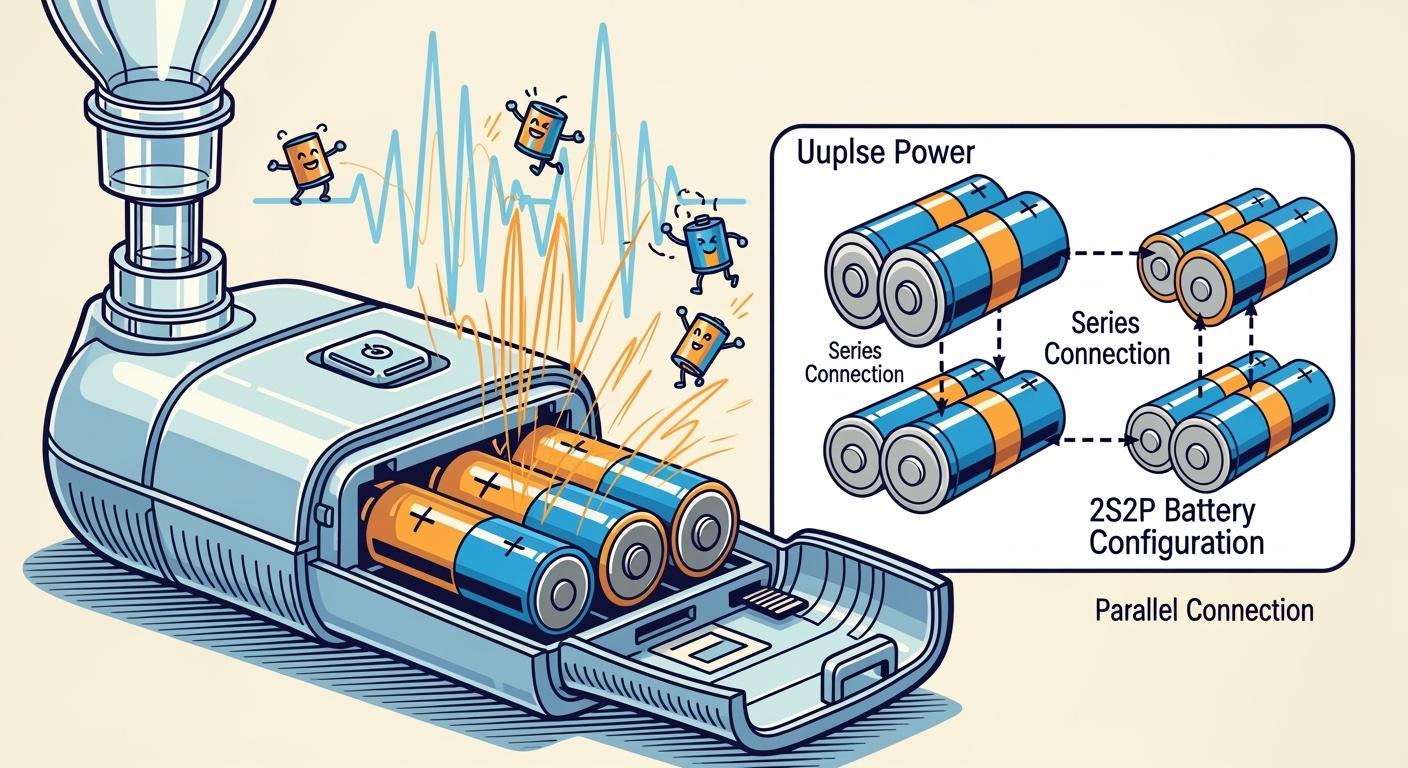
Reliable power is essential for portable nebulizers. You must approach lithium battery selection with care to ensure stable operation under pulsed loads. Matching battery configuration to the device’s energy profile reduces failure risk. Focus on configuration, capacity, voltage, safety, and durability to protect medical device integrity and patient safety.
Key Takeaways
Choose a 2S2P battery for stable voltage and doubled capacity, ideal for medical devices.
Match battery voltage and capacity to device needs for reliable performance.
Prioritize safety features like protection circuits to ensure patient safety.
Part1: 2S2P Battery Basics for Nebulizers
1.1 2S2P Configuration Explained
You often see the 2S2P lithium battery configuration in portable nebulizers. This setup combines two cells in series and two cells in parallel. The structure starts with parallel strings, then connects these in series. You benefit from improved voltage management and balanced energy delivery. The table below summarizes the key aspects:
Aspect | Description |
|---|---|
Definition | A 2S2P configuration consists of 2 cells in series and 2 cells in parallel. |
Structure | The configuration is built by first creating parallel strings, then connecting these in series. |
Voltage Management | This setup helps in managing voltage effectively across the cells. |
When you select a battery for medical devices, such as portable nebulizers, you must consider how the configuration supports stable power under pulsed loads.
1.2 Why 2S2P Suits Portable Nebulizers
You need a battery pack that delivers consistent voltage and enough capacity for extended use. The 2S2P configuration offers a nominal voltage of 7.4V and doubles the capacity compared to a single series setup. This balance makes it ideal for medical applications, where reliability and safety matter most. The table below compares common configurations:
Configuration | Nominal Voltage | Capacity |
|---|---|---|
2S2P | 7.4V | Doubled capacity |
2S3P | Varies | Higher capacity |
You should also consider battery chemistry. Lithium-ion, LiFePO4, lithium-polymer/LiPo, and solid-state battery types each offer unique benefits for medical devices. Lithium-ion batteries provide high energy density and long cycle life, making them a popular choice.
1.3 Key Parameters: Voltage & Capacity
You must match the battery’s voltage and capacity to your device’s requirements. Voltage determines if the battery can power the nebulizer’s motor and electronics. Capacity, measured in milliamp-hours (mAh), affects runtime and reliability. Lithium Battery Selection for portable nebulizers should focus on these parameters to ensure stable performance. You improve device safety and patient outcomes by choosing the right configuration and chemistry. Lithium Battery Selection also impacts long-term durability and maintenance needs.
Part2: Lithium Battery Selection Criteria & Performance

2.1 Capacity & Discharge Rate
You must evaluate both capacity and discharge rate when considering Lithium Battery Selection for portable nebulizers. Capacity, measured in milliamp-hours (mAh), determines how long your device can operate before needing a recharge. For medical applications, you should choose batteries with a minimum of 900 mAh to ensure stable operation and reliable aerosol delivery.
Minimum recommended capacity for portable nebulizers:
900 mAh
Discharge rate affects how well the battery handles pulsed loads. Nebulizers often draw bursts of current, especially during aerosol generation. If you operate at high altitudes or in cold environments, battery performance drops due to increased internal resistance and voltage sag. Your nebulizer will draw more current to maintain output, which leads to faster battery depletion. Consistent discharge rates help maintain stable performance, especially in medical settings where reliability is critical.
2.2 Voltage Compatibility & Stability
You must match battery voltage to your device’s requirements. Most portable nebulizers use a nominal voltage of 7.4V, which aligns with the 2S2P configuration. Voltage stability ensures your device runs smoothly, even under pulsed loads. If voltage drops too low, your nebulizer may fail to deliver medication effectively. You should verify that the battery maintains voltage throughout its discharge cycle, especially for medical devices and robotics, where consistent power is essential.
2.3 Depth of Discharge & Cycle Life
Depth of discharge (DoD) directly impacts battery longevity and performance. You must balance energy delivered per cycle with overall cycle life. Lower DoD increases the number of cycles but reduces energy per use. Manufacturers often specify cycle life at 80% DoD, which balances battery life and performance for medical and industrial applications.
Depth of Discharge (DoD) | Approximate Cycle Life (NMC) | Approximate Cycle Life (LFP) | Comments |
|---|---|---|---|
100% | ~300 | ~600 | High stress, maximum energy per cycle |
80% | ~400 | ~900 | Moderate to heavy use |
60% | ~600 | ~1,500 | Good energy per cycle |
40% | ~1,000 | ~3,000 | Used in energy storage systems |
20% | ~2,000 | ~9,000 | High longevity |
10% | ~6,000 | ~15,000 | Specialized systems |
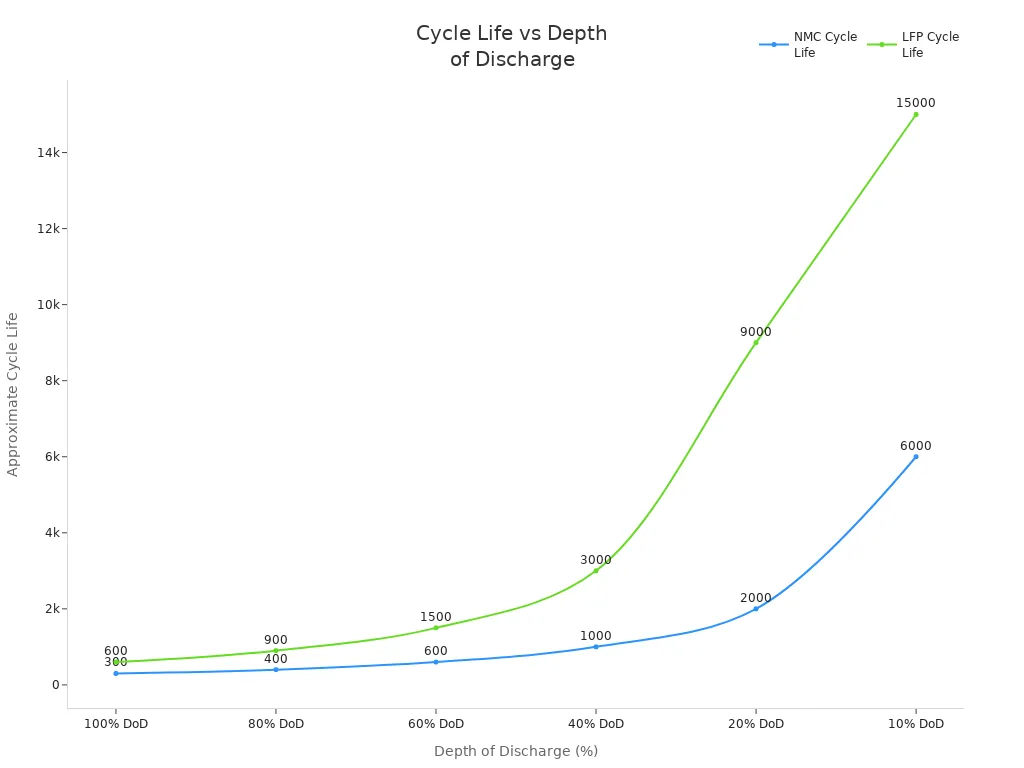
Lower DoD increases cycle count, but reduces energy delivered per cycle.
Manufacturers often specify cycle life at 80% DoD for balanced performance.
2.4 Safety, Durability & Water Resistance
You must prioritize safety features in Lithium Battery Selection for medical devices. Look for batteries with built-in protection circuits, such as overcharge, over-discharge, and short-circuit protection. These features reduce the risk of failure and improve patient safety. Durability matters for devices used in healthcare, security, and industrial environments. Water resistance is essential for portable nebulizers, which may encounter moisture during use. You should verify IP ratings and ensure the battery pack meets industry standards for medical and consumer electronics applications. If you require advanced battery management, consider integrating a battery management system (BMS) for enhanced safety and monitoring.
2.5 Integration: Size, Weight & Connectors
You must consider integration factors when selecting batteries for portable nebulizers. Size and weight affect device portability and user comfort. For example, the MicroAir NE-U100 nebulizer weighs only 4.2 oz, making it easy to carry and operate. You should choose battery packs that fit within your device’s design constraints and do not add excessive bulk.
Handheld and portable design is essential for medical and consumer electronics.
Lightweight batteries improve usability in robotics, security, and industrial sectors.
Connector compatibility also matters. You must ensure that the battery pack matches your device’s connectors and supports easy installation and replacement. For B2B applications, standardized connectors simplify maintenance and reduce downtime.
Note: When you evaluate Lithium Battery Selection, always consider how size, weight, and connector type impact device integration and long-term reliability.
Part3: Recommended Models & Reliability
3.1 Top 2S2P Battery Models
You should consider several reliable 2S2P lithium battery packs for portable nebulizers. Leading models include Panasonic NCR18650B 2S2P packs, Samsung INR18650-35E 2S2P, and LG MJ1 2S2P configurations. These models use lithium-ion chemistry, offer a nominal voltage of 7.4V, and provide energy densities above 200 Wh/kg. You benefit from consistent performance, long cycle life, and compatibility with medical device requirements.
Model | Chemistry | Nominal Voltage | Typical Capacity | Cycle Life (80% DoD) |
|---|---|---|---|---|
Panasonic NCR18650B 2S2P | Li-ion | 7.4V | 6,800 mAh | ~400 cycles |
Samsung INR18650-35E 2S2P | Li-ion | 7.4V | 7,000 mAh | ~400 cycles |
LG MJ1 2S2P | Li-ion | 7.4V | 7,000 mAh | ~400 cycles |
3.2 Built-In Protections & Certifications
You must prioritize battery packs with robust protection features and international certifications. High-quality 2S2P lithium batteries for medical devices typically include:
Protection Circuit Board (PCB) for maximum safety
Overcharge, overdischarge, overcurrent, overheating, and short circuit protection
Permanent over-voltage and under-voltage safeguards
PTC and NTC components for temperature monitoring
Balancing functions to extend lifespan
Certifications ensure compliance with global safety standards. The table below summarizes key certifications:
Certification Standard | Description |
|---|---|
IEC 62133 | Safety for portable secondary cells and batteries |
IEC 60601-1 | Basic safety and essential performance for medical electrical equipment |
UL 2054 | Household and commercial battery safety standard |
UN38.3 | Safety during transport of lithium batteries |
CE | European safety, health, and environmental protection |
3.3 Maintenance Tips
You can maximize battery lifespan and safety by following best practices:
Recharge the battery weekly to ensure reliable operation
Clean contacts regularly to prevent efficiency loss from dirt or corrosion
Use the battery as intended and follow manufacturer specifications
Limit unnecessary device operation to reduce battery drain
Note: The typical shelf life is about 300 cycles from the first use. Regular maintenance and timely replacement help you maintain stable performance in medical environments.
You improve portable nebulizer reliability by matching battery specifications to device needs. Lithium polymer batteries deliver stable voltage and consistent aerosol output. Select packs with capacities between 1500–3000mAh for medical devices:
Device Category | Typical Capacity Range |
|---|---|
Nebulizers & handheld devices | 1500–3000mAh |
B2B Battery Selection Checklist:
Confirm voltage and capacity.
Check size and weight.
Verify safety certifications.
Test for performance and compliance.
FAQ
What advantages do Large Power custom 2S2P lithium battery packs offer for medical nebulizers?
You gain stable voltage, high energy density, and reliable cycle life. Explore custom battery solutions for tailored medical device integration.
How do you ensure lithium battery safety in portable medical devices?
You select packs with built-in protection circuits, certified to IEC 62133 and UL 2054 standards. These features reduce risk and support compliance in healthcare environments.
Can you use 2S2P lithium battery packs in other industries besides medical?
You apply 2S2P packs in robotics, security, and industrial automation. They deliver consistent power for pulsed loads in demanding B2B scenarios.


