

You rely on 8S3P lithium battery packs for dependable power in mobile imaging equipment. These packs deliver stable voltage, high energy efficiency, and superior operational runtime. The industry moved from traditional batteries to lithium-ion solutions for improved performance. Custom Lithium Battery Applications match device requirements and enhance reliability.
Feature | Lithium-Ion Batteries | Traditional Batteries |
|---|---|---|
Voltage Stability | High stability, crucial for imaging | Prone to voltage drops |
Energy Efficiency | 20-25% reduction in power loss | Less efficient |
Operational Runtime | 30% improvement in runtime | Shorter runtime |
Power Density | Higher power density | Lower power density |
Thermal Stability | Greater thermal stability | Less stable |
Key Takeaways
8S3P lithium battery packs provide stable voltage and high energy efficiency, essential for reliable mobile imaging equipment.
These battery packs offer a long operational runtime, allowing devices to function for extended periods without frequent recharging.
Customizable battery solutions enhance the performance of various imaging devices, ensuring they meet specific power requirements.
Part1: 8S3P Lithium Battery Applications and Features

1.1 8S3P Battery Pack Structure
You need to understand the structure of an 8S3P battery pack to optimize lithium battery applications in mobile imaging equipment. The 8S3P configuration means you connect eight cells in series (8S) to increase voltage and three cells in parallel (3P) to boost capacity. This structure delivers a nominal voltage of 25.6V and a total capacity of 45Ah, making it ideal for high-demand, portable medical devices.
Component | Details |
|---|---|
Voltage | 3.2V (per cell) |
Capacity | 15Ah (per cell) |
Energy | 48Wh (per cell) |
Configuration | 8S (8 cells in series) |
3P (3 cells in parallel) | |
Nominal Voltage | 25.6V |
Total Capacity | 45Ah |
Total Energy | 1.152kWh |
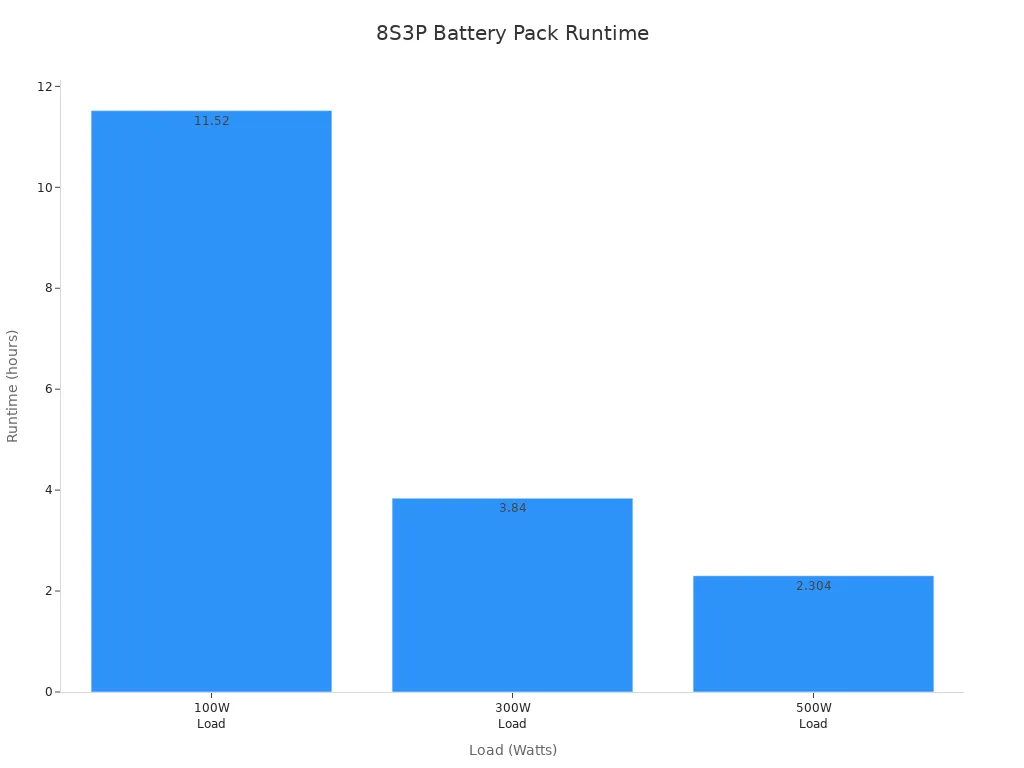
Runtime (100W Load) | 11.52 hours |
Runtime (300W Load) | 3.84 hours |
Runtime (500W Load) | 2.304 hours |
This configuration allows you to achieve both high voltage and high capacity, which are essential for reliable lithium battery applications in advanced imaging systems. The modular design also supports easy integration with battery management systems (BMS) for enhanced safety and monitoring.
1.2 Key Performance Metrics
You evaluate battery performance using several critical metrics. The 8S3P lithium-ion battery pack stands out for its energy density, cycle life, and operational runtime. You can see how the pack performs under different loads in the chart below:
The 8S3P configuration provides:
Nominal Voltage: 24–25.6V, suitable for most mobile imaging platforms.
Capacity: 45Ah, supporting extended use without frequent recharging.
Energy Output: 1.152kWh, ensuring consistent power delivery.
Runtime: Up to 11.52 hours at a 100W load, which meets the demands of portable X-ray and ultrasound devices.
You benefit from a rechargeable battery system that maintains high battery performance over hundreds of cycles. The table below compares the 8S3P configuration with other common lithium battery packs:
Specification | Description |
|---|---|
Nominal Voltage | 24 volts, achieved by connecting eight cells in series. |
Capacity | Calculated by multiplying the single cell capacity by three (parallel cells). |
Configuration | 8S3P, combining series and parallel for optimal voltage and capacity. |
This balance of voltage and capacity makes the 8S3P pack a preferred choice for lithium battery applications in medical imaging.
1.3 Advantages for Mobile Imaging Devices
You gain several advantages by using 8S3P lithium battery applications in mobile imaging equipment:
High Energy Density: The 8S3P lithium-ion battery pack delivers more energy per unit weight, reducing the overall size and weight of your devices. This feature is critical for mobile imaging carts and handheld diagnostic tools.
Long Cycle Life: You can expect over 2,000 charge-discharge cycles, which lowers maintenance costs and increases device uptime.
Stable Power Output: The configuration ensures consistent voltage, which is vital for sensitive imaging electronics.
Scalability: You can customize the pack to match specific power requirements, supporting a wide range of imaging modalities.
The table below highlights how different 8S3P lithium battery chemistries compare:
Factor | 8S3P 18650 Pack | 8S3P 21700 Pack |
|---|---|---|
Capacity | ~7.5Ah | ~15Ah |
Cycle Life | 500-1000 cycles | 500-1000 cycles |
You see that the 8S3P configuration adapts well to various lithium battery applications, from portable X-ray machines to advanced ultrasound systems. The rechargeable battery design ensures you meet the rigorous demands of healthcare environments, where reliability and battery performance are non-negotiable.
Tip: For more on the science behind lithium-ion battery technology, visit Nature’s battery research section.
By choosing the 8S3P structure, you ensure your mobile imaging equipment operates efficiently, safely, and with minimal downtime.
Part2: Lithium-Ion Battery Use in Medical Imaging
2.1 Power Needs of Imaging Equipment
You face demanding power requirements when you select batteries for mobile medical equipment. Portable imaging devices such as X-ray, MRI, and CT scanners need high energy output to operate efficiently. The table below shows typical power requirements for these devices:
Imaging Modality | Power Requirement (kW) |
|---|---|
Portable X-ray | 10–50 |
CT Scanner | >120 |
MRI Scanner | 25–80 |
An MRI scanner consumes more than twice the energy of a CT scanner. It uses ten times the energy of an X-ray scanner. You must choose battery applications that deliver consistent power and support extended operation. Lithium-ion batteries, including LiFePO4 and lithium-polymer/LiPo, provide high energy density and rapid charging. These features enable you to meet the needs of advanced imaging systems.
2.2 Reliability and Uninterrupted Operation
You prioritize medical equipment reliability to ensure patient care and operational efficiency. Lithium-ion batteries offer several advantages over traditional batteries. The table below summarizes key points:
Key Point | Description |
|---|---|
Importance of Uninterrupted Power | Essential for patient safety and operational efficiency in healthcare environments. |
Advantages of Lithium-Ion Technology | Higher energy density, lighter weight, and longer cycle life compared to traditional batteries. |
Hot-Swap Capability | Allows for battery replacement without interrupting power to the device, ensuring continuous operation. |
You benefit from hot-swap capability, which lets you replace batteries without shutting down equipment. This feature is critical in medical settings where uninterrupted operation is necessary. Lithium-ion batteries enhance mobility and reliability in medical imaging equipment. Risks such as thermal runaway, overheating, and improper battery management can impact patient safety. You mitigate these risks by using a structured management framework and integrating a Battery Management System (BMS). Thermal runaway occurs due to internal short circuits, overcharging, or physical damage. The process generates heat that can ignite flammable gases, leading to rapid fire spread. You must follow best practices for battery management to maintain safety and reliability.
2.3 Real-World Lithium Battery Applications: X-ray, MRI, Ultrasound
You see lithium-ion batteries powering a wide range of portable imaging devices. The MinXray Impact Wireless is a portable X-ray generator that uses a rechargeable lithium-ion battery. Custom lithium battery solutions are designed for various medical imaging devices, ensuring reliable performance. They provide stable, high-quality power for portable ultrasound, X-ray, and diagnostic equipment. These solutions are tailored to meet specific energy requirements, enhancing compliance with safety standards.
Power Sonic’s batteries are engineered to meet the unique demands of medical devices.
They are suitable for powering digital imaging, patient monitoring systems, and surgical devices.
The batteries have a proven track record of high-quality performance.
You benefit from technological superiority, extended lifespan, and advancements in equipment. The table below highlights trends in lithium-ion battery adoption for medical imaging:
Feature | Description |
|---|---|
Technological Superiority | Higher energy-to-weight ratio enables smaller, lighter devices, enhancing patient comfort and portability. |
Extended Lifespan | Long cycle life reduces costs and minimizes disruptions from frequent battery replacements. |
Advancements in Equipment | High-capacity batteries support sophisticated imaging devices, improving operational times and imaging quality. |
You rely on custom lithium battery solutions to address the unique requirements of different imaging devices. These solutions ensure reliable performance and support the evolving needs of mobile medical equipment. You achieve consistent power delivery, improved safety, and enhanced patient care by integrating advanced lithium battery packs into your imaging systems.
You gain reliable power and customizability with 8S3P lithium battery packs in mobile imaging equipment. Custom solutions maximize space and efficiency.
Solid-state batteries and wireless charging will improve safety and usability.
EU regulations require removable batteries for sustainability.
Operando monitoring and solid-state chemistry boost performance and reliability.
FAQ
What makes 8S3P lithium battery packs ideal for mobile imaging equipment?
You benefit from high storage capacity and stable energy storage. Large Power designs packs for medical imaging devices. Consult Large Power experts for custom battery solutions.
How do you ensure safe storage and energy storage in lithium-ion battery packs?
You use battery management systems to monitor storage and energy storage. Large Power provides advanced safety features for medical applications.
Can you customize storage and energy storage for different imaging devices?
You request tailored storage and energy storage solutions from Large Power. Custom packs optimize storage for portable X-ray, MRI, and ultrasound devices.


