


You need stable power for your Outdoor Security System, especially when you face extreme temperatures and harsh weather. Cold weather slows ion movement in batteries, increases internal resistance, and causes voltage drops. Heat speeds up battery aging, raises internal pressure, and damages the internal structure. See the table below for details:
Effect | Explanation |
|---|---|
Increased Internal Resistance | Cold weather thickens the electrolyte, slowing ion movement and increasing internal resistance. |
Voltage Drops and Power Output Loss | Higher resistance causes voltage drops, reducing battery power output. |
Reduced Capacity at Low Temperatures | Electrolyte viscosity increases, lowering efficiency and capacity. |
Faster Aging and Degradation | High temperatures accelerate chemical reactions, leading to faster aging and degradation of battery performance. |
Thermal Degradation | Heat causes internal pressure to rise, damaging the battery’s internal structure. |
Increased Internal Resistance | Chemical changes from heat increase internal resistance and accelerate capacity loss. |
Lithium battery packs and UPS systems give you reliable performance. Battery design, cell layout, and solar integration help you build a durable solution. You can select, install, and maintain these systems to maximize uptime.
Key Takeaways
Choose lithium battery packs for outdoor security systems. They offer high energy density and long cycle life, ensuring reliable performance in harsh conditions.
Integrate uninterruptible power supply (UPS) systems to enhance reliability. UPS systems reduce maintenance costs and provide backup power during outages.
Use weatherproof enclosures with high IP ratings to protect battery packs. This prevents damage from dust, moisture, and extreme temperatures.
Implement smart monitoring technology for real-time insights. This helps detect issues early and schedule maintenance, extending battery lifespan.
Plan for routine inspections and upgrades. Regular checks and future-proofing ensure your security system remains efficient and reliable.
Part1: Outdoor Security System Power Design
1.1 Environmental Challenges
You face many environmental challenges when you deploy an Outdoor Security System. High humidity and moisture can cause corrosion of battery components. Dust can block sensors and reduce their effectiveness. Precipitation can lead to water entering the system, which may cause electrical malfunctions or even total system failure.
High humidity and moisture corrode battery terminals and connectors.
Dust buildup blocks sensors and cooling vents, which lowers system reliability.
Rain and snow can seep into enclosures, causing short circuits and damaging lithium battery packs.
You must select battery packs with robust weatherproofing and IP-rated enclosures. These features protect your system from water, dust, and other environmental hazards. You should also consider UV-resistant housing and proper drainage to extend the life of your Outdoor Security System.
1.2 Stable Power Principles
You need to follow key principles to design a stable power solution for your Outdoor Security System. These principles help you maintain reliable operation in harsh environments.
Power Balance: Match power generation with demand to keep voltage and frequency stable.
Power Quality: Use clean voltage and current waveforms to avoid performance issues.
Power Security: Build your system to withstand disturbances and keep running.
Power Efficiency: Minimize energy loss and use resources wisely.
Control Principles: Apply feedback and adaptive controls to manage system changes.
You should use lithium battery packs with advanced battery management systems (BMS) for better control and safety. For example, LiFePO4 batteries offer high cycle life and stable platform voltage, which makes them ideal for continuous outdoor use. You can find these batteries in security, medical, and industrial applications.
Industry standards like ISO 9001, UL, IEC, CB, CE, and FCC certifications ensure your power system meets safety and quality requirements. The table below highlights best practices for stable power delivery:
Feature/Benefit/Best Practice | Description |
|---|---|
IP-rated power enclosures and sealed connectors | Protects against environmental factors |
UV-resistant housing with drainage and airflow control | Shields components from harsh weather |
Automatic docking and charging contact interfaces | Enables reliable charging |
Ensures uptime and mission continuity | Supports 24/7 security operations |
Reduces field failures and water-related malfunctions | Improves reliability in tough conditions |
Extends equipment life in harsh environments | Increases system longevity |
Design shelters into patrol zones | Optimizes charging efficiency |
Use predictive charging during low-risk periods | Maximizes battery life and efficiency |
Provide backup power options for blackout resilience | Maintains operation during outages |
1.3 UPS and 24/7 Operation
You must ensure your Outdoor Security System operates without interruption. Uninterruptible power supply (UPS) systems play a key role in achieving this goal. UPS systems reduce the number of batteries you need and lower failure rates. They also cut maintenance costs and require less space—up to 75% smaller than traditional battery setups.
The table below shows how UPS systems benefit your installation:
Benefit | Description |
|---|---|
Eliminates or reduces batteries | Lowers reliance on batteries and reduces failure points |
Lowers system maintenance costs | Decreases need for frequent maintenance and replacements |
Requires less space | UPS systems are more compact |
Provides fail-safe backup power | Ensures continuous power during outages |
Infinite life cycle | Flywheel technology offers longer lifespan than batteries |
You should integrate a UPS with your lithium battery packs to provide seamless backup power. This setup ensures your security cameras, sensors, and communication devices stay online during power outages or grid disturbances. You can also use predictive charging and backup options to maximize uptime and mission continuity.
By following these design principles, you build a reliable Outdoor Security System that withstands harsh conditions and delivers stable power year-round.
Part2: Power Requirements Assessment
2.1 Load and Runtime Calculation
You need to start by calculating the power load and runtime for your Outdoor Security System. This step helps you size your battery packs and UPS correctly.
Determine the total wattage or VA rating for all devices, including cameras, sensors, lighting, and communication equipment.
Select a UPS that can handle peak loads and provide continuous power output.
Use online UPS calculators to input your power consumption and get recommendations for UPS sizing. These tools consider load type and power factor.
Compare different UPS models based on efficiency, runtime, and features.
Tip: Always plan for future expansion. Add extra capacity to your calculations to avoid undersizing your power solution.
2.2 Environmental Impact on Consumption
Environmental factors change how much power your system uses. Devices work harder in extreme temperatures, which increases energy consumption. Lighting technology also affects power draw.
Lighting Technology | Power Consumption (Watts) | Energy Efficiency |
|---|---|---|
Incandescent and Halogen | 100 – 500 | Low |
Compact Fluorescent Lamps | 13 – 42 | Moderate |
Light Emitting Diodes (LED) | 5 – 50 | High |
Lighting duration impacts energy use. Continuous operation uses more power than motion-activated lights.
Higher brightness settings require more power.
LEDs use less energy than traditional bulbs.
Smart control systems with sensors help reduce unnecessary consumption.
Note: Extreme cold or heat can cause batteries to discharge faster. You should monitor battery performance and adjust runtime calculations for seasonal changes.
2.3 Redundancy Planning
Redundancy keeps your Outdoor Security System running during outages or failures. You must design your power solution with backup strategies.
Strategy | Description |
|---|---|
Real-time source monitoring | Enables fast failover response to power issues |
Customizable settings | Allows for adjustments like brownout thresholds and restoration delays |
Battery backups | Provide continuity during outages; must be properly sized and fast-charging |
Tiered redundancy | Classifies components by critical function to prioritize uptime |
Smart oversight tools | Includes telemetry and remote alerts for monitoring system health |
Real-time monitoring lets you respond quickly to power issues.
Customizable settings help you fine-tune your system for different environments.
Properly sized battery backups ensure continuous operation.
Tiered redundancy prioritizes critical devices.
Smart oversight tools provide alerts and telemetry for remote management.
Tip: Test your redundancy plan regularly. Simulate outages to confirm your system responds as expected.
Part3: Outdoor Security System Battery Types
3.1 Lithium vs. Lead-Acid
When you select a battery for your Outdoor Security System, you must compare lithium and lead-acid technologies. Each type offers unique characteristics that affect performance, reliability, and maintenance. The table below highlights the main differences:
Feature | Lithium Batteries (LiFePO4, NMC, LCO, LMO) | Lead-Acid Batteries |
|---|---|---|
Energy Density | Over 150 Wh/kg | Around 45−50 Wh/kg |
Charge Rate | 0.5C to 1C (up to 60C for high-rate) | 0.2C to 0.5C |
Efficiency | Over 95% | Around 85% |
Cycle Life | 2,000-5,000 cycles | 300-500 cycles |
Maintenance | Maintenance-free | Requires regular maintenance |
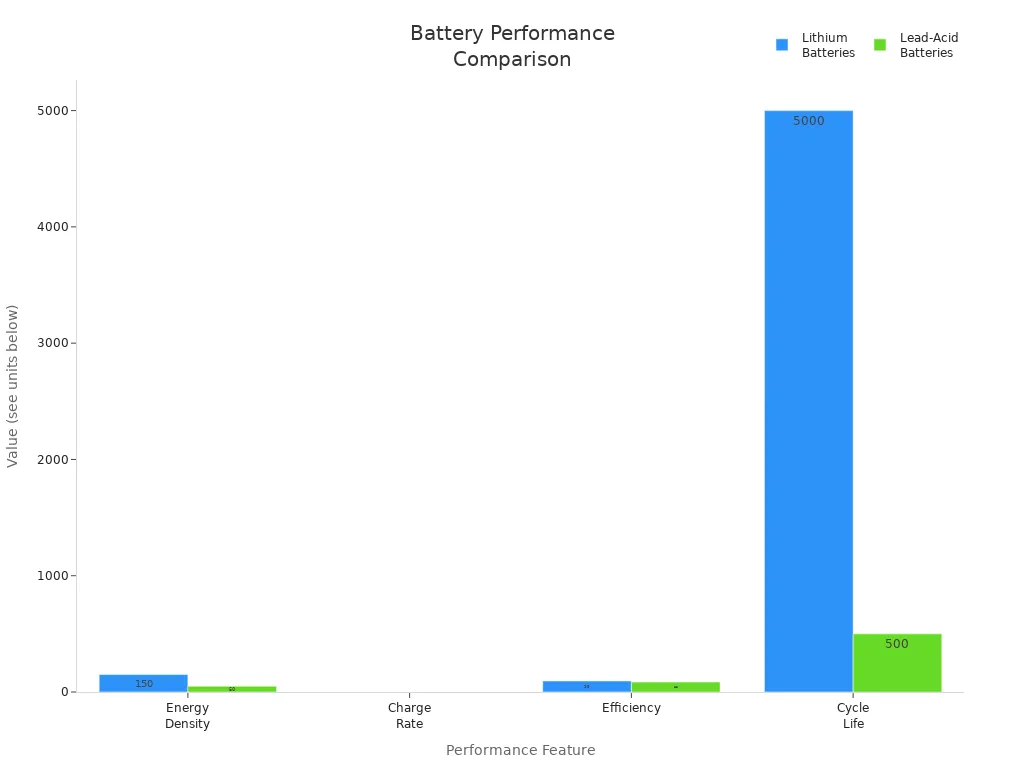
You see that lithium batteries, such as LiFePO4 (lithium iron phosphate), NMC (nickel manganese cobalt oxide), LCO (lithium cobalt oxide), and LMO (lithium manganese oxide), deliver higher energy density and longer cycle life. These chemistries support platform voltages from 3.2V (LiFePO4) to 3.7V (NMC, LCO, LMO), which enables compact and lightweight designs. Lead-acid batteries, by contrast, offer lower energy density and require frequent maintenance, especially in outdoor environments.
Temperature tolerance also plays a critical role. Lithium-ion batteries maintain cycle life at high temperatures, up to 55°C (131°F), and retain more capacity in cold weather. Lead-acid batteries lose performance in both hot and cold conditions. The following tables summarize these differences:
Battery Type | Cycle Life (Cycles) |
|---|---|
Lithium-Ion | 2,000 – 5,000+ |
Lead-Acid | 300 – 500 |
Battery Type | High Temperature Performance | Low Temperature Performance |
|---|---|---|
Lithium-Ion | Maintains better cycle life | Maintains more capacity |
Lead-Acid | Decreased performance | Decreased performance |
Note: Lithium batteries require less maintenance and provide more reliable power for critical applications in security, medical, robotics, and industrial sectors.
3.2 Lithium Battery Advantages
Lithium battery packs give you several advantages for outdoor security and surveillance. You benefit from long runtime, reliable performance, and enhanced safety features. The table below outlines key benefits:
Advantage | Description |
|---|---|
Long Runtime | Ensures prolonged operation for outdoor monitoring equipment. |
Reliable Performance | Maintains consistent functionality in harsh environments. |
Safety | Built with features to enhance safety during operation in extreme conditions. |
You can rely on lithium batteries engineered for extreme temperatures, from -40°C to +85°C. Manufacturers use robust steel casings and advanced battery management systems (BMS) to protect against overcharge, short circuit, and thermal runaway. High energy density and a stable discharge curve allow you to deploy compact, lightweight devices that run longer between charges.
Lithium batteries deliver ultra-long endurance, which reduces maintenance frequency.
Wide temperature range ensures reliable operation in extreme conditions.
High energy density supports compact and lightweight designs.
Robust construction and advanced BMS improve safety and prevent failures.
For example, the HL18650V lithium battery meets the demands of outdoor surveillance. It maintains ionic conductivity in cold weather and prevents thermal runaway in heat. This reliability is essential for continuous monitoring in security, infrastructure, and industrial applications.
Tip: Choose lithium battery packs with certifications such as UL, IEC, and CE to ensure compliance with safety and quality standards.
3.3 Solar Battery Integration
Solar battery integration increases the autonomy and sustainability of your Outdoor Security System. Modern solar-powered security cameras use advanced lithium-ion batteries, which provide high energy density and long cycle life. This setup ensures continuous operation, even during extended periods without sunlight.
Solar-powered systems reduce operational costs by lowering energy bills and minimizing maintenance. They are designed for outdoor use, with durable construction that withstands rain, snow, and temperature extremes. These systems also provide reliable security during power outages, making them ideal for remote or off-grid locations.
When you install a solar battery system, follow these best practices:
Securely mount the battery to prevent movement, especially in areas with vibration.
Use appropriate mounting brackets and fasteners for stability.
Make careful electrical connections with cables of the correct gauge to avoid voltage drops.
Install a charge controller to manage charging and prevent battery damage.
Match the voltage and current ratings of the battery with those of the solar panels and security cameras.
The integration of solar battery systems allows your security solution to function independently from the electrical grid. This energy independence enhances reliability and supports your sustainability goals. You also reduce costs associated with traditional power sources and avoid disruptions caused by grid outages.
Note: Solar battery integration not only improves system autonomy but also aligns with responsible sourcing and sustainability initiatives. For more information, see sustainability and conflict minerals.
Part4: Key Battery Pack Features
4.1 Capacity and Discharge
You need battery packs with enough capacity to support continuous operation and handle peak loads from high-definition cameras and infrared illuminators. A stable discharge curve ensures your system receives consistent voltage, which prevents malfunctions during critical moments. Lithium chemistries like LiFePO4, NMC, LCO, and LMO offer high energy density (over 150 Wh/kg) and long cycle life (2,000–5,000+ cycles), making them ideal for outdoor security, medical, and industrial applications.
Choose batteries that maintain performance in both extreme heat and cold.
Select packs with a stable discharge profile to avoid voltage drops.
Ensure capacity matches your system’s runtime and peak demand requirements.
Tip: Always size your battery packs for the highest expected load to guarantee reliability.
4.2 Weatherproofing and IP Rating
You must protect your battery packs from dust, water, and harsh weather. IP ratings give you a standardized way to measure enclosure protection. The first digit shows resistance to solid objects (0–6), and the second digit shows moisture protection (0–9K). Higher IP ratings mean better weatherproofing, which is essential for outdoor security systems.
Look for IP65 or higher for strong dust and water resistance.
Match the IP rating to your deployment environment.
Use enclosures with UV-resistant materials for long-term durability.
Note: Proper weatherproofing ensures your lithium battery packs remain operational in all conditions.
4.3 Safety and Cell Layout
You must prioritize safety in your battery pack design. Reliable lithium packs use robust cell layouts and comply with strict industry standards. Multi-level protection mechanisms, such as overcurrent, overvoltage, and thermal safeguards, are essential. Advanced Battery Management Systems (BMS) monitor and balance cells, preventing failures and extending battery life.
Safety Feature | Description |
|---|---|
Reliability | Delivers consistent output in harsh environments. |
Environmental Adaptability | Operates across wide temperature ranges. |
Adherence to Safety Standards | Meets industry certifications for security devices. |
Multi-level Protection Mechanisms | Includes BMS, thermal, and electrical safeguards. |
4.4 Smart Monitoring
Smart monitoring technology gives you real-time insights into battery performance. You can detect issues early and schedule predictive maintenance, which reduces emergency repairs and extends battery lifespan. Analytics optimize charging cycles, improving reliability and lowering costs.
Benefit | Description |
|---|---|
Real-time monitoring | Immediate performance data for quick decisions. |
Predictive maintenance | Early alerts prevent failures and downtime. |
Performance optimization | Analytics adjust charging for longer battery life. |
Reduced maintenance costs | Fewer emergency repairs and replacements. |
Improved reliability | Consistent operation for critical security systems. |
Smart monitoring can cut maintenance costs by 20–30% and boost battery lifespan by up to 25%.
Part5: Installation Best Practices
5.1 Placement and Mounting
You need to plan the placement of your lithium battery packs and security devices carefully. Proper placement maximizes battery life and ensures reliable operation.
Position solar-powered devices in areas with direct sunlight.
Avoid locations where shadows from roofs, trees, or bushes block sunlight.
Choose mounting sites that offer easy access for maintenance and inspection.
Consider electrical access when selecting camera positions, as this affects installation options and ongoing maintenance needs.
Tip: Secure mounting brackets and fasteners prevent vibration and movement, which protects battery packs from physical damage.
5.2 Environmental Protection
You must protect your battery packs from harsh environmental conditions. Weatherproof enclosures with high IP ratings shield lithium batteries from dust, moisture, and temperature extremes.
Use IP65 or higher enclosures for strong resistance to water and dust.
Select UV-resistant materials to prevent degradation from sunlight exposure.
Install drainage systems to avoid water accumulation inside enclosures.
Protection Feature | Benefit |
|---|---|
IP-rated enclosure | Shields against dust and water |
UV-resistant casing | Prevents sun damage |
Drainage system | Reduces risk of water ingress |
Note: Environmental protection extends battery life and reduces maintenance frequency in security, medical, and industrial applications.
5.3 System Integration
You improve security effectiveness and operational efficiency by integrating your battery packs with the broader security system. Centralized management allows real-time data sharing among cameras, sensors, and access control devices.
Integrated systems enable access control to share information with cameras, triggering alerts and lockdowns automatically.
Data correlation across multiple devices increases the likelihood of detecting and responding to threats.
Organizations with integrated security systems report measurable improvements in performance.
Physical property crime causes $15.8 billion in annual losses. In 2022, 39% of business leaders experienced significant security breaches. You can reduce these risks by deploying lithium battery packs with advanced battery management systems (BMS) and integrating them with your security infrastructure.
Smart integration leads to faster response times and enhances reliability for critical applications in security, robotics, and industrial sectors.
Part6: Cost and Value
6.1 Initial vs. Long-Term Cost
You need to consider both the initial investment and the long-term expenses when selecting battery packs for outdoor security systems. Lithium battery packs, such as LiFePO4, NMC, LCO, and LMO, often cost more upfront than lead-acid batteries. However, you benefit from lower maintenance costs and fewer replacements over time. The table below shows a typical cost comparison for a 10-year period:
Battery Type | Initial Cost | Annual Maintenance | Replacement Cycle | 10-Year Total Cost |
|---|---|---|---|---|
Lead Acid | $4,800 | $200 | 3 years | $16,400 |
Lithium | $9,800 | $50 | 10 years | $9,300 |
You see that lithium batteries require less frequent replacement. Lead-acid batteries usually last 3–4 years, while lithium-ion batteries can last 5 years or more. Fewer replacements mean you save money and reduce downtime.
6.2 Maintenance Planning
You must plan for ongoing maintenance to keep your security system running smoothly. Lithium battery packs need less maintenance than lead-acid batteries. You spend less time and money on routine checks, cleaning, and replacements. Smart monitoring systems help you track battery health and schedule predictive maintenance. This approach prevents unexpected failures and extends battery life.
Lithium batteries reduce maintenance frequency.
Smart monitoring tools alert you to potential issues.
Predictive maintenance lowers emergency repair costs.
Regular maintenance planning improves reliability for security, medical, robotics, and industrial applications.
6.3 Total Cost of Ownership
You need to look beyond the initial price and consider the total cost of ownership. Lithium battery packs offer higher energy density, longer cycle life, and stable platform voltage. These features support continuous operation and reduce replacement costs. You gain value from fewer disruptions, lower maintenance, and improved system uptime.
Fewer replacements lower overall expenses.
Longer battery life increases operational efficiency.
Stable performance reduces risk in critical applications.
Investing in lithium battery packs gives you long-term savings and reliable power for outdoor security systems.
Part7: Maintenance and Stability
7.1 Routine Inspection
You need to schedule routine inspections for your outdoor security system battery packs. Regular checks help you spot early signs of wear or damage. Inspect battery terminals for corrosion. Clean connectors to maintain strong electrical contact. Examine enclosures for cracks or leaks. Check for dust buildup inside the housing. Dust can block cooling vents and cause overheating. Use a checklist to track inspection tasks.
Tip: Set a monthly inspection schedule. Document findings and address issues promptly.
7.2 Failure Prevention
You can prevent most failures by understanding common risk factors. Outdoor lithium battery packs face several threats:
Mechanical damage can cause internal short circuits. Protect battery packs from impacts and vibration by using sturdy mounting brackets.
Electrical abuse, such as overcharging or deep discharging, generates excessive heat. Install advanced battery management systems (BMS) to monitor voltage and current.
Thermal stress from high temperatures can trigger thermal runaway. Use IP-rated enclosures with UV-resistant materials to shield batteries from sunlight.
Manufacturing defects may lead to internal short circuits. Choose battery packs from reputable suppliers with UL, IEC, and CE certifications.
Failure Point | Prevention Strategy |
|---|---|
Mechanical Damage | Secure mounting, shock-resistant housing |
Electrical Abuse | BMS, voltage/current monitoring |
Thermal Stress | Weatherproof, UV-resistant enclosures |
Manufacturing Defects | Certified suppliers, quality assurance |
Note: Smart monitoring systems alert you to abnormal conditions, allowing you to act before failures occur.
7.3 Upgrades and Future-Proofing
You should plan for upgrades to keep your security system stable and efficient. Lithium battery packs, such as LiFePO4, NMC, LCO, and LMO, offer high energy density (over 150 Wh/kg) and long cycle life (2,000–5,000+ cycles). When technology advances, consider replacing older packs with newer models that support better performance and longer runtime. Integrate smart monitoring tools for predictive maintenance.
Upgrading your battery packs ensures reliable operation in security, medical, robotics, and industrial applications. Future-proofing your system reduces downtime and supports continuous mission-critical operations.
You can design stable power for outdoor security systems by following these steps:
Choose lithium battery packs (LiFePO4, NMC, LCO, LMO) with high energy density, platform voltage, and long cycle life.
Integrate a UPS for backup and reliability.
Install with weatherproofing and smart monitoring.
Schedule routine maintenance and plan for upgrades.
For B2B clients: Contact a certified supplier for custom solutions in security, medical, robotics, and industrial sectors.
FAQ
What lithium battery chemistry works best for outdoor security systems?
You should choose LiFePO4 for outdoor security systems. It offers a platform voltage of 3.2V, energy density over 150 Wh/kg, and a cycle life of 2,000–5,000+ cycles. This chemistry performs well in harsh environments and supports long-term reliability.
How do you ensure lithium battery packs remain safe in extreme weather?
You must use IP65 or higher enclosures, UV-resistant materials, and advanced Battery Management Systems (BMS). These features protect against dust, moisture, and temperature swings. Regular inspections and smart monitoring further reduce risk.
Can you integrate solar charging with lithium battery packs?
Yes. You can pair lithium battery packs with solar panels and charge controllers. This setup supports off-grid operation for security, medical, and industrial applications. Solar integration reduces operational costs and increases system autonomy.
How often should you replace lithium battery packs in critical systems?
You should expect lithium battery packs (LiFePO4, NMC, LCO, LMO) to last 5–10 years, depending on cycle life and usage. Regular monitoring and predictive maintenance help you maximize lifespan and avoid unexpected downtime.
What industries benefit most from advanced lithium battery packs?
You see strong benefits in security, medical, robotics, infrastructure, and industrial sectors. Lithium battery packs deliver stable power, high energy density, and long cycle life. These features support continuous operation in demanding environments.


