

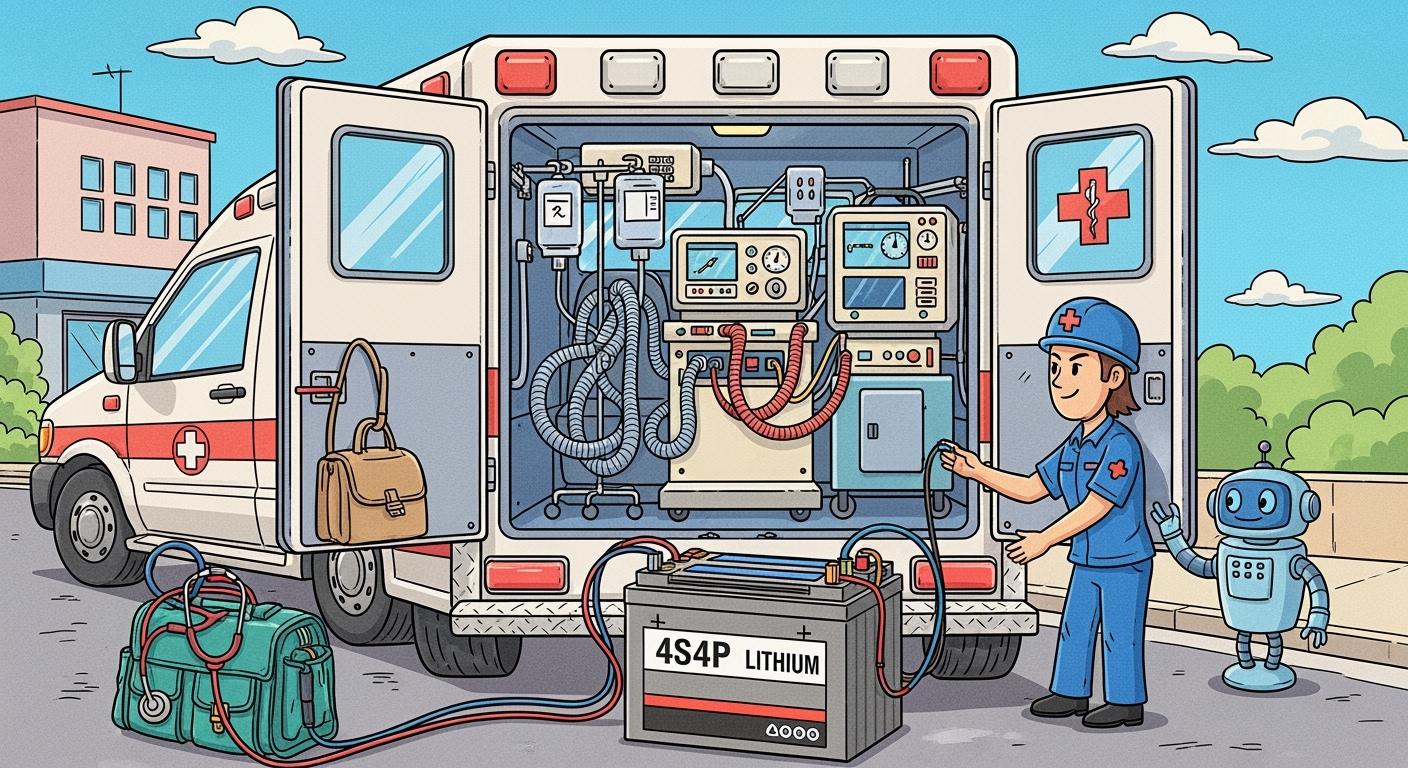
You need a power solution that delivers when every second counts. A 4S4P lithium battery backup solution gives ambulance ventilation equipment stable, lightweight, and high-performance energy. This reliable backup power ensures longer runtime and increased safety, helping you provide uninterrupted care during medical emergencies.
Key Takeaways
The 4S4P lithium battery provides reliable power for ambulance ventilation equipment, ensuring uninterrupted care during emergencies.
This battery design is lightweight and compact, allowing for easy installation and reducing physical strain on medical staff.
Advanced safety features, including a Battery Management System, protect against overcharging and enhance operational reliability.
Part1: 4S4P Lithium Battery Overview

1.1 Configuration & Voltage
You need to understand how a 4S4P lithium battery works to appreciate its value in emergency medical equipment. The “4S4P” label means four cells connect in series, and four of these series groups connect in parallel. This design boosts both voltage and capacity, giving you a reliable power source for demanding applications.
Here is a simple breakdown:
Configuration | Description | Effect on Voltage | Effect on Capacity |
|---|---|---|---|
4S | Four cells in series | Increases total voltage | — |
4P | Four groups in parallel | — | Increases total capacity |
A typical lithium battery cell provides about 3.7V. When you connect four cells in series (4S), you get a nominal voltage of 14.8V (4 x 3.7V). By adding four parallel groups (4P), you multiply the total capacity by four. This means you can power medical devices longer without increasing the battery’s size or weight.
1.2 Role in Ambulance Ventilators
You face high-stress situations in the field. Your equipment must perform without fail. The 4S4P lithium battery configuration gives you the voltage and capacity needed for advanced ambulance ventilators. This setup ensures stable operation during patient transport, even if the main power supply fails.
You benefit from a lightweight and compact battery pack that does not add unnecessary bulk to your ambulance. The high energy density of a lithium battery means you get more runtime in a smaller package. This is critical when every minute counts for patient care. You can trust this backup solution to deliver consistent power, supporting life-saving ventilation equipment when you need it most.
Tip: Always check that your lithium battery pack matches the voltage and capacity requirements of your specific ventilator model for optimal performance.
Part2: Lithium Battery Benefits & Features

2.1 Reliability & Runtime
You need a power source you can trust during ambulance transport. A lithium battery in a 4S4P configuration provides reliable power output. This ensures your ventilation equipment works without interruption, even when the main power supply fails. You can count on a low self-discharge rate, which means the battery stays charged and ready for emergencies. You do not need to recharge it frequently, so your team can focus on patient care instead of battery maintenance.
Here is how these features support patient care:
Feature | Benefit to Patient Care |
|---|---|
Reliable Power Output | Ensures continuous operation of medical devices, crucial for monitoring and treatment during transport. |
Low Self-Discharge Rate | Retains charge for extended periods, ensuring readiness for emergency use without frequent recharging. |
Minimal Maintenance Requirements | Reduces the burden on medical staff, allowing them to focus on patient care rather than battery upkeep. |
Advanced Safety Features | Protects against overcharging and short circuits, enhancing safety for patients and medical personnel. |
Extended Lifespan and Durability | Contributes to operational efficiency and reliability of medical equipment, ensuring uninterrupted patient care. |
You improve patient outcomes by using a lithium battery backup solution that delivers consistent performance in critical moments.
2.2 Lightweight & Portability
You operate in a fast-paced environment where every second matters. The lithium battery offers high energy density, so you get more power in a smaller, lighter package. You can move and install the battery with ease, which is essential in the limited space of an ambulance. The lightweight design reduces the overall load, making it easier for your team to handle equipment during emergencies.
You benefit from:
Quick installation and removal
Less physical strain on staff
More space for other essential medical devices
This portability ensures your ventilation equipment remains flexible and ready for rapid deployment.
2.3 Safety & BMS Integration
You must prioritize safety when using batteries in medical devices. The 4S4P lithium battery includes a Battery Management System (BMS) that protects against overcharging, over-discharging, and short circuits. The BMS uses advanced integrated circuits (ICs: SH366006 + SH367202) and meets strict international standards.
Feature | Details |
|---|---|
Includes Safety Protections? | Yes |
BMS Details | ICs: SH366006 + SH367202 |
Compliance Standards | IEC 62133-2:2017, EC 62133-2:2017/AMD1:2021, EN 62133-2:2017+A1:2021, BS EN 621332:2017+A1:2021 |
You can trust that your lithium battery meets the highest safety requirements for medical use. The BMS also extends battery life and ensures stable operation. For more details on BMS technology, see our Battery Management System (BMS) solutions.
Note: Always verify that your battery system complies with standards like UN 38.3, IEC 62133, and UL 2054 for safe operation in medical environments.
2.4 Compatibility & Fast Charging
You need a backup solution that works with a wide range of ventilator models. The 4S4P lithium battery offers broad compatibility, so you can integrate it with most ambulance ventilation equipment. Fast charging capability means you can recharge the battery quickly between calls, reducing downtime and keeping your equipment ready for the next emergency.
Key compliance certifications include:
UN 38.3
IEC 62133
UL 2054
MSDS
You ensure operational efficiency and safety by choosing a lithium battery that meets these international standards. Fast charging and compatibility help you maintain a high level of readiness for patient care during ambulance transport. For more information on medical battery applications, visit our medical battery solutions.
You meet critical ambulance ventilation needs with a Lithium Battery backup solution.
You gain extended runtime, lightweight design, and advanced safety features.
You improve operational reliability and patient care.
You should consider this technology for your fleet to enhance emergency readiness.
FAQ
What lithium battery chemistries can you select for ambulance ventilator backup?
You can choose NMC. See the table below for key specifications.
Chemistry | Platform Voltage (V) | Energy Density (Wh/kg) | Cycle Life (cycles) |
|---|---|---|---|
LiFePO4 | 3.2 | 100–180 | 2000–5000 |
NMC | 3.7 | 160–270 | 1000–2000 |
LCO | 3.7 | 180–230 | 500–1000 |
LMO | 3.7 | 120–170 | 300–700 |
LTO | 2.4 | 60–90 | 10000–20000 |
How do you request a custom lithium battery pack from Large Power?
You can click here for a custom battery consultation. Large Power engineers will help you design a solution for your ambulance equipment.
Why should you choose Large Power for your ambulance lithium battery backup?
You receive certified, reliable lithium battery packs tailored for medical use. Large Power ensures compliance, safety, and performance for your critical ambulance ventilation needs.


