

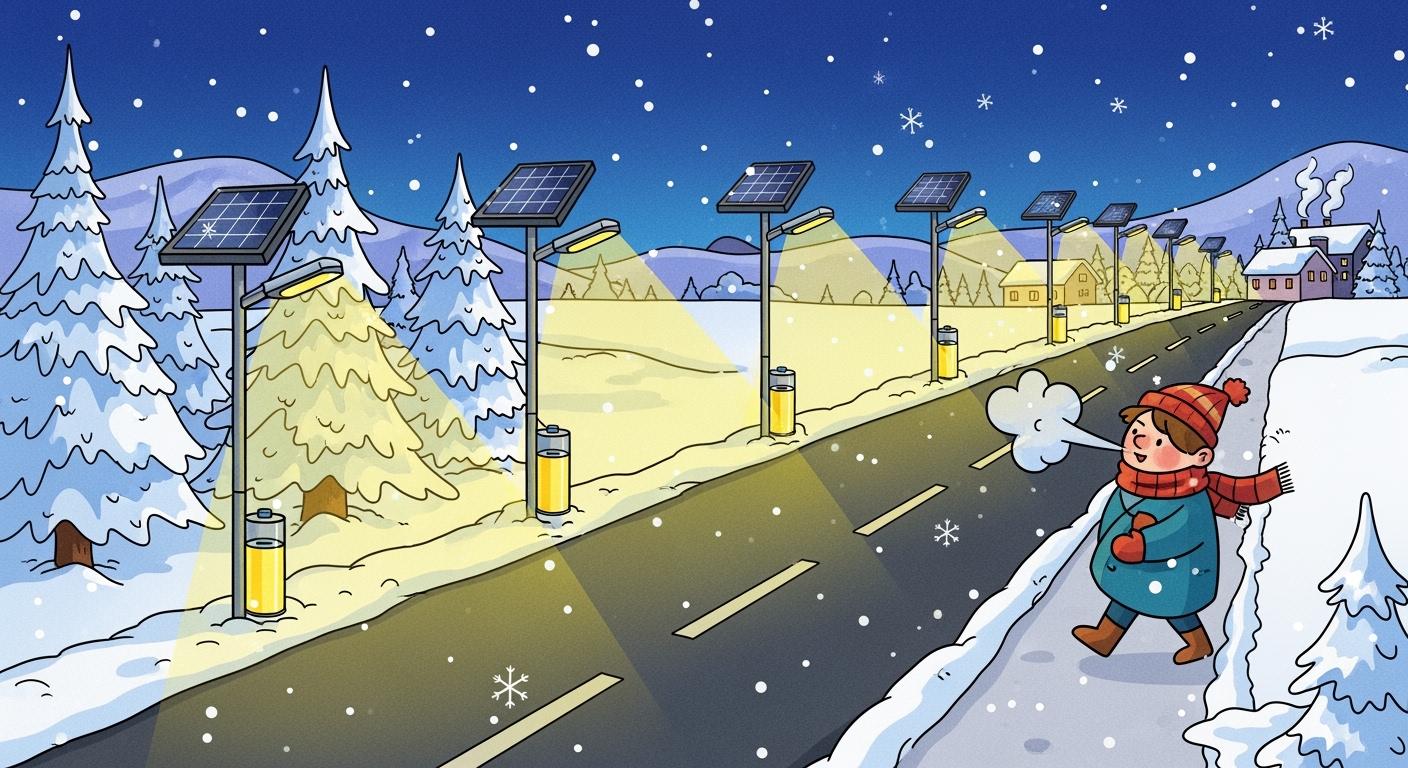
You need reliable energy storage to keep solar street lights working in cold climates. Solar street light battery performance drops when temperatures fall below freezing. LiFePO4 and NMC lithium batteries offer better storage and reliability than older options. When batteries fail, streets and paths become dark, increasing accident risks. Solar street lights maintain visibility and safety even when traditional power sources cannot. Choosing the right battery ensures consistent lighting and protects public spaces during harsh winter conditions.
Key Takeaways
Choose LiFePO4 or NMC batteries for solar street lights in cold climates. These batteries perform better than lead-acid options, ensuring reliable lighting even in freezing temperatures.
Implement thermal management solutions, such as insulation and heating systems, to protect batteries from extreme cold. This helps maintain performance and extends battery life.
Regularly monitor battery performance and temperature. Use a battery management system to prevent charging at low temperatures and avoid potential damage.
Follow best installation practices by placing battery enclosures in sheltered locations. Insulated boxes or underground placements help maintain stable temperatures.
Conduct routine maintenance checks to ensure battery connections are secure and clean. This prevents corrosion and maximizes energy efficiency.
Part1: Cold Weather Performance Challenges For Solar Street Light Batteries
1.1 Effects Of Low Temperatures On Batteries
You face several challenges when you operate solar street light battery systems in cold climates. Low temperature changes the way batteries work. When the temperature drops below freezing, the chemical reactions inside lithium batteries slow down. This reduces power output and efficiency. You also see the movement of ions decrease, which limits energy storage and delivery.
Slowed chemical reactions make it harder for batteries to provide steady power.
Irreversible damage can occur if batteries stay cold for long periods. Internal parts contract and block electron transfer.
Lithium dendrites may form in cold conditions. These can puncture the battery diaphragm and cause failure.
Cold weather performance drops because the electrolyte inside batteries becomes thicker. At -10°C, the viscosity can increase up to four times. This spike in internal resistance slows ion movement and reduces available capacity.
1.2 Capacity And Lifespan Reduction
You notice a steep decline in battery capacity as temperature falls. At -10°C, LiFePO4 batteries deliver about 70% of their rated capacity. At -20°C, this drops to 50%. Standard lithium batteries provide around 80% capacity at -10°C and 60% at -20°C. The runtime of solar street lights shortens as a result.
Battery Type | Impact in Cold Weather |
|---|---|
Lead-Acid | Reduced capacity |
Lithium-Ion | Performance drops |
Cold weather performance also affects battery lifespan. Prolonged exposure to freezing temperatures can cause permanent damage, especially if batteries remain idle.
1.3 Common Battery Failure Modes
You must watch for common failure modes in cold climates. Increased internal resistance leads to energy loss and reduced storage. Formation of lithium dendrites can puncture the battery diaphragm, causing sudden failure. Irreversible damage from contraction of internal components can shorten battery life. These issues make it essential to choose the right solar street light battery and manage temperature for reliable operation.
Tip: Always monitor battery temperature and performance to prevent unexpected failures and maximize storage efficiency.
Part2: Best Battery Technologies For Solar Street Light In Cold Climates
Choosing the best batteries for solar lights in cold climates requires you to understand how different chemistries perform when temperatures drop. Not all batteries can handle freezing conditions. You need to select a solar street light battery that delivers reliable storage, stable performance, and minimal maintenance, even in harsh winter weather.
2.1 LiFePO4 Battery Advantages
LiFePO4 (lithium iron phosphate) batteries stand out as the top choice for solar street light battery systems in cold climates. You benefit from their ability to retain capacity and deliver steady voltage, even when temperatures fall below -10°C. These batteries can operate reliably down to -20°C, making them ideal for outdoor solar lighting systems in regions with severe winters.
LiFePO4 batteries maintain better stability in cold weather.
They provide consistent voltage output, which keeps your solar street light shining bright.
Enhanced safety features make them reliable for cold-weather applications.
You get superior capacity retention with LiFePO4 batteries. This means your solar street light will have stable power for longer periods, even during long, cold nights. These batteries also offer a long cycle life, often reaching 2,000 to 7,000 cycles, which reduces replacement costs and ensures your solar lighting systems remain maintenance-free for years.
Note: LiFePO4 batteries are maintenance-free batteries, so you spend less time and money on upkeep.
Battery Type | Discharge Efficiency in Cold | Capacity Retention | Safety Features |
|---|---|---|---|
LiFePO4 | Efficient at -10°C | High | Excellent |
Gel Lead-Acid | Poor in cold | Low | Moderate |
2.2 NMC Lithium Batteries
NMC (Nickel Manganese Cobalt) batteries, also serve as a strong option for solar street light battery storage. You will find that these batteries perform better than lead-acid batteries in cold weather, though they do not match the cold-weather stability of LiFePO4. NMC batteries offer high energy density, which means you can store more energy in a smaller space. This feature is useful for compact solar lighting systems.
NMC batteries typically provide 500 to 1,000 cycles, which is less than LiFePO4 but still suitable for many solar street light projects. They also require less maintenance than traditional batteries, making them a good choice if you want maintenance-free batteries for your solar applications.
Tip: Always use a battery management system (BMS) with NMC batteries to prevent charging at low temperatures and protect your investment.
2.3 Comparison With Lead Acid And Other Batteries
Lead-acid batteries, including gel types, have been used in solar street light systems for years. However, you will notice a sharp decline in their performance and usable capacity when temperatures drop. These batteries lose efficiency quickly in cold weather and require more frequent maintenance, which increases your operational costs.
When you compare the best batteries for solar lights, LiFePO4 and NMC batteries clearly outperform lead-acid options in cold climates. Both lithium chemistries offer longer cycle life, higher energy density, and require less maintenance. This makes them the preferred maintenance-free batteries for solar lighting systems in challenging environments.
Battery Chemistry | Platform Voltage | Energy Density (Wh/kg) | Cycle Life (cycles) | Cold Weather Performance | Maintenance Needs |
|---|---|---|---|---|---|
LiFePO4 | 3.2V | 90-120 | 2,000-7,000 | Excellent | Minimal |
NMC | 3.7V | 150-220 | 500-1,000 | Good | Minimal |
Gel Lead-Acid | 2.0V | 30-50 | ~1,000 | Poor | High |
LiFePO4 batteries maintain better performance in cold weather compared to lead-acid batteries.
Lead-acid batteries experience significant capacity loss in low temperatures.
NMC batteries perform better than lead-acid in cold conditions but have a shorter cycle life than LiFePO4.
For solar street light battery systems in cold climates, you should always consider batteries designed for low-temperature operation. Use insulated enclosures and a BMS to further protect your investment. Maintenance-free batteries like LiFePO4 and NMC reduce downtime and ensure your solar lighting systems stay bright and reliable, even in freezing weather.
Part3: Key Features For Solar Street Light Battery Systems In Cold Weather
3.1 Heating Systems And Thermal Management
You need to address heating and thermal regulation solutions to keep batteries operating in freezing temperatures. When the temperature drops, the chemical reactions inside lithium battery packs slow down, which reduces energy storage capacity and overall performance. To solve this, many solar street light systems use built-in heating systems and intelligent temperature control modules.
High-quality solar street lights use thermal insulation to shield the battery from extreme cold.
An intelligent temperature control module activates heating when the temperature falls below a set point. This keeps the battery within its optimal range and prevents charging challenges.
Real-time monitoring of battery charge helps prevent over-discharge, which can cause freeze damage and reduce storage life.
Heating systems often rely on low-power heating pads or flexible heaters placed near the battery cells. These systems only turn on when needed, which saves energy and extends battery life. You can also use temperature compensation charging to adjust the charging process based on the battery’s temperature, further protecting the battery from damage.
Tip: Always select a solar street light system with an integrated heating solution if you expect regular sub-zero temperatures. This will help you maintain reliable energy storage and lighting even during harsh winters.
3.2 Insulation And Enclosure Design
Proper insulation and enclosure design play a key role in protecting batteries from cold weather. The right materials and construction methods help maintain a stable internal temperature, which supports battery performance and extends storage life.
Material | Properties | Fire Resistance | Weather Resistance |
|---|---|---|---|
Rock Wool | Made from steel production slag, very safe, does not catch fire easily. | High | Good |
Mineral Wool | Made from various minerals, virtually non-flammable. | High | Good |
Pink Foam Board | Fire retardant, resistant to weather and molds, commonly used in pools. | Moderate | Excellent |
Polyiso Board | Effective insulation, used around batteries for thermal protection. | High | Good |
You can combine insulation materials for the best results. For example:
Use half an inch of XPS foam board on the outside of the enclosure.
Add polyiso board for extra thickness and thermal protection.
Seal any gaps with spray foam to create a well-insulated, weatherproof enclosure.
The design of the enclosure itself also matters. Modern solar street light systems often integrate LiFePO4 batteries into weather-resistant, insulated boxes. Some installations bury the battery underground, which uses the earth’s natural insulation to keep the battery above freezing. This approach helps maintain stable storage temperatures and prevents freeze-related failures.
3.3 Battery Management Systems (BMS)
A battery management system (BMS) is essential for safe and reliable operation of lithium battery packs in cold climates. The BMS monitors the battery’s state of charge, voltage, and temperature. It prevents charging at low temperatures, which protects the battery from damage and extends its lifespan.
The BMS blocks charging below 0°C to prevent issues like lithium plating, a common failure mode in cold weather.
It adjusts the charge current in high temperatures to maintain battery health.
Advanced BMS solutions use smart energy management to optimize battery performance based on temperature and sunlight.
Low-temperature charging protection is a key feature in modern BMS designs. This function reduces the charge current in cold weather, which helps prevent internal damage and supports long-term storage reliability. You will also find temperature sensors and real-time monitoring in advanced BMS units, which further improve safety and performance.
Battery management systems are not only used in solar lighting. You see them in medical devices, robotics, security systems, infrastructure, consumer electronics, and industrial applications. These systems ensure that lithium battery packs deliver consistent energy storage and performance, even in challenging environments.
By combining heating systems, proper insulation, and advanced BMS technology, you can maximize the energy storage capacity and reliability of your solar street light batteries. These features work together to maintain stable operation and protect your investment in cold climates.
Part4: Installation And Maintenance For Solar Street Light Batteries In Cold Climates
4.1 Optimal Placement And Wiring
You can improve battery performance and storage reliability in cold climate installations by following best practices during installation. Place the battery enclosure in a location shielded from direct wind and extreme cold. Use insulated boxes or underground placements to help maintain a stable temperature. Always add insulation beneath the batteries to prevent cold from the ground affecting storage.
Inspect all battery connections and cables for tightness and corrosion.
Use weather-resistant wiring and seal all entry points to prevent water ingress after snow or rain.
Consult with a trusted professional to ensure proper installation and protection from cold weather.
Monitor battery temperature with a thermometer and adjust insulation as needed.
Tip: Insulated enclosures and careful placement help you avoid deep discharge and maintain steady solar street light operation.
4.2 Routine Maintenance And Checks
Routine maintenance keeps your battery system running smoothly and extends its lifespan. You should check and balance battery levels regularly to prevent deep discharge, which reduces capacity and storage performance. Inspect battery connections and cables for rust or grime buildup. Clean terminals to prevent corrosion and ensure efficient power flow.
Check battery voltage every month.
Use a trickle charger if voltage drops below recommended levels.
Ensure proper ventilation in the battery housing to avoid overheating during charging.
Add insulation if the battery is not in a climate-controlled space.
Note: Batteries designed for cold weather, such as LiFePO4, require less maintenance but still benefit from regular checks.
4.3 Monitoring And Diagnostics
Monitoring systems help you detect battery issues early and prevent unexpected failures. Remote diagnostics provide real-time access to system status, including voltages, currents, and charging state. You can receive automatic alerts for problems like battery failure or panel faults. This technology allows you to optimize performance and adjust lighting schedules without physical inspections.
Monitor charging and discharging patterns to spot early signs of battery degradation.
Replace batteries that show reduced capacity or physical damage.
Store spare batteries in a cool, dry place to maintain storage quality.
Regular monitoring and remote diagnostics help you maintain reliable solar street light operation in cold climates.
Part5: Real-World Solar Street Light Battery Case Studies In Cold Weather
5.1 Successful Deployments
You can find many examples of solar street light systems operating reliably in cold climates. Here are some notable deployments:
In Romania, 737 solar street lights use LiFePO4 batteries. These units deliver stable lighting with minimal maintenance, even as temperatures fluctuate through harsh winters. The batteries are expected to last over a decade.
In the northern UK, LiFePO4 batteries power solar street lights that maintain efficiency during sub-zero nights. Their performance has influenced technical approvals for new solar installations in the region.
In rural Russia, engineers faced extreme cold down to -30°C. They overcame this by adding insulation and heating components to the battery casing. This approach kept the lights running and extended battery service life.
In Ukraine, urban parks needed reliable lighting during winters with temperatures below -15°C. The solar streetlights were designed to function efficiently at -20°C, preventing capacity loss and ensuring public safety.
These projects show that you can achieve dependable lighting in cold climates by selecting the right battery technology and system design. The same principles apply to other industries, such as security systems, infrastructure, and industrial sites, where lithium battery packs must operate in freezing conditions.
5.2 Performance Data And Lessons Learned
Field data confirms that specialized cold-resistant batteries like LiFePO4 outperform standard options in low temperatures. For example, in Minnesota, LiFePO4 batteries in solar systems continue to discharge efficiently below -10°C, though charging below 0°C requires careful management. Lead-acid batteries, by contrast, lose much of their capacity below freezing.
Battery Type | Cold Resistance Temperature Range | Low-Temperature Discharge Efficiency | Cycle Life |
|---|---|---|---|
LiFePO4 Battery | -20°C ~ 60°C (some models -40°C) | ≥85% | More than 2000 |
Lead-acid Battery | 0°C ~ 40°C | ≤50% below 0°C | 500–1000 |
From these deployments, you learn several key lessons:
High-quality batteries with low internal resistance can handle charging below freezing.
Keeping charge currents low improves cold-weather performance.
Designing with extra capacity ensures reliability during short winter days.
Proper enclosure and orientation help maximize thermal gain.
Advanced microcontrollers, such as nRF52-class, can further enhance system performance in cold environments.
Tip: Always use a battery management system to protect lithium battery packs and maintain stable operation in cold climates.
You ensure reliable solar street light operation in cold climates by choosing LiFePO4 or NMC lithium battery packs, using robust thermal management, and following best installation practices.
Select batteries with proven cold-weather performance and long cycle life.
Use insulated enclosures and advanced battery management systems.
Prioritize sustainability and avoid conflict minerals by reviewing our sustainability policy and conflict minerals statement.
Municipalities and facility managers should invest in solar solutions designed for harsh winter environments to protect public safety and maximize system longevity.
FAQ
What makes LiFePO4 batteries better for cold climates than lead-acid batteries?
You get higher capacity retention and longer cycle life with LiFePO4 batteries. These batteries work efficiently at temperatures as low as -20°C. Lead-acid batteries lose much of their capacity below freezing and require more maintenance. For custom battery solutions, contact Large Power.
Can you charge lithium batteries like NMC or LiFePO4 below 0°C?
You should avoid charging lithium batteries below 0°C. Charging at low temperatures can cause lithium plating, which damages the battery. Use a battery management system (BMS) to block charging when temperatures drop below freezing.
How does insulation improve battery performance in winter?
Insulation keeps your battery pack warmer by reducing heat loss. This helps maintain stable voltage and capacity. You can use materials like rock wool or polyiso board to protect batteries from extreme cold.
Do solar street light batteries need regular maintenance in cold weather?
You should check battery voltage and connections monthly. Even maintenance-free batteries like LiFePO4 benefit from routine inspections. Clean terminals and monitor temperature to prevent unexpected failures.
What is the typical cycle life of LiFePO4 and NMC batteries in solar street lights?
LiFePO4 batteries offer 2,000–7,000 cycles. NMC batteries provide 500–1,000 cycles. Both types outperform lead-acid batteries, which usually last about 1,000 cycles. You get longer service life and better reliability with lithium chemistries.


