

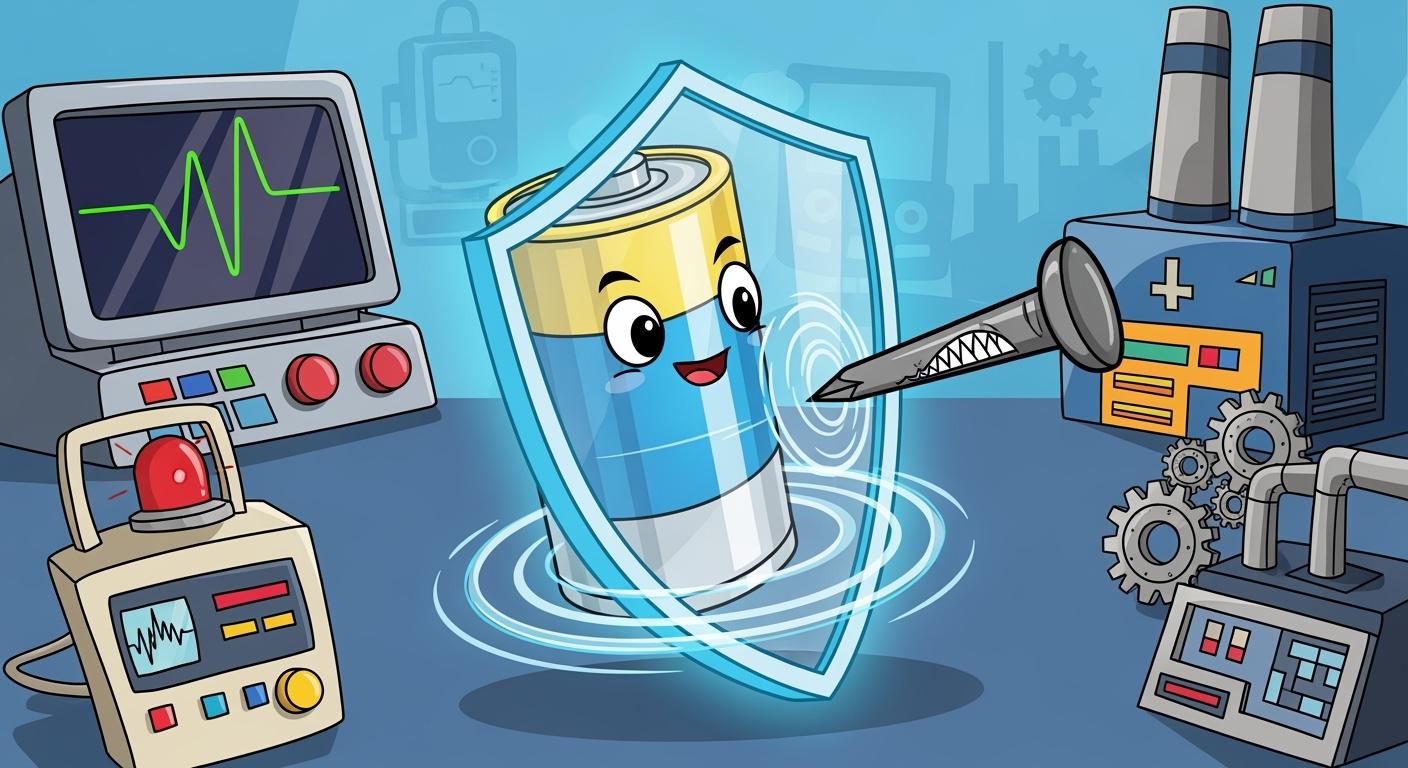
Imagine a hospital ventilator shutting down because of a sudden battery failure caused by internal short-circuit from a sharp object. You know the consequences could be severe. Nail penetration resistant battery technology gives you a solution by using multi-layered barriers that block ignition, stop heat from spreading, and prevent chemical reactions that lead to fires.
Safety Mechanism | Description |
|---|---|
Material Barrier | Non-flammable solid electrolyte eliminates primary ignition source |
Thermal Barrier | Low thermal conductivity prevents heat spread |
Chemical Barrier | High decomposition activation energy prevents runaway reactions |
Mechanical Barrier | Solid electrolyte physically constrains dendrite growth |
Electrochemical Barrier | Wide electrochemical stability window prevents decomposition |
You also benefit from advanced safety features in lithium battery packs:
Real-time cell voltage and temperature monitoring
Cell balancing for stable operation
Over-voltage and over-temperature protections
High-voltage interlock for safe maintenance
Pressure-relief to prevent explosions
Rugged design for vibration and shock resistance
By choosing this battery technology, you reduce downtime and protect your critical equipment.
Key Takeaways
Nail penetration resistant battery technology uses multiple barriers to prevent fires and short circuits, ensuring safety in critical equipment.
Choosing LiFePO4/LiFePO4 Lithium batteries offers high thermal stability, reducing the risk of fire during mechanical abuse.
Regularly monitor battery voltage and temperature to maintain safety and reliability in professional devices.
Select battery packs that meet rigorous nail penetration test standards to ensure they can withstand severe conditions.
Implement custom battery solutions to enhance safety and reduce downtime in industrial and medical applications.
Part1: Nail Penetration Resistant Battery Technology

1.1 Definition and Principles
You rely on battery technology that can withstand harsh conditions. Nail penetration resistant battery technology uses advanced materials and design strategies to prevent catastrophic failures when sharp objects pierce the battery. This approach protects your equipment from internal short circuits, fires, and thermal runaway.
The principles behind this technology focus on mechanical, thermal, and chemical barriers. Engineers use solid electrolytes, reinforced separators, and robust casing to block the spread of heat and prevent dangerous reactions. You see continuous improvements in testing standards, which push battery technology to higher levels of safety.
Nail Size | Key Developments | Implications for Battery Design |
|---|---|---|
3mm | Initial testing standard | Identified weak points in early designs, leading to improvements in battery chemistry and safety mechanisms. |
5mm | New standard for testing | Reflected challenges of modern applications, prompting innovations in separators and safety circuits. |
8mm | Current rigorous benchmark | Ensures advanced batteries withstand severe damage, driving advancements in materials and thermal management systems. |
You benefit from these rigorous standards because they ensure your lithium battery packs perform reliably in demanding environments.
1.2 Application in Lithium Battery Packs
You use nail penetration resistant battery technology in LiFePO4/LiFePO4 Lithium battery, NMC/NMC Lithium battery, LCO/LCO Lithium battery, and LMO/LMO Lithium battery packs. These chemistries offer different platform voltages, energy densities, and cycle lives. For example, LiFePO4/LiFePO4 Lithium battery packs provide a platform voltage of 3.2V, energy density of 90-160 Wh/kg, and cycle life exceeding 2000 cycles. NMC/NMC Lithium battery packs deliver higher energy density, up to 250 Wh/kg, and platform voltage of 3.7V.
You select the right chemistry based on your application needs. Nail penetration resistant battery technology enhances the safety profile of each chemistry. You gain confidence that your equipment will operate without interruption, even in industrial or medical settings where reliability is critical.
Tip: When you choose battery packs with nail penetration resistance, you reduce the risk of downtime and protect your investment in professional equipment.
Part2: Reliability in Professional Equipment
2.1 Risks of Battery Failure
You face several risks when battery failure occurs in professional electronic equipment. These risks can threaten both safety and operational reliability.
Heavy batteries can add weight to your devices, making them harder to handle and increasing the risk of mechanical stress.
Flammable solvents inside lithium batteries can ignite, causing fires or explosions if the battery is damaged or abused.
Batteries store significant electric charge, which can lead to electric shock if not managed properly.
Uncontrolled energy release may result in thermal runaway, where the battery heats up rapidly and can catch fire or explode.
You also need to consider the root causes of these failures. Most failures come from integration, assembly, and construction issues (over 40%). Operation errors account for about 30%, while design flaws make up around 15%. Manufacturing problems cause less than 10% of failures. Balance of System (BOS) components and control systems are often the weak points, responsible for about 85% of failures.
Real-world incidents highlight these risks. For example, a fire at Moss Landing in the USA started when rainwater entered through a faulty vent. In Australia, the Victoria Big Battery experienced a fire due to coolant leakage. South Korea reported 27 fires in 2018-19, linked to poor operational limits and high states of charge.
Note: Lithium-ion batteries are sensitive to high temperatures. If the electrolyte leaks and meets an ignition source, fire or explosion can occur. Internal short circuits or charging beyond safe limits can trigger thermal runaway.
2.2 Impact on Industrial and Medical Devices
You depend on reliable battery performance in sectors like healthcare, robotics, security systems, and industrial automation. Battery failure in these environments can cause serious consequences.
Healthcare technology management professionals often rank battery management as a top concern, even above alarm management.
Lack of clear requirements for battery life can create liability issues for hospital departments.
For critical medical equipment, you should use only original manufacturer batteries unless you have completed a thorough risk analysis.
Custom battery packs help you meet safety standards and reduce the risk of failure. Longer battery life lowers total ownership costs and reduces waste, which means fewer interruptions in device operation. Modular battery designs allow your staff to swap batteries quickly, minimizing downtime and keeping essential equipment running.
You must ensure that your battery technology meets global safety standards. This approach reduces hazards like chemical exposure and electrical accidents, which can lead to safety incidents in both industrial and medical devices.
Part3: Technical Mechanisms and Battery Technology
3.1 Nail Penetration Test and Thermal Runaway
You need to understand how the nail penetration test works. This test simulates mechanical abuse by driving a metal pin or nail through a battery cell. The goal is to see how the battery responds when its internal structure is compromised. When the nail pierces the cell, it can tear the polymer separator. The separator keeps the positive and negative electrodes apart. If the separator fails, the electrodes touch, causing an internal short circuit. This short circuit generates a large current and heat, which can trigger thermal runaway.
Mechanical abuse of a battery, such as crushing or penetration, can lead to deformation that tears the polymer separator. This separator is crucial as it prevents the positive and negative electrodes from contacting each other. If the separator is compromised, it can create an internal short circuit, resulting in a significant current that generates enough heat to trigger thermal runaway.
You see different responses depending on the battery chemistry. LiFePO4/LiFePO4 Lithium batteries show high thermal stability. Decomposition only happens at temperatures between 500°C and 800°C. NMC/NMC Lithium batteries can trigger thermal runaway at temperatures above 200°C. This difference matters for safety. In nail penetration tests, LiFePO4/LiFePO4 Lithium cells remain stable and do not ignite. NMC/NMC Lithium cells ignite almost immediately after penetration. This contrast highlights the superior safety profile of LiFePO4/LiFePO4 Lithium batteries.
Battery Type | Thermal Stability | Response to Nail Penetration |
|---|---|---|
LiFePO4/LiFePO4 Lithium battery | High (decomposition at 500-800°C) | Extremely stable, no ignition |
NMC/NMC Lithium battery | Lower (degradation above 200°C) | Immediate ignition upon penetration |
You must also consider other chemistries. Lithium sulfur batteries and solid-state batteries offer unique safety features. Solid-state batteries use non-flammable electrolytes and show no explosion or fire in nail penetration tests. Labs like Argonne National Lab and companies such as Samsung SDI have demonstrated this with clear video evidence. The solid electrolyte’s high thermal stability prevents thermal runaway even under severe abuse.
Several factors influence safety during nail penetration tests:
State of Charge (SOC): Higher SOC increases the risk of thermal runaway and explosion.
Internal Resistance: Higher internal resistance can raise the risk of thermal runaway.
Battery Design: Cell design, pin diameter, and capacity affect the electrochemical and thermal response.
You must evaluate these factors when selecting battery packs for professional equipment.
3.2 Advances in Battery Technology for Safety
You benefit from advances in battery technology that improve safety against nail penetration. The transition from 3mm to 8mm nail penetration tests has pushed manufacturers to develop safer batteries. Engineers now use advanced cathode and anode materials, solid-state electrolytes, and innovative cell designs. These improvements enhance thermal management and pressure relief systems. Batteries can now withstand severe internal damage without catastrophic failure.
You see several safety barriers in modern battery packs:
Material Barrier: Non-flammable solid electrolyte eliminates the primary ignition source.
Thermal Barrier: Low thermal conductivity prevents heat from spreading.
Chemical Barrier: High decomposition activation energy stops runaway reactions.
Mechanical Barrier: Solid electrolyte constrains dendrite growth.
Electrochemical Barrier: Wide electrochemical stability window prevents decomposition.
You also notice differences in cell formats. Cylindrical cells have robust metal casings and offer better mechanical protection. Prismatic cells are space-efficient but can be more vulnerable to swelling and mechanical stress. Pouch cells are lightweight and flexible but can be prone to physical damage and leakage.
Solid-state batteries represent a major advance. You can trust their safety because real-world tests show no fire or explosion during nail penetration. The solid electrolyte’s high thermal stability and non-flammable nature make these batteries ideal for critical applications.
You should select battery packs that meet the latest test standards and incorporate these safety features. This approach ensures reliable operation in industrial, medical, and commercial devices.
Part4: Benefits and Comparison
4.1 Safety and Equipment Uptime
You want your professional equipment to operate without interruption. Nail penetration resistant battery technology helps you achieve this goal. When you use lithium battery packs with this safety feature, you reduce the risk of fire or explosion, even during severe mechanical abuse. In a case study with LiFePO4/LiFePO4 Lithium battery cells, a nail penetration test showed no fire or explosion. The voltage stabilized at 3.1V, and the cell stayed cool. This result means your equipment can keep running safely, even after a physical impact.
You also benefit from slower temperature increases and minimal component damage. Most SRL cells remain stable during impact tests. You see less downtime and fewer emergency repairs. Your staff can focus on core operations instead of dealing with battery failures.
Test Condition | SRL Cells | Bare Cells |
|---|---|---|
Ignition Rate | Low | High |
Temperature Surge | Slow | Fast |
Voltage Recovery | Stable | Immediate Drop |
Tip: Choose battery packs with nail penetration resistance to maximize uptime and protect your investment.
4.2 Comparison with Traditional Safety Solutions
You may have used traditional safety solutions like external fuses, thermal cutoffs, or reinforced casings. These methods provide some protection, but they do not address the root cause of internal short circuits. Nail penetration resistant battery technology works at the cell level. It prevents dangerous reactions before they start.
You see several advantages over older methods:
The majority of SRL cells remain stable during impact.
Components show minimal damage.
Temperature increases are much slower.
Traditional solutions often react after a problem occurs. Nail penetration resistant technology stops the problem from developing. You gain higher safety and longer equipment life. You also reduce maintenance costs and improve reliability in demanding environments.
Part5: Real-World Cases and Implementation

5.1 Case Studies in Professional Devices
You can see the impact of nail penetration resistant battery technology in real-world devices. The BYD Blade Battery stands out as a leading example. This battery uses a unique cell-to-pack design with LiFePO4/LiFePO4 Lithium chemistry. It delivers a platform voltage of 3.2V, energy density between 90-160 Wh/kg, and a cycle life that exceeds 2000 cycles. In nail penetration tests, the BYD Blade Battery does not catch fire or explode. This result gives you confidence in its safety for industrial and medical equipment.
Amprius has also advanced safety with its silicon anode batteries. These batteries use a polymer electrolyte that resists ignition. During nail penetration tests, Amprius batteries show no thermal runaway. You can use these batteries in robotics, drones, and portable medical devices.
Other industry cases include solid-state batteries from Samsung SDI and research labs. These batteries use non-flammable electrolytes and show high thermal stability. You can find more about responsible sourcing and sustainability in our sustainability statement and conflict minerals statement.
Note: You should always review third-party test results before selecting a battery for your equipment.
5.2 Implementation Advice for Manufacturers
You can integrate nail penetration resistant battery technology into your products by following these steps:
Select the Right Chemistry: Choose LiFePO4/LiFePO4 Lithium battery for high thermal stability and long cycle life. Use NMC/NMC Lithium battery for higher energy density (up to 250 Wh/kg, 3.7V platform voltage).
Meet Rigorous Test Standards: Ensure your battery packs pass the latest nail penetration tests (up to 8mm diameter).
Design for Safety: Use reinforced separators, solid electrolytes, and robust casings. Add real-time monitoring for voltage and temperature.
Prioritize Sustainability: Source materials responsibly. Review your supply chain for conflict minerals. See our sustainability statement for guidance.
Train Your Team: Educate your staff on safe handling, installation, and maintenance of lithium battery packs.
You can improve reliability and safety in your professional equipment by adopting these practices. This approach reduces downtime and supports your commitment to sustainability.
You improve reliability in professional electronic equipment when you choose nail penetration resistant battery technology. This approach offers unique advantages over traditional safety solutions for lithium battery packs:
LiFePO4/LiFePO4 Lithium batteries resist fire and explosion during short circuits.
These batteries stay safe even under severe abuse, unlike chemistries that can reach over 550°C and cause fires.
Testing shows clear safety differences between battery types.
You see rapid industry adoption as technology advances.
Trend Description | Implication for Adoption |
|---|---|
Integration with Fast Charging Networks | Enhances competitiveness of Blade Battery technology. |
Adoption in Commercial and Public Transport Vehicles | Increases demand due to safety and longevity benefits. |
Advancements in Energy Density | Potential for improved performance and efficiency. |
Sustainable Battery Recycling Solutions | Addresses environmental concerns, promoting adoption. |
You set your equipment apart by adopting these batteries. Future trends point to even safer, more efficient, and sustainable solutions.
FAQ
What is nail penetration resistant battery technology?
You use nail penetration resistant battery technology to protect lithium battery packs from internal short circuits and fires. Engineers design these batteries with solid electrolytes and reinforced separators. This technology keeps your equipment safe during mechanical abuse.
Which lithium battery chemistries offer the best nail penetration resistance?
You find LiFePO4/LiFePO4 Lithium battery packs provide the highest thermal stability. They resist fire and explosion during nail penetration tests. NMC/NMC Lithium battery packs offer higher energy density but ignite more easily. Choose based on your application needs.
How does nail penetration resistance improve equipment reliability?
You reduce downtime and avoid emergency repairs when you use nail penetration resistant battery packs. These batteries stay stable after impact, keeping your industrial or medical devices running safely. You protect your investment and maintain operational continuity.
What test standards should you look for in battery packs?
You should select battery packs that pass rigorous nail penetration tests, such as 8mm diameter standards. These tests simulate severe mechanical abuse. Batteries that meet these standards show superior safety and reliability in professional environments.
Can you retrofit existing equipment with nail penetration resistant batteries?
You can upgrade your equipment by choosing custom battery packs with nail penetration resistance. Work with your supplier to match platform voltage, energy density, and cycle life. Ensure compatibility with LiFePO4/LiFePO4 Lithium battery or NMC/NMC Lithium battery chemistries.


