

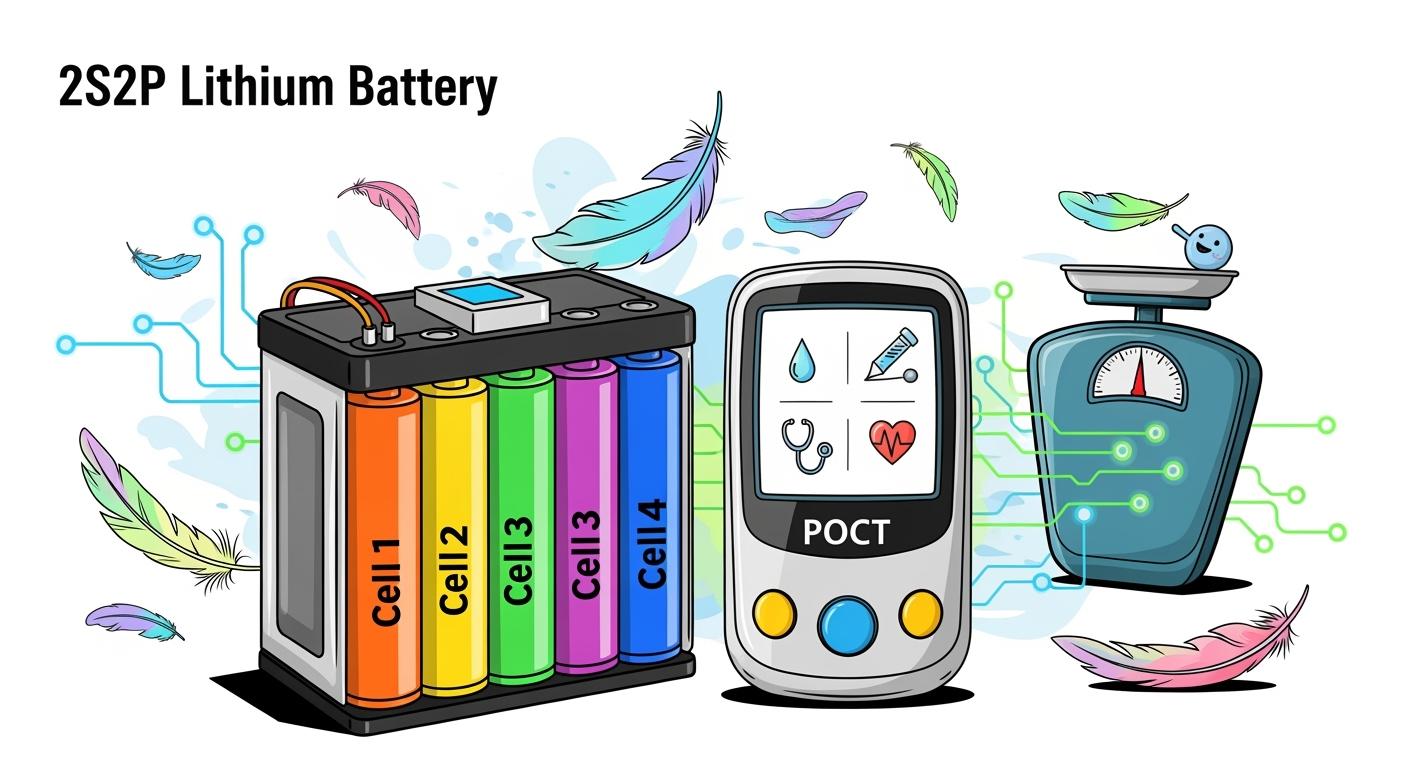
Point-of-care diagnostic devices increasingly depend on compact, lightweight, and reliable power systems. Optimized lithium battery pack structures help reduce device weight while providing the stable voltage and runtime required for testing, monitoring, and data transmission. These improvements make portable medical devices easier to carry, safer to operate, and more dependable in clinics, laboratories, ambulances, and field environments.
Higher energy density supports longer runtime without increasing device size.
Lightweight battery designs improve portability and patient comfort.
An integrated Battery Management System (BMS) helps manage cell balance, temperature, charging, and fault protection.
Application-specific battery configurations simplify integration with modern medical devices.
Together, advances in battery chemistry, pack configuration, and protection design are enabling a new generation of efficient and dependable point-of-care diagnostic equipment.
Key Takeaways
The 2S2P battery configuration optimizes voltage and capacity, enhancing the performance of point-of-care diagnostic devices.
Advancements in battery materials and structures lead to lighter, more efficient batteries, improving device portability and usability.
Safety and compliance are crucial when integrating lithium batteries into medical devices, ensuring reliable operation and patient safety.
Part1: Lithium Battery Structures in POCT Devices

1.1 2S2P Configuration Basics
You encounter the 2S2P configuration frequently when designing lithium battery packs for point-of-care diagnostic devices. This structure combines two cells in series and two in parallel, optimizing both voltage and capacity. You select this configuration because it balances power output and operational longevity, which is essential for miniaturization and portability.
The 2S2P setup doubles the voltage compared to a single cell, while the capacity matches that of one parallel group.
Battery management systems (BMS) monitor and balance voltage differences between cells, maintaining consistent performance.
You achieve reliable energy delivery, which supports the demanding requirements of medical devices.
Tip: The 2S2P configuration enables you to scale power and capacity without increasing the physical footprint, supporting miniaturization in advanced medical and industrial applications.
1.2 Impact on Device Performance
Lithium battery structures directly affect the voltage, capacity, and operational reliability of point-of-care diagnostic devices. You must consider these factors to ensure your devices deliver accurate results and maintain uptime.
Voltage and capacity adjustments allow you to tailor lithium battery packs for specific diagnostic workflows.
Surface treatments, such as coatings and doping, enhance battery longevity and performance. Coating technologies create protective layers that prevent degradation, improving battery lifespan and reducing maintenance needs. Surface doping improves structural stability and electronic conductivity, contributing to better battery performance and longevity.
The balancing mechanisms in the BMS ensure stable operation, which is crucial for sensitive diagnostic equipment.
Design Consideration | Impact on Reliability |
|---|---|
Fire-resistant ABS/PC enclosure | Enhances safety and reduces fire risk |
Thermal pads for heat transfer | Improves thermal management |
Shock-absorption foam structures | Protects battery from physical damage |
Medical-grade connectors | Ensures reliable electrical connections |
You see that these design features improve operational reliability, reduce maintenance, and extend the service life of lithium battery packs in medical and industrial environments.
1.3 Why Structure Matters for Diagnostics
You recognize that the structure of lithium battery packs determines the portability and usability of point-of-care diagnostic devices. Compact, self-powered devices enable you to deliver accurate results quickly, which is vital for medical professionals and patients.
Ultrasound-based diagnostics help you assess the structural integrity of battery components. This non-invasive method allows real-time monitoring, enabling you to detect defects that could affect accuracy and reliability. As battery systems become more complex, you rely on these diagnostic tools to ensure operational safety and extend device lifespan.
Note: Optimal lithium battery structures support miniaturization and flexibility, especially in wearable applications. You achieve compliance with anatomical structures, which enhances patient comfort and device usability.
You also compare different lithium battery chemistries to select the best option for your application. Here is a table summarizing key properties:
Chemistry | Platform Voltage (V) | Energy Density (Wh/kg) | Cycle Life (cycles) |
|---|---|---|---|
LiFePO4 | 3.2 | 90-120 | 2000+ |
NMC | 3.7 | 150-220 | 1000-2000 |
LCO | 3.7 | 100-150 | 500-1000 |
LMO | 3.7 | 100-120 | 1000-2000 |
LTO | 2.3 | 70-90 | 5000+ |
You select the chemistry based on your device’s requirements for energy density, cycle life, and safety. Medical and industrial sectors benefit from these optimized lithium battery structures, which support miniaturization and enhance diagnostic accuracy.
Part2: Engineering Challenges for Lithium Battery Packs
2.1 Power Density and Miniaturization
You face significant challenges when designing lithium battery packs for medical devices that demand high volumetric density and lightweight structure. Increasing capacity often reduces power density because larger cells take up more space. High power density batteries may require frequent recharging, which impacts rapid testing workflows. You must balance capacity and power density to ensure reliable energy storage systems. High power density generates more heat, so you need effective cooling mechanisms to maintain battery systems performance and safety.
Portable ventilators require consistent power delivery.
Infusion pumps need high discharge rates.
Mobile defibrillators must operate reliably under variable load conditions.
Miniaturization leads to smaller, lighter batteries that align with the trend of portable medical devices. Solid-state batteries enhance safety and energy density, addressing traditional lithium-ion batteries concerns. Advanced battery management systems optimize both performance and safety, especially in micro implantable batteries.
2.2 Safety and Compliance
You must address safety and reliability concerns when integrating lithium battery packs into medical devices. Fires, leaks, fumes, and blasts pose risks in clinical environments. The following table summarizes common safety concerns:
Safety Concern | Description |
|---|---|
Fires | Thermal runaway can lead to uncontrollable heat and pressure, causing medical devices to ignite. |
Leaks | Corrosive chemicals in batteries can cause severe injuries, including burns and blindness. |
Fumes | Off-gassing can release toxic and combustible hydrocarbons, posing evacuation risks in hospitals. |
Blasts | Explosions from thermal runaway can cause unique damage, especially to individuals with implantable devices. |
Regulatory standards such as IEC 62133-2, UL 1642, and UL 2054 ensure lithium battery packs meet strict safety requirements. You must comply with these standards to guarantee safe operation in energy storage systems and battery systems.
2.3 Integration in Compact Devices
You encounter integration challenges when incorporating miniaturized lithium battery packs into compact medical devices. Regulatory compliance hurdles in the EU and U.S. increase certification costs and restrict faster adoption. You must balance small size, high volumetric density, and safety compliance as devices become more advanced. Quality control inspections and post-market assurance processes help you maintain reliability in energy storage systems. Process Failure Modes, Effects, and Criticality Analysis (P-FMECA) assesses risks at both the battery-cell level and within medical devices, supporting structured corrective actions.
Note: You optimize battery systems for energy density, safety, and reliability to support rapid testing and enhance patient outcomes in medical devices.
Part3: Lightweight Trends in Lithium-Ion Batteries
3.1 Material Innovations
You see rapid advancements in materials that drive the evolution of high density lithium polymer battery packs for point-of-care diagnostic devices. New catholyte compounds combine cathode and electrolyte functions, reducing inactive material and dead weight. This innovation allows you to achieve lighter batteries with higher energy density. The following table summarizes key material innovations:
Innovation | Description |
|---|---|
New Catholyte | Liquid fluorinated compound merges cathode and electrolyte, minimizing inactive material. |
Weight Reduction | Design lowers dead weight from 50% to 20%, enabling lighter batteries for medical devices. |
Energy Density | Offers a 50% increase in useful lifetime or a decrease in size and weight for same capacity. |
You also benefit from lithium oxide components that enhance energy density, improve performance, and increase stability in high density lithium polymer battery packs.
3.2 Structural Optimization
You optimize battery structure to reduce weight and maximize capacity in point-of-care diagnostic devices. Structural analysis improves performance and mechanical resilience. Optimized designs lower internal resistance and enhance ion transport. You focus on electrode porosity, current collector architecture, and cell-level design to improve safety and efficiency. The geometric arrangement of battery components supports thermal management and reliability.
Structural analysis reduces weight and boosts performance.
Optimized designs lower resistance and improve resilience.
Electrode porosity and current collector architecture maximize capacity and safety.
3.3 Enhancing Portability and Cycle Life
You prioritize portability and cycle life when selecting high density lithium polymer battery packs for medical devices. Soft-packed batteries offer a good safety factor and can be as thin as 0.5mm, making them ideal for compact devices. These batteries are 40% lighter than steel-shell alternatives and provide 10-15% more capacity. Customization allows you to tailor shape and thickness for specific applications. Flexible batteries improve patient comfort and usability, enabling ergonomic wearable technologies for continuous monitoring and drug delivery. You rely on advanced battery management systems to ensure safety, reliability, and longevity. Sustainable battery technologies support environmental goals and market competitiveness. The adoption of high density lithium polymer battery packs enhances the performance and portability of point-of-care diagnostic devices, supporting rapid diagnostics and decentralized healthcare. Next-generation battery solutions address environmental concerns by promoting sustainable battery technologies.
You see 2S2P lithium battery structures and lightweight trends advancing point-of-care diagnostic devices. You benefit from innovations that improve device performance, safety, and sustainability.
Recyclable and non-toxic batteries support sustainability in manufacturing.
Rechargeable systems reduce disposable battery usage, boosting sustainability.
Printed and organic flexible batteries align with sustainability goals.
Lithium-ion batteries drive sustainability through high energy density and long lifespan.
Ultra-thin, flexible batteries enhance sustainability in wearable devices.
Battery chemistry advancements extend operational life, supporting sustainability in healthcare.
You can consult our team for custom battery solutions that meet your sustainability targets and operational needs.
FAQ
What advantages do lithium battery packs offer for implantable diagnostic devices in healthcare?
You gain reliable power, extended cycle life, and high energy density. Lithium battery packs support digital diagnostics and rapid diagnosis, improving patient outcomes in implantable devices.
How do lithium battery packs enhance digital diagnostics in industrial and medical devices?
You achieve consistent voltage and capacity. Lithium battery packs enable accurate diagnosis and efficient digital diagnostics, supporting advanced healthcare and industrial diagnostic workflows.
Where can you consult for custom lithium battery packs for implantable diagnostic devices?
You can contact Large Power for tailored lithium battery packs. Consult our battery solution experts for implantable devices in healthcare, robotics, and security systems.


