

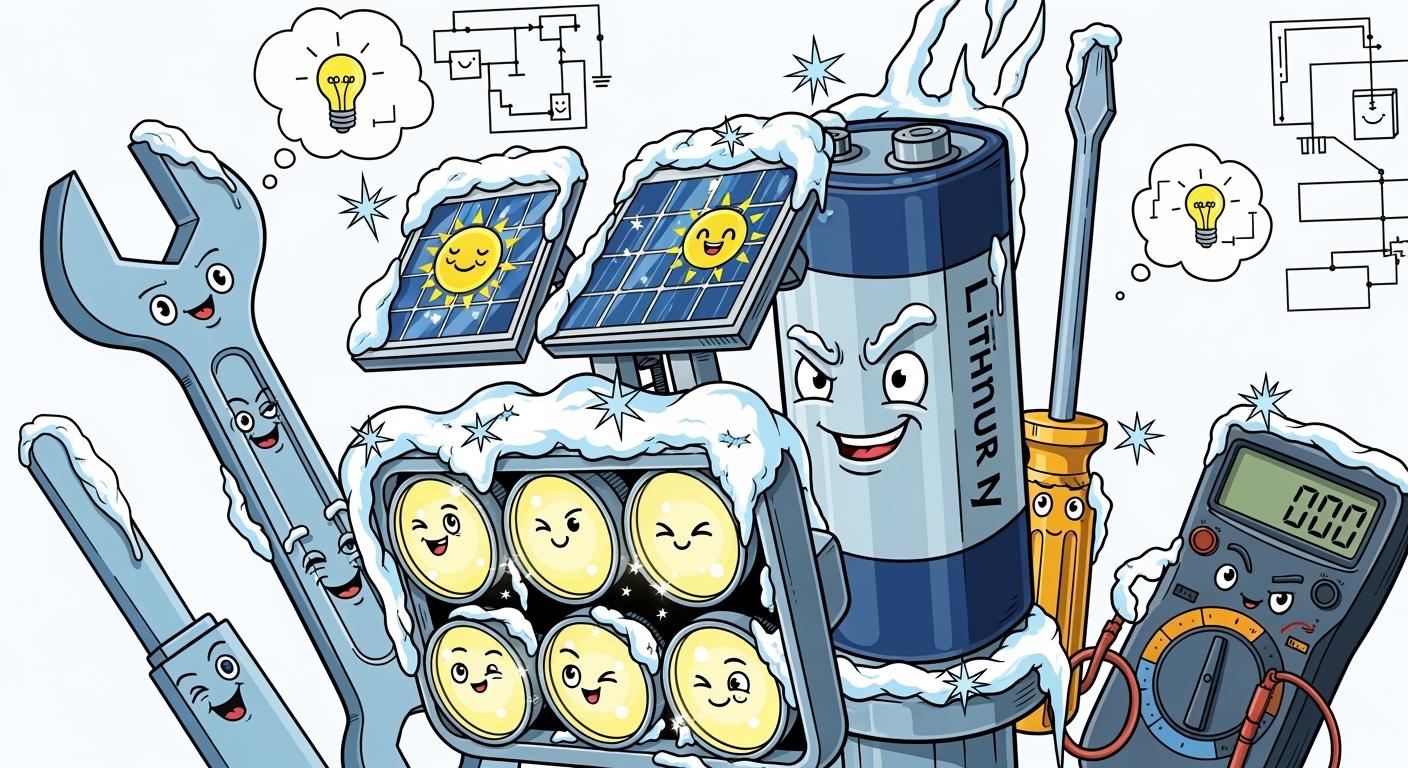
Outdoor solar lighting systems face two connected winter challenges: less available solar energy and reduced battery performance. At sub-zero temperatures, lithium-ion batteries develop higher internal resistance, lower usable capacity, and reduced charge acceptance. Charging becomes particularly important because attempting to charge some lithium-ion cells below their specified minimum temperature can cause lithium plating and permanent cell damage.
Reliable winter operation therefore depends on more than choosing a battery chemistry. Engineers must coordinate cell selection, battery capacity, solar-array sizing, insulation, active heating, charge control, and Battery Management System (BMS) protection. A system designed around verified temperature limits can maintain dependable lighting without exposing the battery to unsafe charging conditions.
Key Takeaways
Sub-zero temperatures increase battery resistance and reduce usable capacity and power output.
Low-temperature charging presents a greater risk than discharging and must follow the cell manufacturer’s specifications.
LiFePO4 and NMC can both be used in outdoor systems, but neither chemistry is automatically suitable for sub-zero charging.
Insulation slows temperature changes but does not generate heat; severely cold sites may require controlled battery heating.
The BMS should monitor temperature and block or limit charging outside the permitted range.
Winter solar and battery capacity must be calculated using local irradiance, required lighting hours, system losses, temperature derating, and the required number of backup days.
Part1: Lithium Batteries Performance in Cold
1.1 Electrochemical Challenges Below 0°C
At low temperatures, electrolyte conductivity decreases and charge-transfer reactions slow down. Lithium ions move less efficiently between the electrodes, increasing internal resistance and causing a larger voltage drop under load. As a result, the lighting controller may reach its low-voltage cutoff even though some energy remains in the battery.
Cold-weather capacity loss is not a universal fixed percentage. It varies with chemistry, cell construction, discharge rate, state of charge, battery age, and temperature. Some of the apparent capacity may recover after the battery returns to a moderate temperature, but damage caused by improper low-temperature charging may be permanent.
Low-temperature effect | System consequence |
|---|---|
Lower electrolyte conductivity | Slower ion transport and reduced charge acceptance |
Higher internal resistance | Greater voltage drop and lower peak-power capability |
Reduced usable capacity | Shorter lighting duration during winter nights |
Slower electrochemical reactions | Longer charging time and reduced charging efficiency |
Low-temperature charging risk | Possible lithium plating if cell limits are exceeded |
1.2 Internal Resistance and Power Delivery
As battery temperature falls, increasing internal resistance reduces the voltage available to the LED driver and control electronics. This effect becomes more pronounced at higher current. A battery may therefore operate normally at a low lighting level but experience an early cutoff when the system switches to full brightness.
Engineers should evaluate the battery under the system’s actual load profile rather than relying only on room-temperature capacity. Validation should include startup current, full-brightness operation, communication loads, and any temporary power required by cameras, sensors, or controllers.
1.3 ithium-Plating Risk During Charging
Lithium plating can occur when a lithium-ion cell is charged faster than lithium ions can be inserted into the anode. Low temperature, high charging current, high state of charge, and unsuitable cell design can increase this risk. Deposited metallic lithium can reduce capacity and may contribute to internal short circuits.
A fixed 0°C charging prohibition should not be applied to every lithium battery. Many conventional cells restrict charging below 0°C, but specialized low-temperature batteries may use different materials and validated charging limits. The correct threshold and charging current must come from the selected cell’s specifications.
The BMS should block or reduce charging when the battery is outside its permitted temperature range. If active heating is used, charging should begin only after the cells—not merely the enclosure air—have reached a safe temperature.
Part2: Impact on Solar Lighting Systems
2.1 Reliability in Winter
Winter reliability depends on both battery temperature and available solar energy. Solar modules can convert energy efficiently in cold weather, but shorter daylight hours, low sun angles, cloud cover, snow, and shading may substantially reduce daily generation. At the same time, the battery may accept charge more slowly and provide less usable energy.
The system should therefore be sized using site-specific winter solar data and the required lighting profile. Statements such as “winter lighting falls to three or four hours” are not universally valid because runtime depends on panel size, battery capacity, LED power, dimming schedule, weather, and installation location.
2.2 Charging and Power-Delivery Challenges
The following table should replace the existing fixed capacity-loss table:
Operating condition | Likely effect | Engineering response |
Battery below its minimum charging temperature | Charging may damage the cells | Block charging or activate controlled heating |
Cold battery under a high load | Increased voltage sag | Derate current or increase pack capacity |
Short winter daylight period | Less daily charging energy | Recalculate solar-array and battery capacity |
Snow or ice on the panel | Reduced or interrupted generation | Improve panel angle and maintenance access |
Extended cloudy weather | Progressive battery depletion | Design for the required autonomy period |
Cold restart after a long shutdown | BMS or controller may remain inactive | Provide a validated wake-up and recovery strategy |
2.3 System-Level Consequences
Sub-zero operation can create a mismatch between solar generation, charging availability, and nighttime energy demand. If the BMS blocks charging while the battery is too cold, the system may be unable to store available morning solar energy. If heating draws energy from an already depleted battery, the system may also fail to recover.
This interaction should be addressed at system level. Engineers must define when heating begins, where the heating energy comes from, what temperature permits charging, and how lighting loads are reduced during extended low-energy periods. Low-voltage dimming and staged load shedding can preserve essential lighting while protecting the battery from deep discharge.
Cold temperatures do not normally “freeze” a lithium battery in the same way that water freezes. The more relevant risks are reduced ion mobility, increased resistance, unsuitable charging, seal or enclosure problems, and condensation during temperature changes.
Part3: Thermal Management
3.1 Thermal Management
A winter battery enclosure must manage both heat loss and moisture. Passive insulation reduces the rate of temperature change but cannot warm a battery indefinitely. Active heating may be required when the site remains below the cell’s permitted charging temperature for long periods.
Thermal strategy | Purpose | Design consideration |
Insulated enclosure | Slows heat loss | Must not trap excessive heat in summer |
Controlled heating element | Raises cell temperature before charging | Requires temperature feedback and energy budgeting |
BMS temperature monitoring | Enforces charge and discharge limits | Sensors should represent actual cell temperature |
Weather-resistant enclosure | Limits water and dust ingress | Condensation and pressure equalization must be considered |
Placement below or behind the panel | Reduces direct environmental exposure | Must preserve ventilation and maintenance access |
A BMS does not automatically regulate temperature unless it controls a heater, cooling device, or charging circuit. Its actual functions should be described accurately.
3.2 Battery Heating and Insulation
Remove the claims that a battery can always heat from -20°C to 0°C in 20 seconds or that heating requires only 3.8% of stored energy. These values apply only to specific experimental designs and should not be presented as general performance.
A controlled heating system should be designed around battery mass, enclosure insulation, ambient temperature, available solar power, heater output, and required warm-up time. The heater should include temperature feedback, overtemperature protection, and a control sequence that prevents charging before the cells enter their approved temperature range.
Insulation should be non-conductive, flame-resistant where required, and compatible with the enclosure’s ventilation and moisture-control strategy. Wind chill does not reduce an object below ambient temperature, but moving air can increase the rate at which heat is lost.
3.3 Smart Energy Management
Smart energy management coordinates lighting, battery heating, and charging according to the available solar energy. The controller may prioritize heating when solar power becomes available, begin battery charging after the cells reach an acceptable temperature, and reduce lighting output when the state of charge falls below a defined threshold.
The BMS should monitor cell voltage, pack current, and temperature and provide appropriate protection. The solar charge controller should also use charging parameters compatible with the selected battery chemistry. Communication between these systems can improve fault reporting, remaining-runtime estimation, and winter recovery.
3.4 Selecting Battery Chemistry
LiFePO4 offers strong thermal stability and long cycle life, making it a common choice for stationary solar lighting. However, conventional LiFePO4 cells can still experience substantial capacity and charging limitations in cold conditions. NMC generally offers higher energy density and may provide different low-temperature discharge characteristics, but it also requires careful thermal and electrical protection.
Design priority | Chemistry consideration |
Long cycle life and thermal stability | LiFePO4 may be preferred |
Compact size and low weight | NMC may be preferred |
Sub-zero charging | Requires a cell specifically validated for the intended temperature |
High discharge power | Must be verified using the cell’s cold-temperature data |
Long winter autonomy | Depends on total pack energy and system efficiency, not chemistry alone |
Select cells using manufacturer data for charge temperature, discharge temperature, capacity retention, impedance, and cycle life. Do not describe a battery as suitable for sub-zero use solely because it uses LiFePO4 chemistry.
3.5 Engineering for Reliable Winter Performance
A dependable winter system combines several measures:
Select cells validated for the site’s minimum temperature.
Calculate battery capacity using cold-temperature derating data.
Block charging below the specified temperature.
Add controlled heating where passive insulation is insufficient.
Size the panel using local worst-month solar irradiance.
Include heater energy and conversion losses in the power budget.
Use MPPT charging where it provides a meaningful system benefit.
Apply adaptive dimming during extended low-energy periods.
Validate the complete system in representative temperature and load conditions.
A custom lithium battery pack should be evaluated as part of the complete solar lighting system rather than as an isolated component.
Part4: Practical Tips and Case Studies
4.1 Best Practices for Installation
You can boost lithium battery reliability in cold outdoor solar lighting projects by following proven installation methods. Insulation protects batteries from freezing temperatures. Oversizing your solar array by 25% to 40% ensures enough energy during winter. You should develop operational habits that support battery health. Daily checklists help you maintain system performance.
Best Practice | Description |
|---|---|
Insulation | Passive insulation improves winter charging reliability. |
Oversizing | Oversize solar generation by 25%–40% for winter reliability. |
Operational Habits | Good habits keep batteries healthy and reliable. |
Daily Checklist | Check battery temperature, clear snow from panels, monitor state of charge, avoid deep discharge, run heavy loads during sunny hours, use heating before charging, confirm BMS protection. |
Installation Techniques | Use adjustable ground-mounted arrays, MPPT controllers, insulated indoor battery banks, self-heating LiFePO4 batteries, oversized solar capacity, and real-time monitoring. |
Tip: You should always clear snow from solar panels and check battery temperature before charging. These steps prevent power loss and extend battery life.
4.2 Real-World Sub-Zero Projects
You see successful solar lighting systems in medical clinics, security installations, robotics platforms, infrastructure sites, and industrial facilities. In northern clinics, insulated battery banks and self-heating LiFePO4 batteries keep lights running during long winter nights. Security companies use oversized solar arrays and MPPT controllers to maintain surveillance cameras in freezing conditions. Robotics teams rely on real-time monitoring and heated battery enclosures for reliable operation outdoors. Industrial sites install adjustable solar arrays and use daily checklists to ensure uninterrupted lighting.
Note: You can achieve reliable winter performance by combining insulation, oversizing, and smart energy management. These strategies work across medical, security, robotics, and industrial applications.
4.3 Lessons and Recommendations
You learn that winter reliability depends on preparation and system design. Insulation and battery heating protect against freezing. Oversizing solar capacity ensures enough energy for charging. Smart controllers and BMS features prevent unsafe charging. Daily operational checks keep your system running smoothly.
Choose LiFePO4 batteries for stable performance in cold weather.
Install batteries in insulated enclosures.
Use self-heating technology and real-time monitoring.
Oversize your solar array for winter conditions.
Follow daily checklists to maintain battery health.
Callout: You can build robust solar lighting systems for sub-zero environments by applying these best practices. Reliable lighting supports critical operations in medical, security, robotics, and industrial sectors.
You face several scientific and engineering challenges when using lithium batteries in sub-zero outdoor solar lighting systems:
Performance drops at low temperatures.
Specialized testing is needed for extreme conditions.
Solar panels work better in the cold, but batteries do not.
A well-designed system with LiFePO4 chemistry, thermal management, and smart controls keeps your batteries reliable.
Battery Performance | |
|---|---|
Below 15 | Reduced capacity, higher resistance |
15 to 35 | Optimal range |
Above 35 | Risk of damage |
Winter does not stop solar lighting. With the right design, your system can deliver reliable light all season.
FAQ
What is the best lithium battery chemistry for sub-zero solar lighting?
You should choose LiFePO₄ (lithium iron phosphate) batteries. They offer high cycle life, stable platform voltage (3.2V per cell), and retain over 80% capacity at -10°C. This chemistry works well for medical, security, robotics, and industrial outdoor lighting.
How can you prevent lithium plating in cold weather?
You must avoid charging batteries below 0°C (32°F). Use a Battery Management System (BMS) with low-temperature charging protection. Add insulation and heating elements to keep battery temperature above freezing during charging.
Why does battery capacity drop in winter?
Low temperatures slow chemical reactions inside the battery. Internal resistance rises, and lithium ions move slower. You see a 20–50% drop in usable capacity at temperatures below 0°C. This affects power delivery for outdoor lighting systems.
What installation tips help maximize battery life in cold climates?
Insulate battery enclosures.
Oversize your solar array by 25–40%.
Use self-heating LiFePO₄ batteries.
Monitor battery temperature daily.
Clear snow from solar panels.
Tip: These steps help you maintain reliable lighting for critical applications.
Can you use standard lithium-ion batteries in sub-zero outdoor systems?
You can use them, but you will see higher capacity loss and more risk of lithium plating. LiFePO₄ batteries perform better in cold. See the table below for a quick comparison:
Battery Type | Platform Voltage | Energy Density (Wh/kg) | Cycle Life (cycles) | Sub-Zero Performance |
|---|---|---|---|---|
LiFePO₄ | 3.2V | 90–120 | 2000+ | Excellent |
Standard Lithium-Ion | 3.6–3.7V | 150–250 | 500–1500 | Moderate/Poor |


