

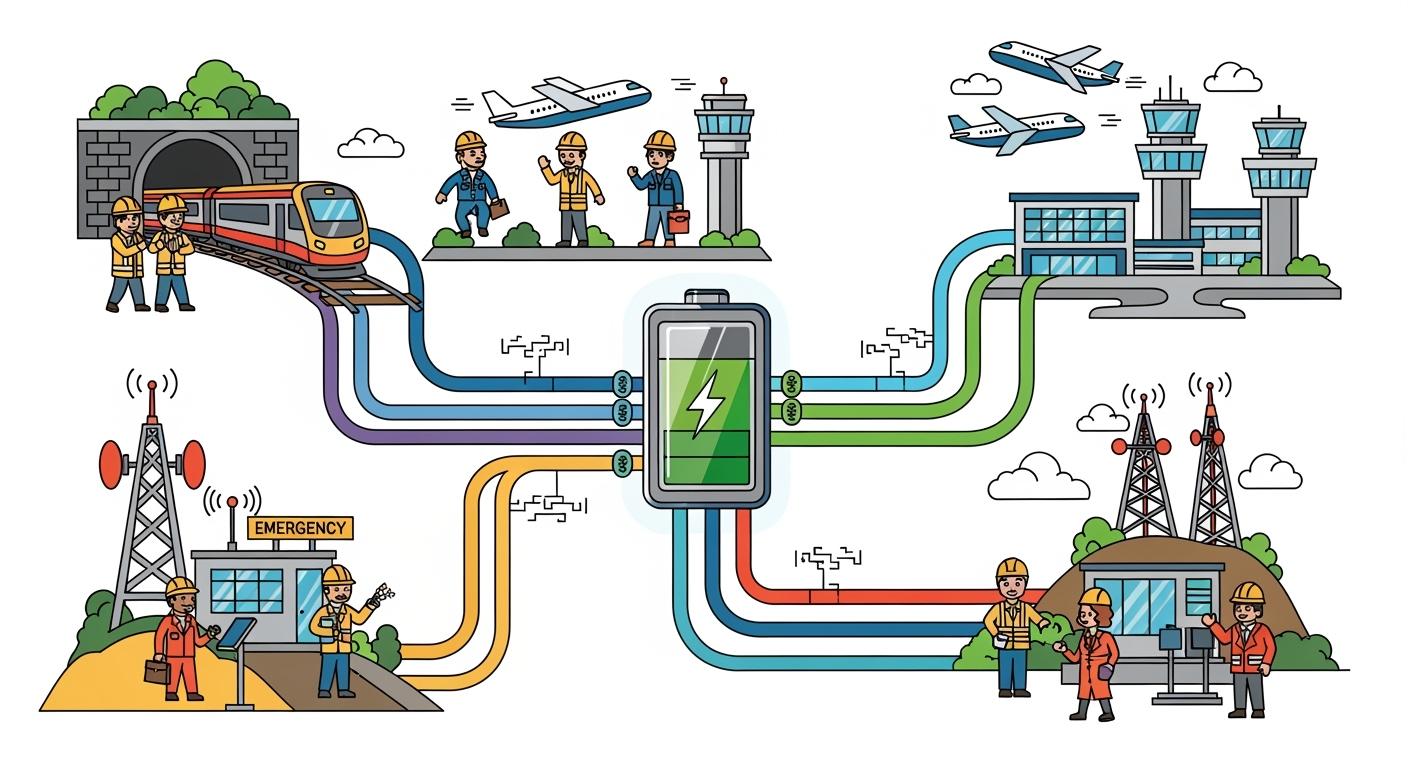
Reliable power is essential to communication systems used across railways, airports, highways, tunnels, bridges, and emergency response networks. Even a brief interruption can disrupt signaling, delay transportation, damage equipment, or compromise public safety. These risks make backup runtime, electrical protection, remote diagnostics, and environmental durability critical design considerations for communication infrastructure.
Quick Answer
Custom lithium battery solutions support railway, airport, highway, tunnel, and emergency communication systems by matching the required voltage, capacity, runtime, enclosure, and communication protocols. An integrated Battery Management System (BMS) monitors voltage, current, and temperature while protecting against overcharge, over-discharge, overcurrent, short circuits, and thermal abnormalities. For critical infrastructure, the battery system should also support backup power, remote diagnostics, surge protection, and resistance to temperature, moisture, vibration, and electromagnetic interference.
The table below summarizes common operational challenges and their potential effects:
Operational Challenge | Potential Impact |
|---|---|
Railway signaling failure | Service delays, routing errors, or safety risks |
Airport communication disruption | Reduced coordination between ground operations, terminals, and flight services |
Highway traffic signal failure | Congestion, traffic disruption, or increased accident risk |
Tunnel or bridge monitoring failure | Loss of structural, environmental, or safety data |
Emergency network interruption | Delayed communication during public safety incidents |
Electrical surges | Damage to communication equipment and unexpected system shutdowns |
Inadequate surge protection | Shortened equipment life and higher maintenance costs |
Application-specific lithium battery packs can be engineered around the actual load profile, required backup time, installation space, connectors, charging system, and communication interface. Remote monitoring allows operators to track state of charge, temperature, battery health, and fault conditions before they cause service interruptions. Combined with a properly configured BMS and durable enclosure, these features help critical communication systems maintain dependable operation in demanding environments.
Key Takeaways
Custom Lithium Battery Solutions provide reliable power, ensuring communication systems in railways, airports, and emergency networks remain operational during outages.
Investing in robust power solutions enhances safety and efficiency, allowing for quick responses to emergencies and minimizing costly delays.
Tailored battery designs offer flexibility in voltage and capacity, enabling seamless integration with existing systems and adapting to specific operational needs.
Advanced battery management systems extend battery life and reduce maintenance, allowing you to focus on operations rather than upkeep.
Compliance with safety regulations ensures reliable performance, helping you meet industry standards and maintain uninterrupted communication.
Part 1: Reliable Power for Communication Systems
1.1 Importance of Uninterrupted Operation
You depend on seamless communication to keep your operations running smoothly. In railways, airports, and emergency networks, even a brief power loss can disrupt critical systems. Custom Lithium Battery Solutions deliver consistent energy, supporting your infrastructure when grid power fails or fluctuates. You gain peace of mind knowing that signaling, control, and monitoring systems stay online.
Tip: Reliable power ensures your teams respond quickly during emergencies, reducing downtime and preventing costly delays.
Consider these facts:
Effective communication is essential for power and utility sectors, which generate, transmit, and distribute resources.
Millions of workers face dangerous noise levels each year, making clear communication vital for safety and productivity.
Specialized products, such as advanced battery packs and communication devices, help maintain operational efficiency in noisy environments.
1.2 Impact on Safety and Efficiency
You improve safety and efficiency when you invest in robust power solutions. Uninterrupted operation means your signaling systems alert staff to hazards, your airport communication networks coordinate flights, and your emergency services respond without delay. Custom Lithium Battery Solutions offer tailored voltage and capacity, matching your exact requirements.
System Type | Benefit of Reliable Power |
|---|---|
Railway signaling | Prevents accidents and delays |
Airport networks | Supports flight coordination |
Emergency services | Enables rapid response |
You minimize risks and maximize productivity by choosing battery packs designed for your environment. Lithium chemistries like LiFePO4, NMC, LCO, and LMO provide high energy density, long cycle life, and stable platform voltage. These features help you meet regulatory standards and ensure your communication systems operate efficiently.
🚦 Reliable power keeps your infrastructure safe and your operations efficient.
Part 2: Custom Lithium Battery Solutions – Benefits & Design
2.1 Reliability and Longevity
You need power solutions that last and perform reliably in demanding environments. Custom Lithium Battery Solutions deliver extended lifespans and reduce maintenance compared to standard battery packs. You benefit from advanced battery management systems (BMS) that monitor and optimize each cell, minimizing wear and maximizing uptime.
Consider the typical cycle life for different lithium battery chemistries used in communication systems:
Battery Chemistry | Platform Voltage | Energy Density (Wh/kg) | Cycle Life (Times) |
|---|---|---|---|
LiFePO4 | 3.2 V | 90-160 | 2,000-5,000 |
NMC | 3.7 V | 150-220 | 500-800 |
LCO | 3.7 V | 150-200 | 300-500 |
LMO | 3.7 V | 100-150 | 300-700 |
Solid-State | 3.7 V | 250-350 | 2,000-10,000 |
Lithium Metal | 3.7 V | 350-500 | 1,000-2,000 |
You see that LiFePO4 offers high stability and long cycle life, making it ideal for critical communication systems. NMC provides high energy density for applications where space and weight matter. Custom Lithium Battery Solutions allow you to select the chemistry that fits your operational needs.
Battery Type | Cycle Life |
|---|---|
Ultra-Stable LiFePO4 | 2,000 – 5,000 Times |
High-Density NMC | 500 – 800 Times |
Custom solutions outlast standard battery packs, especially lead-acid types. You spend less time on maintenance and more time focusing on your operations. Sophisticated battery management systems help reduce wear and extend service life.
2.2 Scalability and Adaptability
You need power systems that grow with your infrastructure. Custom Lithium Battery Solutions offer modular designs and flexible architectures. You can scale your system by adding or removing battery modules as your needs change.
Advanced communication protocols enable seamless integration and scalability across multiple nodes. You can use daisy-chaining, mesh networking, or hierarchical structures.
Adaptive algorithms adjust power distribution and load balancing based on system size and configuration. You optimize performance for every application.
Modular architectures allow easy expansion. You configure your battery packs for different environments and requirements.
Configurable hardware interfaces support various expansion methods and connection topologies. You adapt your system for railways, airports, or emergency networks.
You benefit from tailored voltages and capacities that enhance performance. Custom Lithium Battery Solutions support analog, digital, or mixed communication modes within the same hardware platform. You achieve increased transmission capacity, improved reliability, and fast recovery times.
Key Benefits | Key Features |
|---|---|
Increased transmission capacity and efficiency | Analog, digital or mixed communication modes within the same hardware platform |
Improved reliability, security, and stability | Integration within digital communication networks (IP networking, RS232 /RS422 (V11), RS485) |
Reduced costs by using existing HV power lines | Radius authentication and SSH encryption |
Highly configurable and customizable | Optimized bandwidth allocation with superimposed mode: up to 320 kbit/s @ 48 kHz total bandwidth |
Fast recovery time |
2.3 Safety and Compliance
You must meet strict safety standards and regulatory requirements in transportation and utility sectors. Custom Lithium Battery Solutions integrate advanced thermal management systems, robust protection circuits, and rigorous testing protocols.
Custom battery packs use heat sinks and cooling systems to prevent overheating.
Protection circuits prevent overcharging, over-discharging, and short circuits.
Industry standards ensure reliability and longevity.
You follow a clear process for design, validation, and production:
Define application context. You understand real-world conditions, load profiles, and environmental factors.
Specify voltage requirements. You establish necessary voltage and tolerances.
Determine capacity and runtime. You define operational time between charges.
Outline enclosure and mounting specifications. You ensure the battery pack fits your equipment.
Identify communication needs. You specify data reporting and interface protocols.
Establish certifications and compliance. You identify certifications early to avoid redesigns.
Address thermal requirements. You define operating and charging temperature ranges.
Manage lead times. You lock in specifications to minimize delays.
You comply with regulations for safe transport and operation:
Regulation/Standard | Description |
|---|---|
UN 38.3 Testing | Mandatory testing for lithium batteries to ensure safety during transport. |
IATA Dangerous Goods Regulations | Governs air transport of lithium batteries, classifying them as Class 9 dangerous goods with specific requirements. |
IMDG Code | Applies to sea transport, allowing for larger shipments with rigorous safety standards. |
ADR Framework | Provides guidelines for road transport in Europe, ensuring safety through proper vehicle classification. |
CEIV Lithium Batteries Certification | Ensures compliance and safety in airport operations for lithium battery handling. |
Proper packaging prevents physical damage and short circuits.
Mandatory labeling indicates potential hazards.
Documentation includes the Shipper’s Declaration for Dangerous Goods.
Note: Custom Lithium Battery Solutions help you meet all safety and compliance requirements, ensuring your communication systems operate reliably and safely.
Part 3: Applications in Railways, Airports, Emergency Networks

3.1 Railways: Signaling & Control
You rely on advanced power systems to keep railway signaling and control equipment running in harsh environments. Custom Lithium Battery Solutions support intelligent traffic signals and control systems, ensuring safe and efficient operation. Battery packs from companies like Saft and Stryten Energy deliver high performance and long battery life for rolling stock and signaling equipment.
Company | Application Area | Key Features |
|---|---|---|
Saft | Auxiliary and propulsion systems | Custom-engineered solutions for harsh environments |
Stryten Energy | Railway rolling stock, signaling equipment | High performance and battery life in demanding conditions |
Modern railway systems use components such as BMS, PDU, and CAN Gateway to manage battery operations and protect equipment. Integrated sensors monitor battery health and predict hazards, providing real-time alarms for gas leaks or electrolyte leakage. You see similar technology in medical devices, robotics, and industrial automation, where uninterrupted power is critical.
BMS manages battery safety and efficiency.
PDU protects batteries and communicates with BMS.
CAN Gateway connects batteries in parallel for enhanced performance.
3.2 Airports: Communication & Security
You need reliable backup power for airport communication and security systems. Custom Lithium Battery Solutions provide UPS-grade backup with rapid switching times, ensuring critical infrastructure stays online during outages. Lipower has delivered over 1,000 energy storage systems, helping businesses reduce operating costs and maintain uninterrupted power. Luxembourg City’s Kirchberg district uses LFP-based UPS systems to achieve 99.999% uptime for banking and fintech operations.
UPS-grade backup power switches in less than 10 milliseconds.
Energy storage systems reduce operating costs by up to 40%.
LFP-based systems ensure maximum uptime for critical infrastructure.
These solutions also support security systems, medical facilities, and consumer electronics in airports, where consistent power is essential.
3.3 Emergency Networks: Continuity
You must guarantee communication continuity during emergencies. Custom Lithium Battery Solutions offer telecom battery backup systems that prevent dropped connections and equipment resets. Providers must deliver backup power for 8 to 24 hours, depending on regulations. You see similar requirements in security systems, infrastructure monitoring, and industrial networks.
Requirement | Description |
|---|---|
Backup Power Duration | Providers must offer backup power for 8 hours (after 120 days) or 24 hours (within three years) of standby time. |
Flexibility | Providers can develop their own backup power solutions if they comply with rules. |
Consumer Obligation | Consumers are not required to purchase backup power; providers must make it available. |
Custom lithium battery packs ensure critical communication systems remain operational during emergencies by delivering reliable backup power. This consistent power delivery is essential for maintaining communication capabilities, especially during outages.
Tip: Reliable battery backup prevents network failures and supports rapid response in emergency situations.
Part 4: Features & Customization Options
4.1 Design Flexibility
You gain a competitive edge when you choose custom lithium battery packs that fit your exact requirements. Manufacturers offer a wide range of options for size, shape, and electrical characteristics. You can select cylindrical cells like 18650 or 21700 for portable devices, or prismatic cells with capacities from 50Ah to 300Ah+ for industrial applications. Custom connectors and cable lengths ensure seamless integration with your communication equipment. You also define discharge current and voltage to match your system’s performance needs.
Core Format | Dimensions & Sizing | Best Application |
|---|---|---|
Cylindrical Cells | 18650, 21700, 32700, 46800 | Portable Medical, Power Tools, E-mobility |
Prismatic Cells | Capacity: 50Ah to 300Ah+ | AGVs, Forklifts, Solar ESS, Robotics |
Tip: Custom battery packs optimize space and reduce weight, helping you meet modern device constraints and unique form factors.
4.2 Capacity & Environmental Resilience
You ensure reliable operation by tailoring battery capacity and environmental resilience. Custom lithium battery packs withstand extreme temperatures from -40°C to 70°C and harsh industrial conditions. You select the chemistry—LiFePO4, NMC, LCO, or LMO—to match your cycle life and energy density needs. Smart Battery Management Systems (BMS) protect cells and maintain balance, supporting continuous uptime and stable power delivery.
Multi-level, user-configurable voltage, temperature, and current protection parameters
Communication protocols like CANBus, SMBus, and Bluetooth
Measurement and reporting of capacity, voltage, and temperature for each cell
You achieve operational stability and resilience, even during power disruptions.
4.3 Integration & Compliance
You integrate custom lithium battery solutions with your existing communication systems using smart BMS and compatible connectors. These packs support remote monitoring and management through protocols such as CAN and RS485. You enhance energy efficiency and operational stability in railways, airports, and emergency networks.
Feature/Aspect | Description |
|---|---|
Energy Efficiency | Lithium batteries improve efficiency in communication systems. |
Operational Stability | Reliable power support for critical infrastructure. |
Adaptability to Harsh Environments | Designed for extreme conditions and continuous operation. |
Smart BMS Integration | Enables remote monitoring and management. |
Resilience in Emergencies | Ensures continuous communication during disruptions. |
You must comply with regulations like UN Standard 38.3, which requires vibration, thermal, and crush tests. Proper packaging and handling prevent accidents and ensure safe transport. Lithium-ion batteries fall under Hazmat Class 9, so you need to follow strict guidelines for deployment in transportation and utility sectors.
Note: Custom lithium battery packs help you meet all compliance requirements, supporting safe and reliable communication infrastructure.
Custom lithium battery solutions give you the power to meet the unique demands of communication systems in railways, airports, and emergency networks. You benefit from tailored designs, advanced safety features, and reliable performance, which support operational efficiency and infrastructure resilience.
Tailored integration boosts communication and secure connectivity.
Safety and reliability help maintain business continuity.
Digital technologies reduce risk and improve system resilience.
Aspect | Benefit |
|---|---|
Performance Optimization | Custom BMS ensures peak efficiency for your specific needs. |
Safety | Built-in features prevent overcharging and thermal issues. |
Compliance | Meets industry standards for reliability and market access. |
Unique Challenges | Handles extreme temperatures and fast-charging requirements. |
You can future-proof your operations by choosing custom lithium battery packs designed for your critical infrastructure.
FAQ
What advantages do custom lithium battery packs offer for utility and transportation communication systems?
Custom lithium battery packs can be engineered around the system’s required voltage, capacity, backup duration, installation space, connectors, and communication interface. Application-specific protection and environmental design also improve reliability in railway, airport, highway, tunnel, and emergency communication systems exposed to vibration, moisture, temperature changes, and electrical disturbances.
Which lithium battery chemistry is suitable for long cycle life?
LiFePO4 batteries are commonly selected when long cycle life, thermal stability, and predictable performance are priorities. LiFePO4 cells typically have a nominal voltage of approximately 3.2V and offer a longer cycle life than many conventional lithium-ion chemistries. However, the final chemistry should be selected according to runtime, available space, weight, discharge current, operating temperature, and maintenance requirements.
How do custom lithium battery solutions support regulatory compliance?
Custom battery packs can be designed and tested for applicable requirements such as UN 38.3 for transportation and relevant IEC or UL battery safety standards. Packaging, labeling, shipping documentation, traceability, and quality records can also support IATA or IMDG transportation procedures. Because railway, aviation, and emergency communication projects may have additional regional or system-specific requirements, manufacturers should confirm the complete compliance scope during the design stage.
Can custom lithium battery packs integrate with existing communication systems?
Yes. A custom pack can incorporate CAN bus, RS485, SMBus, or other communication interfaces to exchange battery status and fault information with the host system. Custom connectors, charging interfaces, mounting structures, and firmware settings can support new equipment or retrofit projects. Compatibility with the existing load, charger, control system, and surge protection architecture should be validated before installation.
How does a BMS improve the reliability of critical communication equipment?
A Battery Management System (BMS) monitors cell voltage, pack current, temperature, and state of charge. It can provide cell balancing and protection against overcharge, over-discharge, overcurrent, short circuits, and abnormal temperatures. Remote diagnostics and fault reporting help operators identify battery problems before they interrupt critical communication services.
Where can you obtain a custom battery solution for a transportation communication project?
Large Power develops battery systems for railway communications, airport equipment, traffic monitoring, emergency networks, and other critical infrastructure. Contact Large Power to discuss your voltage, runtime, environmental, communication, and compliance requirements.


