

Quick Answer
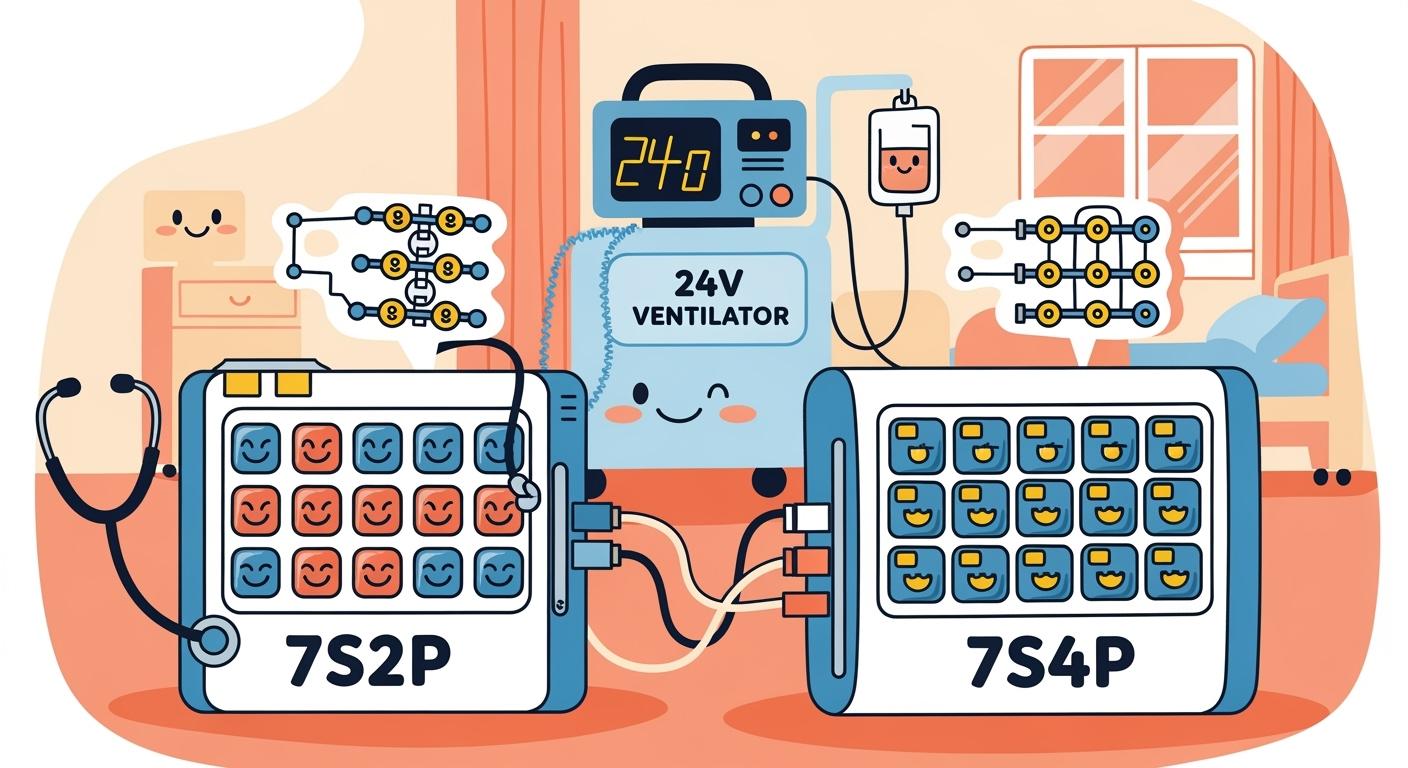
A 7S2P battery pack is generally smaller and lighter, while a 7S4P pack can provide approximately twice the capacity and runtime when both use the same cell model. However, 7S4P is not automatically the better choice for every medical ventilator. The correct configuration depends on the ventilator’s power consumption, required backup time, enclosure space, weight limit, peak current, charging strategy, and risk-management requirements.
For NMC lithium-ion cells, a 7S configuration typically provides a nominal voltage of approximately 25.2–25.9 V and reaches 29.4 V when fully charged. A 7S LiFePO4 pack operates at a different voltage range, approximately 22.4 V nominal and 25.55 V fully charged. These chemistries therefore require different chargers, protection thresholds, and power-interface designs.
You want a ventilator battery pack to provide predictable backup power without compromising portability, patient safety, or device reliability. A properly engineered design combines qualified cells, a robust Battery Management System, redundant protection, temperature monitoring, secure mechanical construction, and compatibility with the ventilator’s power architecture.
Design factor | 7S2P | 7S4P |
|---|---|---|
Total cells | 14 | 28 |
Nominal voltage | Same when using the same chemistry | Same when using the same chemistry |
Capacity | Lower | Approximately twice that of 7S2P |
Runtime | Shorter | Longer |
Size and weight | Smaller and lighter | Larger and heavier |
Current sharing | Higher current per parallel cell | Lower current per parallel cell at the same pack load |
Typical fit | Portable or space-constrained ventilators | Longer-runtime systems with sufficient enclosure space |
Key Takeaways
Select 7S2P when compact dimensions and lower weight are more important than maximum runtime.
Select 7S4P when the ventilator requires longer backup time and can accommodate additional cells, weight, and thermal load.
Do not treat NMC and LiFePO4 versions of a 7S pack as electrically interchangeable.
Size the battery from the ventilator’s measured power profile, required backup duration, conversion efficiency, aging allowance, and safety margin.
Use a medical-device risk-management process to define protection, monitoring, fault response, charging, and replacement requirements.
Validate the complete battery and ventilator system instead of relying only on individual cell or battery certifications.
Part1: Comparing 7S2P and 7S4P Configurations
1.1 Electrical and Capacity Comparison
The designation 7S2P means that seven cell groups are connected in series, with two cells connected in parallel within each group. This arrangement contains 14 cells in total.
A 7S4P configuration also has seven series-connected groups, but each group contains four parallel cells. It therefore uses 28 cells.
Connecting cells in series increases pack voltage. Adding cells in parallel increases capacity and current capability while keeping the nominal pack voltage unchanged.
Design factor | 7S2P | 7S4P |
|---|---|---|
Total cell count | 14 | 28 |
Series groups | 7 | 7 |
Cells per parallel group | 2 | 4 |
Nominal voltage | Determined by chemistry | Determined by chemistry |
Capacity | Two times single-cell capacity | Four times single-cell capacity |
Stored energy | Lower | Approximately twice that of 7S2P |
Size and weight | Smaller and lighter | Larger and heavier |
Current per cell | Higher at the same pack load | Lower at the same pack load |
Typical application | Portable or compact ventilators | Longer-runtime ventilators |
For example, when 3.5 Ah cells are used, a 7S2P pack has a nominal capacity of approximately 7 Ah. A 7S4P pack built with the same cells provides approximately 14 Ah. Actual usable capacity depends on discharge current, temperature, cutoff voltage, cell aging, and power-conversion efficiency.
1.2 Choosing the Right Configuration
A 7S4P configuration offers more stored energy, but that does not make it universally superior. The additional cells increase pack dimensions, weight, cost, assembly complexity, and the number of electrical connections that must be controlled and validated.
A 7S2P pack may be more appropriate for:
Portable and transport ventilators
Home-care devices with strict weight limits
Ventilators that use the battery primarily for short backup periods
Designs with limited internal enclosure space
Systems that support external or swappable backup batteries
A 7S4P pack may be more appropriate for:
Ventilators requiring longer internal backup time
Devices with higher continuous power consumption
Systems that must reduce the current carried by each cell
Equipment with sufficient space and structural support
Applications where fewer battery changes are required
The selection should follow the ventilator’s power budget and risk-management process rather than a general assumption that more cells always produce a safer system.
Part2: 7S2P vs 7S4P Basics
2.1 What Is 7S2P?
When you see “7S2P,” it means seven cells are in a line. There are two groups of these lines next to each other. This makes a battery pack with 14 cells. Each cell in a line adds more voltage. The groups next to each other give more power to use. For ventilators, you use LiFePO4, NMC, LCO, or LMO. The 7S2P pack gives about 25.2V. It can give a steady current of 5A. You can charge it with 2A.
Specification | Value |
|---|---|
Nominal Voltage | 25.2V |
Max Continuous Discharge Current | 5A |
Charge Current | 2A |
You pick 7S2P if you want a light and small pack. These packs are good for portable medical tools or as backups.
2.2 What Is 7S4P?
If you need more energy and longer use, you pick “7S4P.” Seven cells are in a line, and there are four groups next to each other. This makes a pack with 28 cells. The voltage stays at 25.2V, but you get double the power of 7S2P. You see this setup in ventilators for intensive care and important systems. The bigger pack gives more energy and lasts longer.
You choose 7S4P when you need the battery to last a long time. Hospitals and clinics use these packs so care does not stop.
2.3 Series and Parallel Effects
It is important to know how series and parallel setups change how batteries work and stay safe. Series setups make the voltage higher. Parallel setups give more power to use. Each way has its own effects.
Configuration Type | Performance Impact | Safety Considerations |
|---|---|---|
Series | Higher voltage, but if one cell fails, the whole pack is affected | Electrical shorts can cause big fire risks |
Parallel | More power, and if one cell fails, it is not as bad | Needs checking to stop too much current |
Overcharge protection stops charging at 4.25V.
Over-discharge protection works at 2.75V.
Temperature checks keep packs safe from -20°C to 60°C.
Short-circuit protection keeps the pack from harm.
Packs follow the UL 2054 safety rule.
Tip: Always check each cell’s voltage and temperature. This helps your ventilator battery pack stay safe and work well.
Part3: Performance Comparison
3.1 Capacity and Runtime
When you pick a battery pack for a ventilator, you must think about capacity and runtime. The 7S4P setup gives more battery power than 7S2P. This means the battery lasts longer, which is very important in intensive care. Hospitals need batteries to meet strict rules. The table below shows how long the battery should work:
>30 min |
>20 min |
≥1 |
Your battery must run for at least 20 minutes. Many hospitals want batteries to last over an hour. The 7S4P pack helps you reach these goals. More cells in parallel give more energy. This is important for safety and making sure the ventilator works well.
3.2 Weight and Size
You need to balance how long the battery lasts with its weight and size. The 7S2P pack is lighter and smaller. You can use it in portable medical tools or backup systems. The 7S4P pack is bigger and heavier. It is best when you need the battery to last a long time and work well. This trade-off happens in robotics, security, and industry too. You must check if your device can handle the extra weight and space.
Note: Always check what your device can handle before picking a battery pack.
3.3 Intensive Care Ventilator Needs
Intensive care ventilators need strong batteries and good safety. You must use a battery pack that lasts a long time and meets venting needs. The 7S4P pack gives more runtime, but you must manage venting well. More cells make more heat, so you need good venting systems. You must follow safety rules for medical devices. Good venting keeps the battery safe and the ventilator working.
These needs are also seen in other fields like infrastructure and industry. But in medical devices, safety and venting are always most important.
Part4: Safety and Compliance in Battery Pack Design
4.1 Venting Systems
A good vent system keeps your ventilator safe. Dual-stage venting is very important. The first stage lets out a little gas. It also blocks dust and water. If pressure gets too high, the second stage opens fast. This lets out more gas quickly. These two steps help stop battery failure if it gets too hot. Controlled venting sends gases away from important parts. This lowers the chance of leaks, fires, or explosions. Using these vent systems protects the battery and people who need the ventilator.
4.2 Thermal Management
Thermal management keeps the battery cool and working right. New systems use liquid cooling and special phase change materials. Liquid cooling moves heat away from the cells. The phase change materials soak up extra heat when the battery works hard. This stops the battery from getting too hot. It keeps all the cells at the same temperature. Good thermal management helps the battery last longer and work better. This is very important for ventilators used for many hours in hospitals. Always check that your design has these features.
4.3 Medical Standards
You must follow strict rules when making battery packs for ventilators. These rules keep patients safe and make sure the product works well. The table below shows the most important standards:
Standard | Description |
|---|---|
ISO 13485 | Safety and performance for medical device makers |
IEC 60601-1 | Basic safety and risk management for medical electrical equipment |
UL 2054 | Safety for batteries in medical devices |
IEC 62133 | |
UN 38.3 | Tests for safe shipping of lithium-based batteries |
You also need overcharge and over-discharge protection. You need temperature checks and short-circuit protection too. These steps help stop problems like fires or gas leaks. Always make sure your battery pack meets these standards before using it in a ventilator.
Part5: Practical Design Factors for Ventilators
5.1 Swappable and Hot-Swap Design
You want your ventilator to keep working all the time. Swappable battery packs let you change batteries fast when the power gets low. Hot-swap designs let you put in a new battery while the ventilator is still running. This is very important for emergencies and intensive care. Many medical, robotics, and security devices use hot-swap packs so they do not stop working. You should pick a vent system that makes it easy and safe to take out the battery. Always make sure the vent path is open when you change batteries.
Tip: Hot-swappable packs help you keep the ventilator running, which is very important for patient safety.
5.2 Charging and Maintenance
Charging and taking care of your lithium battery pack helps it last longer. You should do these things:
Keep the battery partly charged (40-60%) when not using it.
Do not let the battery get too hot or too cold. Keep it between 15–25°C.
Watch the battery’s temperature when charging.
Check the battery often for swelling, cracks, or leaks.
Test the battery’s power and load on a schedule.
Do not let the battery run out all the way before charging.
Use charging that checks the temperature for safety and better charging.
Charge the battery sometimes even when not using it to stop it from losing power.
A good battery management system (BMS) or protection circuit module (PCM) helps you check charging, temperature, and venting. These systems are used in medical, infrastructure, and industrial devices.
5.3 Hardware Integration
You need to connect the battery pack to the ventilator hardware so it works safely and well. The table below shows important things:
Aspect | Description |
|---|---|
Safety Standards | Batteries must follow strict safety and compliance rules to keep them safe and reliable for patients. |
Hot-Swappable Packs | These packs let the ventilator keep working, which is very important for portable life-saving machines. |
Regular Testing and Monitoring | Checking the battery often helps find problems early and keeps the battery working with industry rules. |
You should make the vent system work with the ventilator’s airflow and cooling. Good design helps the battery last longer and keeps it safe in medical, robotics, and industrial uses. Always test the vent and battery system together to make sure they meet all the rules.
Part6: Recommendations for Application
6.1 Runtime and Capacity Needs
You need to make sure the battery lasts as long as your ventilator needs. In hospitals, batteries usually need to last 2 to 4 hours. Some special ventilators can last up to 8 hours. You should always check how long the battery lasts, especially in emergencies or intensive care. Hospitals change batteries when they last 25% less time or hold less than 70% of their power. You must also check if the voltage stays steady while using the device. This helps make sure your ventilator does not stop working without warning.
Most ventilators work for 2–4 hours on a battery.
Some top models can last up to 8 hours.
Change the battery if:
Power drops below 70%
Battery lasts 25% less time
Voltage is not steady
You should pick a lithium battery pack (LiFePO4, NMC, LCO, LMO) that meets or goes above these needs. This is important for medical, robotics, security, and industrial devices.
6.2 Weight and Portability
You need to think about weight when picking a battery for portable ventilators or field tools. Lighter batteries make it easier to carry and use the device in emergencies, military, or transport. You should find a good balance between battery life and weight. Heavier batteries can last longer but are harder to use in the field.
Aspect | Details |
|---|---|
Battery Duration | At least 4 hours is best for emergencies |
Weight Impact | Heavy batteries make devices harder to carry |
Device Types | Turbine-driven ventilators use up batteries faster than piston-driven ventilators |
You should look at where and how you will use the device. In medical, security, and infrastructure jobs, both battery life and weight matter for how well the device works.
6.3 Cost and Supply Chain
You need to think about cost, how easy it is to get batteries, and if they are made in a good way. You should look at the total cost, including how often you need to buy new batteries when they lose power. Good suppliers help you avoid waiting for batteries or running out. You must also make sure the batteries are made without hurting the environment or using conflict minerals. Learn more about sustainability and conflict minerals.
Pick suppliers who show where LiFePO4, NMC, LCO, and LMO cells come from.
Check battery life and plan to change them on time.
Look for supply chain problems in medical, robotics, security, and industrial jobs.
Tip: A good supply chain and safe sourcing help you keep your device working and follow the rules.
You learned that 7S4P has more capacity and lasts longer than 7S2P. This is why it works best for ventilators in intensive care. You need to check venting, thermal management, and if it follows medical rules. Always test your battery pack for pressure equalization, keeping out water and dust, and letting out gas in emergencies. If you want more information, look at the tables about design or read the rule guides.
Design Consideration | Why It Matters for Medical Devices |
|---|---|
Pressure Equalization | Protects sensitive parts |
Ingress Protection | Keeps water and dust out |
Emergency Degassing | Prevents damage during critical events |
Tip: Pick a battery pack that fits how long you need it to run, keeps people safe, and follows the rules for your device.
FAQ
What is the main advantage of a 7S4P lithium-ion battery pack for ventilators?
A 7S4P pack gives you more power and lasts longer. It is best for ventilators used in hospitals and clinics. This setup works with LiFePO4, NMC, LCO, and LMO chemistries.
How do you ensure battery pack safety in medical devices?
You need dual-stage venting, thermal management, and a battery management system (BMS). These features stop the battery from getting too hot. They help keep patients safe. Always follow IEC 60601-1 and UL 2054 rules.
Why do medical devices need overcharge and over-discharge protection?
Overcharge and over-discharge protection keep lithium battery packs safe. These systems help stop fires and make batteries last longer. You should check for these features in LiFePO4, NMC, LCO, and LMO packs.
Can you hot-swap lithium battery packs in ventilators?
Yes, you can hot-swap packs if the ventilator allows it. This lets you change batteries without turning off the device. It helps keep medical, robotics, and security devices working all the time.
What is the typical cycle life for lithium-ion chemistries used in ventilator battery packs?
LiFePO4 packs last over 2,000 cycles. NMC, LCO, and LMO packs last more than 1,000 cycles. Pick the chemistry that fits your needs for runtime and replacement.


