

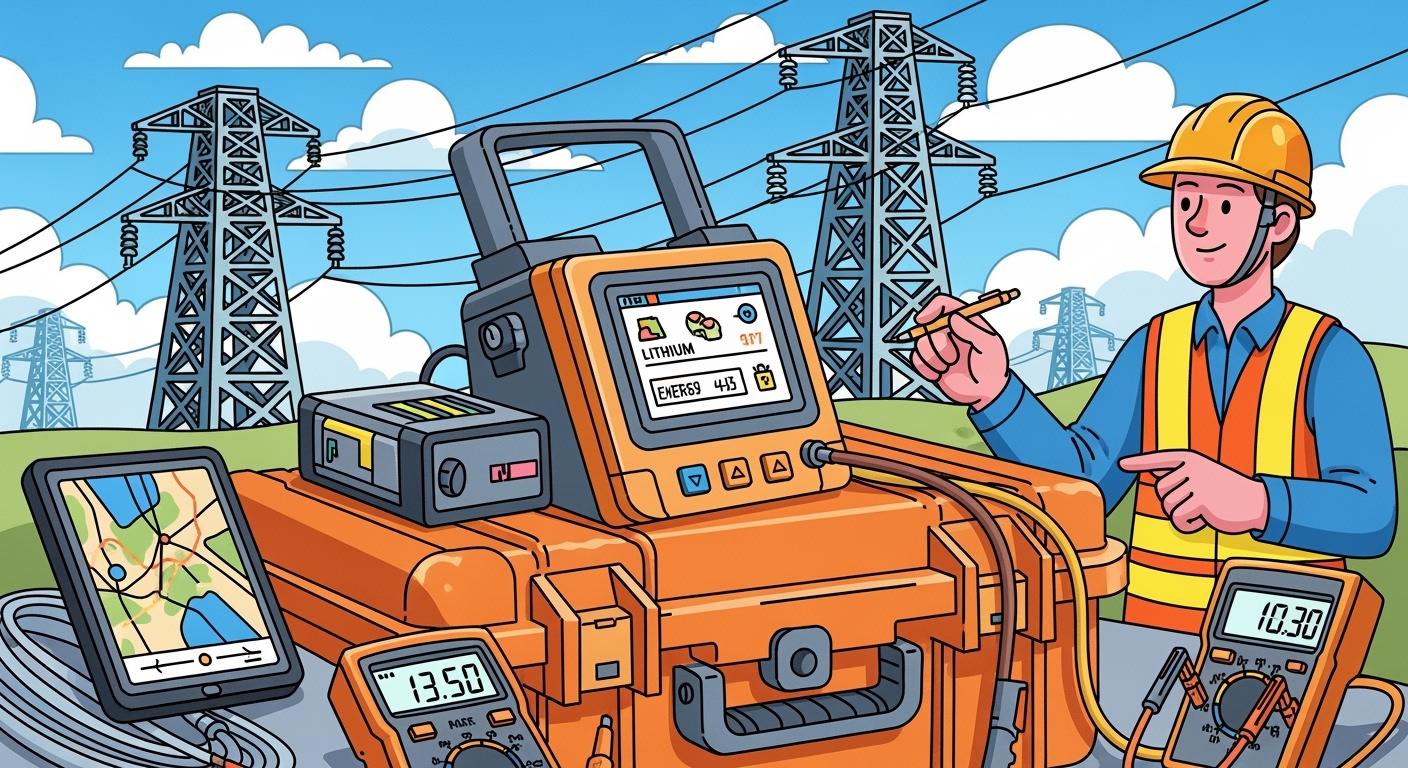
Quick Answer: Lithium battery solutions can improve the runtime, portability, charging efficiency, and diagnostic reliability of power grid inspection equipment. LiFePO4 is generally preferred when safety and long cycle life are priorities, while NMC is suitable when higher energy density and lower weight are required. The battery chemistry, capacity, BMS, enclosure, connectors, and charging system must be designed around the equipment’s actual load and operating environment.
Power grid inspection equipment must operate reliably across substations, transmission lines, tunnels, and remote utility sites. Inspection robots, thermal imagers, partial-discharge detectors, communication terminals, and portable diagnostic instruments may encounter vibration, moisture, dust, temperature extremes, and limited access to charging infrastructure.
Compared with lead-acid batteries, properly designed custom lithium battery packs can offer higher usable energy, lower weight, faster charging, and reduced maintenance. A dedicated Battery Management System further improves reliability by monitoring voltage, current, temperature, and cell balance.
Feature | Lithium Batteries | Lead-Acid Batteries |
|---|---|---|
Typical cycle life | Approximately 1,000–5,000+ cycles, depending on chemistry and operating conditions | Approximately 300–800 cycles |
Energy density | Approximately 90–220 Wh/kg | Approximately 30–50 Wh/kg |
Charging time | Commonly 2–5 hours when supported by the cells and charger | Commonly 8–12 hours |
Weight | Lower for equivalent usable energy | Higher |
Maintenance | Generally low | Regular inspection may be required |
BMS requirement | Essential for monitoring and protection | Usually uses simpler charge control |
Field suitability | Well suited to portable and mobile equipment | Better suited to stationary, cost-sensitive applications |
These figures are typical engineering ranges rather than guaranteed specifications. Actual performance depends on cell chemistry, depth of discharge, temperature, charge rate, pack design, and maintenance practices.
Key Takeaways
Choose LiFePO4 batteries when thermal stability and long cycle life are the main priorities.
Consider NMC lithium-ion batteries when portable inspection equipment requires higher energy density and lower weight.
Use a properly configured BMS to manage overcharge, over-discharge, overcurrent, short-circuit, cell-balancing, and temperature risks.
Calculate capacity from continuous power consumption, peak loads, required runtime, temperature derating, and an appropriate design reserve.
Validate the complete battery system for vibration, shock, ingress exposure, temperature, charging behavior, and electromagnetic compatibility.
Customize voltage, capacity, enclosure, connectors, and communication protocols for the specific inspection device or robot.
Part1: Utility Inspection Equipment and Power Grid Needs

1.1 Types of Utility Inspection Equipment
You encounter a wide range of utility inspection equipment when monitoring the power grid. These tools include advanced lithium battery-powered inspection devices, non-destructive inspection equipment, and power inspection devices. Non-destructive inspection equipment helps you assess the integrity of cables, transformers, and substations without causing damage. You use power inspection devices to check voltage, current, and thermal conditions in real time. Non-destructive inspection equipment also includes portable analyzers, drones, and robots that perform inspection operations efficiently. You rely on utility inspection equipment to detect faults, measure performance, and ensure safety. Non-destructive inspection equipment supports your inspection operations by providing accurate data and reducing manual labor. You deploy utility inspection equipment in harsh environments, so you need reliable energy sources for continuous operation.
1.2 Energy Demands in Power Grid Operations
Utility inspection equipment faces unique energy demands during inspection operations. Non-destructive inspection equipment requires stable power for extended periods. You need quick charging and seamless transitions between inspection tasks. Power inspection devices must deliver consistent energy output to avoid interruptions. Non-destructive inspection equipment often operates in remote locations, so you depend on batteries with high energy density and long cycle life. Lithium battery packs, including LiFePO4 and NMC chemistries, provide the reliability you need. These batteries offer fast charging, stable performance, and reduced maintenance. You benefit from advanced battery management systems that monitor voltage and temperature, enhancing safety and efficiency.
Lithium batteries reduce maintenance needs by up to 75%, allowing you to focus on inspection operations and minimize downtime.
The table below compares lithium batteries to traditional batteries in utility inspection equipment:
Feature | Lithium Batteries | Traditional Batteries |
|---|---|---|
Energy Storage Mechanism | Fast ion movement between electrodes | Slower chemical reactions |
Charge Speed | Quicker charging | Longer charging times |
Maintenance Needs | Requires less maintenance | Frequent inspections needed |
Efficiency | Higher efficiency overall | Lower efficiency |
You gain reliable energy for non-destructive inspection equipment and power inspection devices, ensuring your inspection operations run smoothly in the power grid.
Part2: Lithium Battery Solutions Advantages
2.1 Performance and Maintenance Reduction
You depend on inspection robots and equipment that operate in demanding environments. High-performance lithium batteries, especially LiFePO4 and NMC chemistries, deliver reliable performance and minimize maintenance needs. You benefit from lithium battery solutions that do not require water topping or regular servicing. This reduces operational costs and lets you focus on inspection tasks.
You see a clear difference when comparing lithium battery solutions to other battery types. The table below shows standardized technical data for common battery chemistries used in inspection robots and equipment:
Battery Type | Cycle Life (100% DoD) | Energy Density (Wh/kg) | Maintenance Frequency | Typical Applications |
|---|---|---|---|---|
LiFePO4 | 3,500-6,000+ | 120-160 | Minimal | Inspection robots, grid monitoring |
NMC | 1,000-2,000 | 150-220 | Minimal | Inspection robots, field diagnostics |
LCO | 500-1,000 | 150-200 | Moderate | Portable equipment |
LMO | 300-700 | 100-150 | Moderate | Handheld inspection devices |
Solid-State | 5,000+ | 250-350 | Minimal | Advanced battery technology, future inspection robots |
Lithium Metal | 1,000-2,000 | 300-400 | Minimal | High energy density batteries, prototype equipment |
You notice that lithium battery solutions require minimal upkeep compared to traditional battery technologies. You do not need regular fluid level checks, watering, or equalization charges. You follow a structured service schedule to maximize safety and lifespan:
Monthly: Visual inspection, check for alerts, clean exterior
Quarterly: Check connection tightness, review performance logs
Annually: Full system diagnostic, firmware updates, torque checks
Primary lithium batteries can last 10-20 years without maintenance. You choose these batteries for remote inspection robots and equipment where access is limited.
2.2 Safety and Reliability in Field Use
You trust lithium battery solutions for their safety features and reliable performance in harsh environments. Battery management systems play a key role in protecting your inspection robots and equipment. These systems monitor voltage, temperature, current, and state of charge to prevent abnormal conditions.
The table below highlights essential safety features:
Safety Feature | Description |
|---|---|
Battery Management Systems (BMS) | Continuously monitor voltage, temperature, current, and state of charge to prevent abnormal conditions. |
Cooling Systems | Prevent overheating, especially in high-capacity applications. |
Regulatory Standards | Ensure compliance and safety in various operational environments. |
You benefit from recognized testing expertise and a holistic systems approach to safety. You rely on failure analysis and audits to identify vulnerabilities in battery systems. You use inspection robots and equipment that undergo multimodal assessments to ensure reliable performance in harsh field environments. This approach helps you identify risks and mitigate hazards, providing a comprehensive understanding of the system.
2.3 Battery Management Systems and Longevity
You maximize the lifespan of high-performance lithium batteries by using advanced battery management systems. These systems keep cells within safe voltage and temperature limits, significantly extending battery life compared to unprotected operation. An effective BMS prevents overcharging, over-discharging, and excessive cycling, which are critical for increasing battery longevity.
The table below shows the impact of battery management systems on cell life:
BMS Implementation | Impact on Lifespan |
|---|---|
Poor BMS (allows voltage limits, overheating) | Shortens cell life |
Good BMS (maintains safe limits) | Extends cell life |
You use ai-powered battery management to optimize performance and safety in inspection robots and equipment. You monitor real-time data and adjust charging protocols to ensure reliable performance and long-life batteries.
You see differences in lifespan between LiFePO4 and NMC batteries in inspection robots and equipment. The table below summarizes cycle life at different temperatures:
Temperature (°C) | LiFePO4 Cycles (100% DoD) | NMC Cycles (100% DoD) | Notes |
|---|---|---|---|
10°C (Cool) | 2,000 – 3,000 | 800 – 1,200 | Internal resistance increases; NMC degrades slightly faster. |
25°C (Standard) | 3,500 – 6,000+ | 1,000 – 2,000 | Ideal operating temperature; LiFePO4 shows a massive advantage. |
35°C (Warm) | 2,500 – 4,000 | 500 – 1,000 | Heat accelerates chemical breakdown; NMC life shortens drastically. |
You select high-performance lithium battery solutions for inspection robots and equipment to ensure reliable performance, high energy density, and minimal maintenance. You rely on advanced battery technology and ai-powered battery management to deliver consistent energy density and maximize operational uptime.
Note: You achieve reliable performance and safety by combining high-performance lithium batteries with robust battery management systems and structured maintenance schedules.
Part3: Features and Safety for Inspection Robots

3.1 Key Features of Lithium Battery Packs
You need inspection equipment that performs reliably in the field. Lithium battery packs offer several features that enhance the performance of inspection robots and non-destructive inspection equipment:
You can customize battery packs to meet specific power and size requirements for each piece of equipment.
These batteries fit a wide range of robotic applications, including rail inspection and delivery robots.
You benefit from extended operating hours and compact designs, which support long non-destructive inspection tasks.
Custom battery packs allow you to match the shape and size to your robot’s design.
You receive precise voltage and current delivery, which optimizes inspection performance.
Battery management systems enable predictive maintenance and reduce unexpected downtime.
Advanced safety features, such as thermal fuses and redundant cutoffs, protect your equipment during operation.
LiFePO4 batteries provide long cycle life, ensuring reliability for repeated non-destructive inspection cycles.
High energy density supports efficient movement and load capacity, even in challenging environments.
3.2 Safety Standards and Certifications
You must ensure that your inspection equipment meets strict safety standards. Lithium battery packs for non-destructive inspection equipment comply with several important certifications:
UL 1642 covers the safety of individual cells through rigorous abuse tests.
UL 2054 addresses the safety of entire battery packs, including electrical and mechanical stress tests.
UN38.3 ensures safe transportation by evaluating battery safety performance.
UL Certification confirms fire resistance and electrical safety.
CE Certification demonstrates compliance with European safety, health, and environmental requirements.
IEC/EN 62133 provides a global safety standard for lithium-ion batteries.
RoHS Compliance regulates hazardous substances to protect health and the environment.
FCC Certification ensures batteries with wireless functions do not cause electromagnetic interference.
3.3 Maintenance Best Practices
You can extend the life of your inspection equipment by following best practices for battery maintenance:
Inspect battery packs visually before and after each inspection operation.
Monitor battery management system alerts for early signs of wear or failure.
Clean battery terminals and housings to prevent dust buildup.
Schedule regular firmware updates for battery management systems.
Store non-destructive inspection equipment in a cool, dry place when not in use.
Replace batteries at the end of their rated cycle life to maintain reliability and safety.
Train your team on advanced safety features and emergency procedures.
You ensure reliable, safe, and sustainable operation for all your non-destructive inspection equipment by following these guidelines.
Part4: Selecting Lithium Battery Solutions
4.1 Matching Batteries to Utility Inspection Equipment
You must match lithium battery solutions to your inspection robots and non-destructive inspection equipment for optimal performance. Each application requires a unique approach. You need to consider the load profile, operating temperature, and usage cycles. You should select batteries with the right voltage, capacity, and discharge ratings for your inspection tasks. You also need battery management systems that provide cell balancing, temperature sensors, and integration with real-time monitoring platforms. Customization plays a key role. You can tailor battery packs for physical design, electrical specifications, and software programming to fit your inspection robots.
Factor | Description |
|---|---|
Application-Specific Engineering | Batteries must be designed for specific load profiles, temperatures, and usage cycles. Key specifications include voltage, capacity, and discharge ratings. |
Battery Management System (BMS) | A high-quality BMS is essential for safety and longevity, featuring cell balancing, temperature sensors, and system integration. |
Customization | Batteries should be tailored to meet unique equipment needs in terms of physical design, electrical specifications, and software programming. |
You can see how these factors influence your choice for inspection robots, non-destructive testing devices, and field diagnostic tools. For example, you may need a compact LiFePO4 pack for a rail inspection robot or a high-capacity NMC solution for a drone performing real-time monitoring of transmission lines. You must ensure that your battery management systems support real-time data collection and predictive maintenance.
4.2 Selection Criteria for Power Grid Applications
You must follow strict criteria when selecting lithium battery solutions for power grid inspection. Safety, accessibility, and compliance matter most. You should choose battery packs with secure compartments to prevent unauthorized access. You need to test battery compartments to ensure they are not easily accessible, which reduces risks in industrial settings. You must confirm that your batteries meet force and method standards for safety compliance. Clear warning labels help your teams understand hazards and follow grid safety protocols. You should select battery compartment options that protect your inspection robots and non-destructive equipment.
Criteria | Description |
|---|---|
Construction | Choose battery packs with secure compartments to prevent unauthorized access and enhance grid safety. |
Accessibility | Test battery compartments to ensure they are not easily accessible, reducing risks in utility and industrial settings. |
Testing Requirements | Confirm that your battery meets force and method standards for safety compliance. |
Warning Labels | Use clear labels to inform teams about hazards and support grid safety protocols. |
Battery Compartment Options | Select secure options to protect your equipment and maintain grid safety. |
You must also consider the operational requirements of your inspection robots. You need batteries that deliver high energy density for long missions and support real-time monitoring. You should select battery management systems that provide real-time alerts and diagnostics. You must ensure that your solutions meet industry standards for non-destructive inspection and field diagnostics.
4.3 Application Scenarios and Examples
You can apply lithium battery solutions across many sectors. In the power grid, you use inspection robots for substation monitoring, line patrol, and transformer diagnostics. You rely on non-destructive inspection equipment for cable testing and fault detection. In the medical sector, you use battery-powered imaging robots for real-time monitoring of patient conditions. In robotics, you deploy autonomous vehicles for infrastructure inspection and maintenance. Security systems use non-destructive robots for perimeter checks and real-time alerts. In transportation, you use inspection robots for rail track analysis and tunnel safety. Industrial sectors rely on non-destructive equipment for pipeline inspection and asset management. Consumer electronics benefit from high energy density batteries for portable diagnostic tools.
You must address quality control and production challenges when selecting lithium battery solutions for your inspection robots. You face issues such as inconsistent internal resistance among cells, which can cause voltage discrepancies and affect performance. Uneven heat distribution can lead to thermal runaway, creating severe safety hazards. Regulatory compliance issues arise when you need consistent performance across battery packs. You must avoid penalties by meeting all standards. New production facilities require extensive safety validations and environmental assessments before you can begin operations. Maintaining consistent quality in high-volume production is difficult due to tight tolerances and contamination-free requirements. Variations in production processes can lead to safety concerns and performance degradation.
Tip: You should work with suppliers who provide rigorous testing, certification, and quality assurance for all lithium battery solutions. This ensures your inspection robots and non-destructive equipment deliver reliable real-time monitoring and high energy density in every application.
You can optimize your inspection operations by selecting the right lithium battery solutions, following industry standards, and addressing production challenges. You ensure safe, efficient, and sustainable performance for all your inspection robots and non-destructive equipment.
Part5: Innovations and Trends in Power Grid Inspection
5.1 Advances in Lithium Battery Technology
You see rapid progress in lithium battery technology for utility inspection robots and field diagnostics. New battery chemistries, such as solid-state batteries, deliver higher energy density and longer cycle life. AI-powered battery management systems help you predict maintenance needs and optimize performance. You benefit from improved recycling methods that recover valuable materials and reduce environmental impact. These innovations support your sustainability goals and lower resource dependency.
Here is a summary of key advances:
Innovation | Description | Impact |
|---|---|---|
Recycling and Sustainability Efforts | Improved methods for recycling lithium batteries to recover valuable materials. | Lowers environmental impact and reduces resource dependency. |
AI-Powered Battery Management Systems | Using AI to optimize battery performance and lifespan through predictive maintenance. | Extends battery life and enhances safety through better diagnostics. |
Solid-State Batteries | Utilize a solid electrolyte, offering greater energy density than traditional lithium-ion batteries. | Potential for longer-lasting batteries that can hold more energy. |
You can learn more about sustainability efforts in lithium battery solutions at Our Approach to Sustainability.
5.2 Inspection Robots and Utility Monitoring Trends
You notice inspection robots becoming smarter and more autonomous. These robots use lithium battery packs with advanced chemistries like LiFePO4 and NMC. You gain longer operating hours and improved reliability. Real-time monitoring platforms help you track battery health and performance. You see robots equipped with sensors and AI algorithms that detect faults and optimize inspection routes. Utility companies invest in robots that handle complex tasks, such as substation monitoring and transmission line patrol. You benefit from reduced manual labor and increased safety in hazardous environments.
Robots with lithium battery packs support efficient utility monitoring and help you meet industry standards for reliability.
5.3 Future of Field Diagnostics
You prepare for a future where field diagnostics rely on smarter energy solutions. Solid-state batteries promise longer-lasting power and safer operation. AI-powered battery management systems give you real-time insights and predictive alerts. You expect inspection robots to become more efficient and sustainable. Utility companies will adopt lithium battery solutions that minimize downtime and maximize uptime. You see a shift toward greener practices and advanced recycling methods.
You stay ahead by choosing lithium battery packs that support innovation and sustainability.
You see how lithium battery solutions transform inspection robots in the power grid. These solutions deliver What are the main benefits of LiFePO4 and NMC batteries for power grid inspection equipment?
LiFePO4 provides strong thermal stability, long cycle life, and predictable performance. NMC offers higher energy density, making it suitable for portable instruments and inspection robots where size and weight are important. The best chemistry depends on runtime, power demand, operating temperature, and enclosure constraints.
How do lithium battery packs compare with lead-acid batteries?
Lithium battery packs generally provide higher energy density, lower weight, faster charging, and longer cycle life. Lead-acid batteries can remain suitable for stationary equipment where weight and volume are less important and initial cost is the primary concern.
What safety features should a field inspection battery include?
The pack should include overcharge, over-discharge, overcurrent, short-circuit, and temperature protection. Depending on the configuration, it may also require cell balancing, state-of-charge estimation, fault logging, and communication through CAN, RS485, or SMBus. Relevant transport and product-level compliance requirements should also be confirmed.
How does a BMS improve reliability?
A BMS monitors cell voltage, pack current, temperature, and operating status. It can disconnect the battery when unsafe conditions occur, balance series-connected cells, record faults, and provide diagnostic data to the host equipment. These functions help prevent unexpected shutdowns and premature battery degradation.
Can lithium battery packs be customized for different inspection robots and instruments?
Yes. A custom lithium battery solution can be developed around the equipment’s voltage, capacity, peak current, dimensions, connector, communication protocol, IP-rated enclosure, and environmental requirements. Large Power supports battery integration for industrial equipment, infrastructure monitoring, and inspection robots.


