

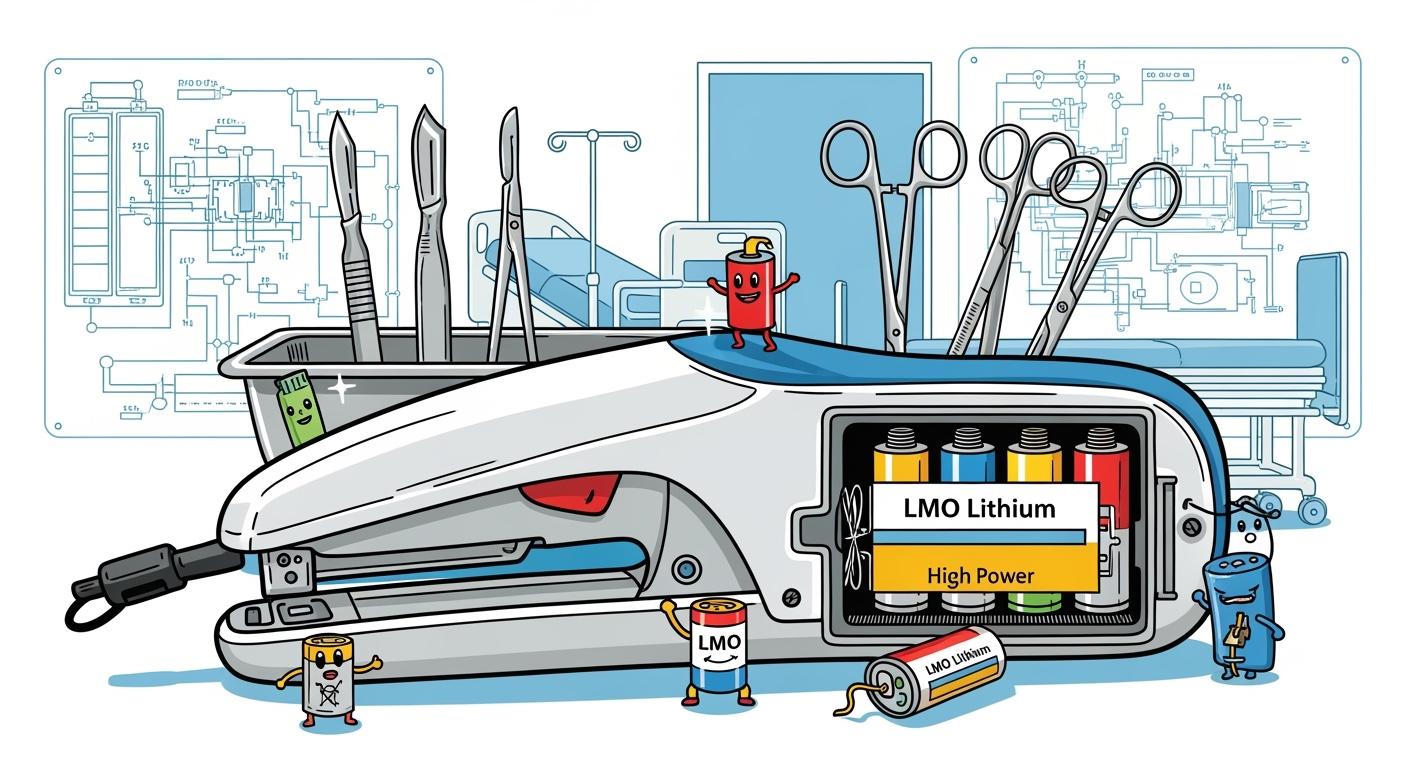
Quick Answer: Powered medical staplers require batteries that can deliver short, high-current pulses without excessive voltage drop, heat generation, or premature shutdown. Rechargeable LMO cells may support high-power applications, but engineers must distinguish them from primary lithium manganese dioxide cells. Cell chemistry, pulse capability, internal resistance, protection design, sterilization strategy, shelf life, and medical-device validation must be evaluated together.
Powered surgical staplers use electric motors to drive tissue compression, staple formation, cutting, and control functions. These operations can create short current peaks that are substantially higher than the device’s standby or average current. A battery that appears adequate from its nominal capacity may still fail if its internal resistance causes excessive voltage sag during actuation.
High-power lithium manganese oxide cells can offer strong rate capability and good thermal characteristics. However, the term “manganese lithium battery” may describe different electrochemical systems. Engineers should confirm whether the application requires rechargeable LMO cells or primary Li-MnO₂ cells before defining voltage, charging, shelf-life, and protection requirements.
Feature | Rechargeable LMO | Primary Li-MnO₂ |
|---|---|---|
Typical nominal voltage | Approximately 3.7V per cell | Commonly approximately 3.0V per cell |
Rechargeability | Rechargeable | Non-rechargeable |
Main design advantage | High power and relatively low internal resistance | Long storage life and readiness for single-use devices |
Pulse capability | Depends on cell size, construction, temperature, and state of charge | Depends strongly on spiral or bobbin construction and cell specification |
Cycle life | Application- and cell-dependent | Not applicable |
Shelf life | Lower than specialized primary lithium cells | Can be long when properly stored |
Charging circuit | Requires controlled charging and protection | Must not be recharged |
Typical design use | Reusable powered instruments | Single-use or long-shelf-life medical devices |
These values are general chemistry characteristics rather than product specifications. Engineers must use the selected cell manufacturer’s datasheet and validate pulse current, voltage drop, temperature rise, and shelf life in the finished stapler.
Key Takeaways
Evaluate peak motor current and voltage sag, not only nominal capacity and average power consumption.
Distinguish rechargeable LMO batteries from primary Li-MnO₂ batteries before designing the power architecture.
Measure internal resistance and temperature rise across the full state-of-charge and operating-temperature range.
Use appropriate electrical protection for overcurrent, short-circuit, undervoltage, overtemperature, and unintended activation.
Do not assume the battery can withstand autoclave, vaporized hydrogen peroxide, ethylene oxide, radiation, or other sterilization processes.
Design removable or separately sterilized battery modules when the selected cells cannot tolerate the device’s sterilization method.
Maintain cell and component traceability through the applicable medical-device quality and risk-management process.
Part1: Battery Design Considerations for Medical Staplers
1.1 Power and Reliability
You need reliable power delivery for powered medical staplers. These devices must generate high current pulses to drive the stapling mechanism quickly and consistently. High-power LMO lithium cells support strong current output, which ensures that each staple fires with precision. You cannot risk inconsistent performance in surgical settings. Battery Design Considerations must include the ability to deliver peak power on demand, even after long storage periods. LMO lithium cells offer low self-discharge rates, so you can trust the stapler to work when needed. In medical, robotics, and industrial sectors, reliability remains a top priority for battery-powered tools.
1.2 Safety and Fault Protection
You must prioritize safety in every aspect of battery pack design. Medical staplers operate in environments where failure can have serious consequences. You should integrate advanced fault protection features, such as overcurrent, overvoltage, and short-circuit protection. A robust Battery Management System (BMS) helps monitor cell health and prevent unsafe conditions. You also need to select cell chemistries with stable thermal characteristics. LMO lithium cells provide a strong safety profile, which reduces the risk of thermal runaway. In security and infrastructure applications, similar safety standards apply to battery packs.
1.3 Size, Weight, and Ergonomics
You must consider the physical design of the battery pack. Size and weight affect how surgeons handle powered staplers during procedures. Compact and lightweight battery packs improve device balance and reduce user fatigue. The Powered ECHELON FLEX™ stapler demonstrates how ergonomic battery design enhances usability:
You can operate the device with one hand, which improves control and reduces unwanted movement.
Tactile feedback and the ability to pause or reverse stapling contribute to a safer surgical experience.
Ergonomic design minimizes fatigue, which improves surgical efficiency.
These features show why Battery Design Considerations must address both technical and human factors. In consumer electronics and robotics, ergonomic battery integration also improves user satisfaction.
1.4 Sterilization and Autoclave Resilience
You must ensure that battery packs withstand repeated sterilization cycles. Medical staplers often require autoclaving, which exposes batteries to high temperatures and moisture. LMO lithium cells offer a wide operating temperature range, making them suitable for these harsh conditions. You should select materials and sealing methods that protect cells from steam and pressure. Battery Design Considerations must include validation testing for sterilization resilience. In industrial and laboratory environments, similar requirements exist for battery-powered tools that undergo frequent cleaning.
1.5 Regulatory Compliance
You must comply with strict regulatory standards when designing battery packs for medical staplers. Regulatory compliance failures can lead to legal exposure and financial penalties for manufacturers. Non-compliance may result in product recalls, which disrupt supply chains and create liability for procurement partners. The FDA can issue Warning Letters or seize products, which diminishes market confidence and sales potential. In 2024, medical device recalls surged to 1,059 events, marking a four-year high. You should also address responsible sourcing by following guidelines on conflict minerals. Battery Design Considerations must include the use of approved batteries and chargers to minimize risks and ensure marketability.
Part2: High-Power LMO Lithium Cells in Medical Devices
2.1 LMO Chemistry Overview
You benefit from the unique properties of LMO lithium cells when you select them for medical devices. The three-dimensional spinel structure of LMO batteries lowers internal resistance and improves thermal stability. This structure allows lithium ions to move efficiently during charge and discharge cycles. You gain reliable power delivery and enhanced safety. LMO cells resist thermal runaway, which makes them safer than cobalt-based batteries. You can use LMO batteries in medical, robotics, and security applications where high-power output and safety are essential.
Tip: The spinel structure of LMO cells supports efficient ion movement, which improves both performance and safety.
Here is a comparison of lithium battery chemistries relevant to medical and industrial sectors:
Chemistry | Platform Voltage | Energy Density (Wh/kg) | Cycle Life (cycles) | Typical Applications |
|---|---|---|---|---|
LMO | 4.0 V | 100-120 | 1000-2000 | Medical, Robotics, Security |
NMC | 3.7 V | 150-220 | 1000-2000 | Consumer Electronics, Infrastructure |
LiFePO4 | 3.2 V | 90-120 | 2000-5000 | Industrial, Infrastructure |
LCO | 3.7 V | 150-200 | 500-1000 | Consumer Electronics |
Solid-State | 3.8 V | 250-350 | 2000+ | Medical, Security |
Lithium Metal | 3.6 V | 350+ | 500-1000 | Medical, Robotics |
2.2 Performance and Safety Benefits
You require batteries that deliver immediate high-rate power for medical staplers and other surgical tools. LMO lithium cells support continuous currents up to 5 A and pulses up to 15 A. This capability ensures your devices operate reliably during critical procedures. You also benefit from improved safety. LMO batteries show enhanced thermal stability, which reduces the risk of overheating. You can trust these cells in environments where safety and performance matter most. Battery Design Considerations must include the ability to handle high current and maintain safe operation.
2.3 Longevity and Cycle Life
You want batteries that last longer and reduce maintenance costs. LMO lithium cells offer predictable discharge curves, which minimize field failures and warranty claims. You experience fewer battery replacements, lowering labor costs. Enhanced safety features reduce regulatory scrutiny. These factors combine to lower the total cost of ownership for medical device manufacturers. You also improve reliability in robotics, infrastructure, and industrial applications.
Predictable discharge curves lead to fewer field failures.
Enhanced safety features reduce regulatory scrutiny.
Longevity lowers labor costs and warranty claims.
Part3: LMO Lithium Cell Integration and Design
3.1 Electronic Integration
You must ensure seamless integration of LMO lithium cells with your device electronics. Battery packs should support high current pulses without voltage drops. You need to match cell specifications with the stapler’s power requirements. Use a robust Battery Management System (BMS) to monitor voltage, current, and temperature. This approach helps you prevent overcharge, deep discharge, and short circuits. In robotics and security tools, similar integration strategies improve device uptime and safety.
3.2 Thermal Management
You must manage heat generation during both charging and discharging. LMO lithium cells offer good thermal stability, but you should still design for efficient heat dissipation. Use thermal pads or heat sinks if your application involves repeated high-current pulses. Monitor cell temperature with sensors to avoid overheating. In industrial and infrastructure applications, proper thermal management extends battery life and reduces failure rates.
3.3 Pressure Venting and Gas Relief
You need to include pressure venting features in your battery pack design. These features protect against cell rupture during abnormal events. The table below summarizes key aspects of venting for LMO lithium cells:
Aspect | Description |
|---|---|
Operational Pressure | The cell vent must remain intact at normal operational pressures and have a safety margin below the failure pressure. |
Thermal Runaway Relation | Venting does not necessarily indicate thermal runaway, but it often precedes such an event. |
Vented Gas Composition | The gases released depend on cell chemistry, age, state of charge, and temperature. Common gases include electrolyte, carbon dioxide, carbon monoxide, hydrogen, VOCs, and hydrogen fluoride. |
During thermal runaway, pressure relief vents generate high-pressure jets of gas. The gas flow can carry particles, creating a complex flow field. You should use targeted sensors to monitor venting events. This approach is critical for medical, robotics, and industrial battery packs.
3.4 Charging, Maintenance, and Approved Accessories
You must use only approved chargers and accessories with LMO lithium cells. This practice reduces the risk of overcharging and extends battery life. Follow these maintenance protocols:
Inspect batteries for cracks or leaks.
Keep batteries clean and free from dust.
Monitor voltage and temperature regularly.
Balance multi-cell packs.
Store in cool, dry, and well-ventilated areas.
Separate batteries from combustibles.
Maintain moderate charge levels.
Label batteries clearly.
These steps help you maintain safety and reliability in medical and industrial environments.
3.5 Disposal and Environmental Impact
You must follow proper disposal procedures for LMO lithium cells. Do not discard batteries with regular waste. Use certified recycling programs to prevent environmental harm. You can learn more about sustainable battery practices in our sustainability approach. Responsible disposal supports compliance and reduces your environmental footprint in all sectors, including medical, robotics, and infrastructure.
Part4: Case Studies
4.1 Application Examples
You can see high-power LMO lithium cells in action across many sectors. In medical staplers, these batteries power fast and reliable stapling during surgery. In robotics, you find LMO cells in mobile robots that need quick bursts of energy for movement. Security devices, such as electronic locks, use LMO batteries for dependable operation. Infrastructure tools, like smart meters, rely on LMO cells for long life and stable performance. Even in industrial handheld tools, LMO batteries support high current draws. Consumer electronics sometimes use LMO chemistry for devices that need safety and moderate energy density.
Note: LMO lithium cells offer strong safety and reliability, making them a top choice for critical applications.
4.2 Performance Metrics
You should compare LMO lithium cells with other chemistries to understand their strengths. The table below shows key performance metrics in different application scenarios:
Sector | Typical Device | Peak Current (A) | Cycle Life (cycles) | Safety Rating | Maintenance Needs |
|---|---|---|---|---|---|
Medical | Powered Stapler | 10-15 | 1,000-2,000 | High | Low |
Robotics | Mobile Robot | 8-12 | 1,000-2,000 | High | Moderate |
Security | Electronic Lock | 2-5 | 1,500-2,000 | High | Low |
Infrastructure | Smart Meter | 1-3 | 2,000+ | High | Very Low |
Industrial | Handheld Tool | 10-15 | 1,000-2,000 | High | Moderate |
Consumer | Portable Device | 2-5 | 800-1,200 | Moderate | Moderate |
You can see that LMO lithium cells deliver high peak currents and long cycle life, especially in medical and industrial settings.
4.3 Lessons Learned
You gain several insights from these case studies:
LMO lithium cells provide reliable power for devices that need high current pulses.
You reduce maintenance and replacement costs by choosing batteries with long cycle life.
Safety features in LMO chemistry help you meet strict regulatory standards.
You should always match battery specifications to your device’s needs for best results.
Tip: Always use approved batteries and chargers to maximize safety and performance in all sectors.
You see that high-power LMO lithium cells meet the most important Battery Design Considerations for powered medical staplers. You get reliable power, strong safety features, and long service life. You also meet What makes rechargeable LMO cells suitable for powered medical staplers?
Rechargeable LMO cells can provide relatively strong pulse-power performance and lower internal resistance than some energy-optimized lithium-ion cells. Suitability must still be demonstrated through motor-start testing, repeated firing cycles, voltage-sag measurement, temperature monitoring, and end-of-discharge validation.
Are LMO and Li-MnO₂ batteries the same?
No. LMO commonly refers to rechargeable lithium manganese oxide chemistry, while Li-MnO₂ usually describes a non-rechargeable lithium manganese dioxide battery. They use different nominal voltages, charging requirements, service-life models, and protection strategies.
How should battery safety be managed in a powered medical stapler?
The design should include current limiting, short-circuit protection, voltage monitoring, temperature sensing, and fault handling appropriate to the selected chemistry. Rechargeable packs may require a dedicated BMS or PCM. Primary batteries require protection against accidental charging as well as excessive current and external short circuits.
Can the battery pass through the stapler’s sterilization process?
Only when the complete battery assembly has been specifically designed and validated for that sterilization method. High temperature, pressure, moisture, radiation, or reactive sterilants may damage cells, seals, wiring, protection circuits, and adhesives. A removable battery or sterile barrier strategy is often more appropriate.
What tests should be performed before selecting the battery?
Engineers should test peak current, pulse duration, voltage recovery, repeated actuation, temperature rise, low-voltage behavior, short-circuit response, storage life, mechanical shock, vibration, transport safety, and compatibility with the intended sterilization and cleaning processes.
Can Large Power customize batteries for powered medical staplers?
Yes. Large Power can develop a custom battery solution based on motor pulse current, target firing cycles, shelf life, dimensions, sterilization strategy, protection requirements, and applicable medical-device standards. Explore additional capabilities for medical battery solutions.


